In short
The PR guest speaker program is a guest lecture on public relations and corporate communications for universities, business schools, accelerators and corporate learning teams. It covers media, internal, investor and crisis comms, reputation, and how PR careers start. It runs as a one-hour guest lecture, a three-day workshop or a six-module lecture series.
Which format fits: masterclass, workshop or course?
| Format | Length | Best for | Participants leave with |
|---|---|---|---|
| One-hour masterclass | 60 minutes | Guest lectures, conference sessions, team lunch-and-learns, accelerator demo weeks. | A 14-slide framework and a one-page plan. |
| Three-day workshop | 3 days, about 6 hours a day | Accelerator cohorts, leadership offsites, university immersion weeks, in-house comms teams. | A recorded two-minute talk, one portfolio piece and a personal 90-day career plan. |
| Multi-module course | 6 modules, usually one a week | Semester electives, cohort programs, founders who want to run their own PR after the course. | A communications plan for a real organisation of the student's choice: a stakeholder map, a narrative, one announcement written for five audiences, a crisis holding statement, and a five-minute talk presenting the plan to the class. Shilika reviews each plan and gives written feedback. |
What will participants be able to do?
- Name the five desks of corporate communications and what each one owns.
- Explain why a journalist works for their readers, not for the company pitching them.
- Tell earned coverage apart from sponsored or paid placements in a real news story.
- Draft a holding statement in the first hour of a crisis.
- Write the same announcement for press, employees, investors and the community.
- Map a realistic first step into a PR or corporate comms career.
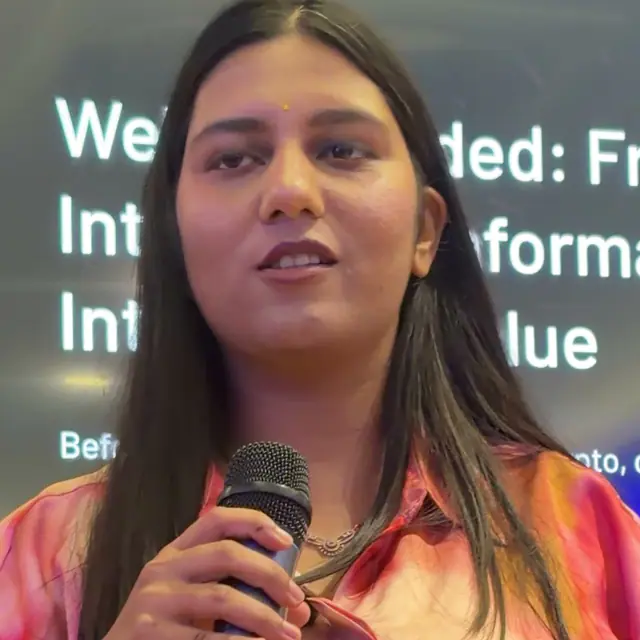
Why learn this from Shilika Jain?
- Spoke to students at SJCC, Bengaluru, on Web3 and blockchain in August 2026.
- Invited to speak at an IIT event in January 2025.
- Taught "Mastering the ABCs of Web3 PR" and moderated the PR panel at India Blockchain Week, December 2024.
- Ran PR workshops for the XRPL Labs Accelerator with Tenity (Jul 2025) and the Myosin Learns series (Jul 2024).
- Interviewed founders for CryptoDaily UK at TOKEN2049 and Solana Breakpoint in 2024, so she teaches both sides of the interview.
Communications is underrated in Web3, but it is everything: community, stakeholders, customers, retail users and journalists.
Format 1 · 60 minutes
One-hour masterclass: the slide-by-slide outline
The core guest lecture: one deck on what corporate communications covers, how reputation is built and broken, and how students get their first job in PR. Built for a single lecture slot, with eight minutes of open Q&A at the end.
Format 2 · 3 days
Three-day workshop: the day-by-day agenda
Three days for university immersion weeks, business school electives and corporate learning programs. Students leave with a stakeholder map, a crisis pack, a recorded talk and a portfolio piece, not just lecture notes.
Day 1: What corporate communications covers
| Time | Session |
|---|---|
| 09:30 to 11:00 | Guest lecture: the five desks. Media, internal, investor, crisis and public affairs, with a real example on each desk and the question it answers for the company. |
| 11:15 to 12:45 | Read the newsroom. Teams pull apart three real stories (RARI Chain, MANTRA Chain, Bullieverse) and mark who spoke, what the hook was, and whether the piece was earned or sponsored. |
| 13:45 to 15:15 | Stakeholder map. Each team picks a listed company and maps every audience it answers to: reporters, staff, investors, regulators, customers and community. |
| 15:30 to 17:00 | One announcement, five audiences. Take one piece of company news and write it five ways: a press note, a staff memo, an investor update, a regulator-facing summary and a community post. |
End of day 1: A stakeholder map for one company and the same announcement written for five audiences.
Day 2: Reputation, crisis and the press
| Time | Session |
|---|---|
| 09:30 to 11:00 | How reputation compounds. GAIA's founder interviews from December 2024 to April 2025 compounded into Forbes, Decrypt and Benzinga. Students trace how steady exposure builds a name reporters can find. |
| 11:15 to 12:45 | Crisis simulation. A breach or outage story breaks mid-session. Teams have 45 minutes to agree the facts, draft a holding statement and decide who speaks. |
| 13:45 to 15:15 | The reporter's side of the table. How a journalist prepares an interview, drawn from Shilika's CryptoDaily UK interviews at TOKEN2049 and Solana Breakpoint. Students write the questions they would ask their own company. |
| 15:30 to 17:00 | Hard questions, on the record. Paired mock interviews on the crisis scenario. Each student practises acknowledging a hard question and bridging to what they can honestly say. |
End of day 2: A holding statement, a reactive Q&A document and a recorded mock interview.
Day 3: Careers and your own voice
| Time | Session |
|---|---|
| 09:30 to 11:00 | Four doors into PR. Agency, in-house, the journalism side and freelance writing. What each first job teaches, what it pays in skills, and which one suits which person. |
| 11:15 to 12:45 | Speaking lab. Toastmasters-style table topics: one-minute answers to surprise prompts, then a prepared two-minute talk on a comms lesson from the week. |
| 13:45 to 15:15 | Portfolio piece. Write a short op-ed outline or a pitch to a named reporter on a topic you care about. It becomes the first sample in a PR portfolio. |
| 15:30 to 17:00 | Open floor and 90-day plan. Unscripted Q&A on PR careers, then each student writes three steps for the next 90 days: a skill, a piece of writing and one person to contact. |
End of day 3: A recorded two-minute talk, one portfolio piece and a personal 90-day career plan.
Format 3 · 6 modules
Six-module course: decks, activities and quizzes
The guest lecture expanded into a six-module lecture series for a semester elective or a cohort program. Each module has its own deck, an activity and a short quiz, and the series ends with a capstone comms plan presented to the class.
Cadence: 6 modules, usually one a week. 75 to 90 minutes live, plus about 2 hours of reading and activity work.
Module 1: What corporate communications is
Deck 1: The five desks of corporate comms
How media relations, internal comms, investor comms, crisis comms and public affairs fit together, and why PR is wider than getting a story published.
Activity: Pick a listed company and sort its last ten announcements by desk. Note which audiences each one was really written for.
Quiz
1. Which of these belongs to the internal comms desk?
Show answer
B. A staff memo sent before a restructuring is announced Internal comms owns what employees hear and when. Staff should hear major news from the company before they read it in the press.
2. What best describes public relations?
Show answer
B. Earning trust from the people a company depends on PR is about trust with every stakeholder. Articles, releases and posts are tools for that, not the definition of the job.
3. A small startup has one comms person. How many of the five desks still apply?
Show answer
C. All five, at smaller scale Even a small company has staff, investors, reporters, regulators and a crisis waiting to happen. One person just holds every desk.
Module 2: How newsrooms work
Deck 2: Reporters, editors and what makes news
Who decides what runs, what reporters owe their readers, and how to tell earned coverage from sponsored or paid content.
Activity: Find five stories about one industry. Label each as earned, sponsored or paid, and write one line on how you could tell.
Quiz
1. Who does a journalist ultimately work for?
Show answer
A. Their publication and its readers Reporters are paid by their publication to serve its readers. A pitch that does not serve those readers gets ignored.
2. Bullieverse's $4M raise appeared in Economic Times and in CoinDesk. What was different about the CoinDesk piece?
Show answer
B. It was sponsored, not earned The same news can appear as earned coverage in one outlet and as paid content in another. Students and analysts should check the label before citing it.
3. Which is the strongest reason a reporter runs a company story?
Show answer
D. The story tells their readers something new and relevant Relevance to readers is the editor's filter. Everything else is noise in a crowded inbox.
Module 3: Reputation and narrative
Deck 3: How reputation is built, and how it compounds
Why reputation builds over years, how one clear narrative helps a company get remembered, and how repeated coverage feeds AI search answers.
Activity: Write a three-line narrative for a company you admire: what it believes, why that matters, and the proof. Then find one story that supports each line.
Quiz
1. Why did RARI Chain's mainnet land in CoinDesk, The Block and Cointelegraph the same week?
Show answer
B. It led with one clear angle: protecting NFT creator royalties A sharp angle reporters already cover gives a launch a slot to fit into. A generic launch competes with every other one that week.
2. What best describes how reputation builds?
Show answer
C. Steady relationships and repeated, consistent stories over time Reputation compounds through repeated honest contact with reporters and audiences. A single campaign fades fast.
3. Why does press coverage now matter for AI search?
Show answer
D. AI answers often draw on what reputable outlets have published Assistants like ChatGPT and Perplexity cite published sources. Coverage in credible outlets shapes how a company gets described in those answers.
Module 4: Crisis communications
Deck 4: The first hour, the holding statement and hard questions
What to do in the first hour of a crisis, how to write a holding statement that is honest without guessing, and how to handle an investigative reporter.
Activity: In teams, respond to a simulated outage or data breach. Produce a holding statement, a staff note and five likely reporter questions with answers.
Quiz
1. An investigative reporter has emailed three times with specific questions. What should the company do?
Show answer
D. Answer sooner rather than later with what it can confirm Specific, repeated questions mean the story is likely running. Answering early gives the company a voice in it.
2. What belongs in a holding statement?
Show answer
B. What you know, what you are doing, and when you will update Early in a crisis you rarely know the cause. A holding statement shows you are on it without guessing at facts that may change.
3. Who should hear crisis news before the press does, if possible?
Show answer
A. Employees and directly affected customers People inside the company and those directly affected lose trust fastest when they learn from a headline.
Module 5: Investors, regulators and the wider world
Deck 5: Investor comms, public affairs and markets abroad
How funding news is framed, why regulated sectors speak carefully, and why the same story reads differently in India, Korea or the Middle East.
Activity: Rewrite one funding announcement for two markets. Note which outlets you would target in each and what angle each audience cares about.
Quiz
1. Why did MANTRA Chain's $11M raise run in CoinDesk with wider reach than a plain funding note?
Show answer
B. It carried a category (RWA) and a regional angle (the Middle East) A number alone is rarely news. A category reporters cover plus a regional angle gives the story somewhere to go.
2. In a regulated sector like crypto, which line should a spokesperson avoid?
Show answer
C. "Our token will 10x by next year." Price predictions invite regulatory trouble and destroy credibility with reporters. Stick to facts you can prove.
3. Why did Bullieverse's raise run in Economic Times, Inc42 and YourStory?
Show answer
A. It was framed as an India business story, not only a crypto story An Indian team's raise is mainstream business news in India. Picking the right frame opens outlets that crypto-only pitches never reach.
Module 6: Building a PR career and your own voice
Deck 6: Four doors into PR, and learning to speak
The main routes into PR and corporate comms, the portfolio that gets a first interview, and why public speaking is a skill you can train.
Activity: Give a recorded two-minute talk on a comms lesson from the series, and write a one-page portfolio with two writing samples.
Quiz
1. Which first step does most to build a PR portfolio as a student?
Show answer
C. Publishing writing under your own byline Bylines prove you can write for an audience and an editor. Hiring managers want to read your work, not a list of courses.
2. A student is nervous about speaking in public. What is the most useful next step?
Show answer
B. Practise regularly in a structured setting like Toastmasters Speaking improves with repetition and feedback. Structured practice turns a weakness into a working skill.
3. What does working on the journalism side teach a future PR professional?
Show answer
A. What reporters need from a pitch and an interview Interviewing people yourself shows what makes a source useful. It is the fastest way to stop writing pitches reporters ignore.
Capstone: A communications plan for a real organisation of the student's choice: a stakeholder map, a narrative, one announcement written for five audiences, a crisis holding statement, and a five-minute talk presenting the plan to the class. Shilika reviews each plan and gives written feedback.
How does it change for students, C-suite and operators?
For students
For undergraduate, MBA and mass communication students the lecture leans on careers, newsroom literacy and public case studies (RARI, MANTRA, Bullieverse, GAIA). Every exercise uses a company the student picks, and the speaking lab gets more time.
For c-suite
For leadership teams and corporate learning programs the careers content drops out. The time goes to what each comms desk needs from executives, how reporters prepare interviews, and crisis readiness, drawn from founder interview prep for GAIA, Fluence and MANTRA and from Shilika's own interviews of founders for CryptoDaily UK.
For founders & operators
For accelerator cohorts and founding teams the lecture becomes a working session: the five desks mapped onto a company of ten people, who holds each one, and which announcement to plan first. It draws on PR sessions for the XRPL Labs Accelerator and feedback given while judging a Stellar cohort.
Frequently asked questions
How do I book a PR guest speaker for a university or business school?
Book a 30-minute call with the course, the date, the audience and the length of the slot. Shilika suggests a lecture format and shares the deck outline before the session.
What topics can a corporate communications guest lecture cover?
The five desks of corporate comms (media, internal, investor, crisis and public affairs), how reputation is built, how newsrooms decide what runs, and how PR careers start. Topics can be weighted toward the course syllabus.
How is a guest lecture different from a keynote or panel?
A guest lecture teaches. It comes with a deck, an assignment and, in longer formats, quizzes and a capstone. Keynotes, panels, fireside chats and podcasts are booked through the speaker page.
Is the PR guest lecture online or in person?
Both. The one-hour lecture and the six-module series work well online. The three-day workshop works best in person, for example during an immersion week or an offsite.
How much does a PR guest speaker cost?
Pricing is quoted per cohort, based on format, group size and location. Student and non-profit sessions are often considered pro bono.
Can the guest lecture become a full course module?
Yes. The six-module lecture series fits a semester elective, with a deck, an activity and a quiz for each module and a capstone comms plan reviewed by Shilika.
Where has Shilika taught and spoken?
- Aug 2026: Spoke to students at SJCC, Bengaluru, on Web3 and blockchain.
- May 2026: Judged a Stellar founder cohort run by Myosin and advised founders on PR strategy.
- Jul 2025: Ran a PR workshop for the XRPL Labs Accelerator with Tenity, for PayFi and tokenisation founders.
- Jan 2025: Invited to speak at an IIT event.
- Dec 2024: Moderated the PR panel at India Blockchain Week.
- Dec 2024: Spoke on "Mastering the ABCs of Web3 PR" at India Blockchain Week 2024.
Related reading and other programs
Book this program
Run it for your cohort, class or team.
Pick a format, share the group size and dates, and Shilika will tailor the decks, exercises and quizzes. Pricing is quoted per cohort. Student and non-profit sessions are often considered pro bono.
Book a 30-min scoping call