
On this page8
- What the platforms actually do differently for Web3 founders
- The wrong way to run both (what most founders do)
- The split: what format belongs where
- The source-material system: one input, two outputs
- What each platform does for your journalist and investor relationships
- What not to do on each platform
- A note on AI search and why both platforms matter now
- The two-platform system in practice
LinkedIn vs X for Web3 Founders: Run Both Without Burning Out
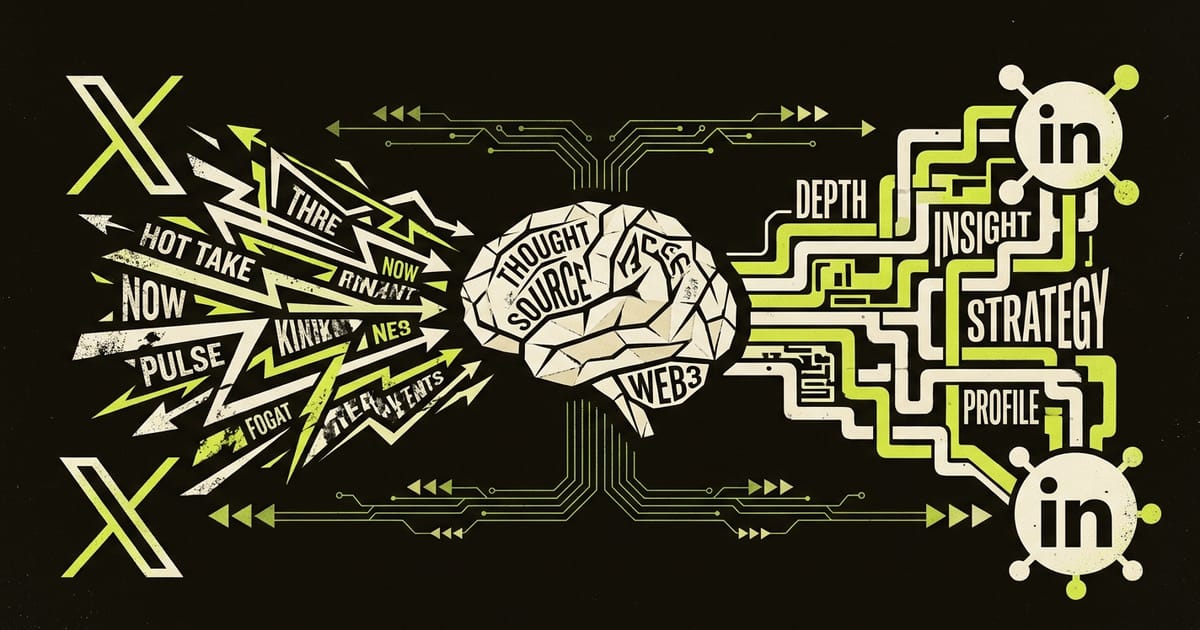
X rewards speed and opinion. LinkedIn rewards depth and professional context. If you're cross-posting the same content to both, you're getting a fraction of the value from each platform and probably burning out on the volume. The fix isn't posting more. It's understanding that the two platforms serve completely different people at completely different moments in your deal flow.
I said something on X a few years ago that still gets shared:
LinkedIn requires too much homework! Twitter is just shitposting! Shilika Jain on X, 1 Sep 2022
That joke contains a real insight. The platforms feel like they're in tension because the format logic actually is different. When you understand what each one does for a Web3 founder specifically, managing both becomes a system rather than a chore.
What the platforms actually do differently for Web3 founders
The generic B2B advice says LinkedIn is your revenue engine and X is optional. That advice doesn't apply to Web3, and following it will cost you.
X is where crypto culture lives and has not been displaced. Journalists at CoinDesk, Decrypt, The Block, and Cointelegraph source it daily. Investors watch it. Founders track each other on it. If you're building a protocol and you're not visible on X, sophisticated buyers notice the absence and draw conclusions. The absence itself is a signal.
LinkedIn is where the professional discovery happens that doesn't occur inside crypto-native circles. VCs who aren't crypto-Twitter-native read it. Enterprise partners check it before a first meeting. Journalists verify your credibility there before replying to a pitch. An 800-word post with a genuine perspective can reach tens of thousands of people organically in ways X rarely replicates for a founder without an existing large following.
You need both. The question is how to run both without two separate content budgets, two separate content calendars, and two separate voices.
The wrong way to run both (what most founders do)
Most Web3 founders do one of three things:
- Post only on X because that's where crypto Twitter is, and treat LinkedIn as a resume they update before a raise.
- Hire a content person who cross-posts the same update to both platforms, then wonder why the LinkedIn engagement is flat.
- Try to maintain two independent content streams for six weeks before one or both goes dark.
The cross-posting failure is the most common. A sharp, punchy X take gets copy-pasted to LinkedIn where it reads as shallow. A long-form LinkedIn post gets squeezed into an X thread where it loses its structure and depth. Both feel off to their respective audiences because they are.
The split: what format belongs where
The content logic difference isn't about word count. It's about what the reader expects and what the algorithm rewards.
X is the real-time intelligence layer. Post when something happens. React to a market event, a protocol exploit, a macro shift, a bad take that's circulating. The best X content from a Web3 founder is fast, specific, and slightly contrarian. A short observation about something you saw on-chain this week. A pushback on a consensus view. A prediction with a number attached. Threads work when you have genuine technical depth to unpack, not just to seem thorough.
The cadence that works for a time-constrained founder: 3 to 5 posts a week, mostly short, one thread per major moment. Original over frequent, always.
LinkedIn is the institutional credibility layer. Post when you have context to add, not just a reaction. A 600-word piece on why your sector is moving in a direction that isn't obvious yet. A specific lesson from a decision you made this quarter. A framework you use that other founders might find useful. LinkedIn's algorithm weights dwell time and comments over raw impressions, which means a well-structured piece with a specific point of view compounds over days, not hours.
The cadence that works: 3 posts a week, one of which is substantive. Never post to post.
The source-material system: one input, two outputs
Here's the operational piece that most guides miss. You don't need two content streams. You need one source of record and a conversion rule.
Your source of record is whatever you're already producing: a weekly internal update, a Slack message to your team about what you learned this week, notes from a founder call, a thesis document you keep updating as the market moves. Most founders produce this material constantly and never publish it.
The conversion rule:
Step 1: Identify the insight. What's the one thing you said this week that made someone ask a follow-up question? That's your raw material.
Step 2: Build the LinkedIn version first. Write 400 to 700 words. Give it context, give it a specific point of view, give it a conclusion that isn't just "follow me for more." This is your primary asset. It takes 30 to 45 minutes if you already know what you think.
Step 3: Extract the X version from the LinkedIn draft. Pull the sharpest one or two sentences from what you just wrote. That's your X post. Not a summary. Not a "here's my latest LinkedIn post" link drop. The most quotable line, standing alone. Add a short reaction thread if it warrants one.
people don't pay for content instead they pay for organised content! Shilika Jain on X, 19 Dec 2022
That's the principle at work. The LinkedIn version organises your expertise. The X version delivers the sharpest point from it in the format the platform rewards.
One piece of source material, two platform-native outputs. Total additional time to convert LinkedIn to X: under 10 minutes.
What each platform does for your journalist and investor relationships
This is where the Web3 specificity matters most and where generic B2B advice fails you.
Journalists use X to source and LinkedIn to verify. A tier-1 trade reporter from CoinDesk or The Block watches X to find voices with a clear angle on a story they're developing. They check LinkedIn to confirm you're who you say you are, what your track record looks like, and whether you've published anything credible. If your X is active but your LinkedIn looks like a 2021 ICO resume, you're leaving sourcing opportunities on the table. If your LinkedIn is polished but your X is silent, you're invisible to the journalists who watch CT for story angles daily.
Investors use LinkedIn to diligence before a call and X to form a view. The pattern I see consistently: an investor reads your deck, then checks your LinkedIn before taking the meeting, then checks your X to understand how you think in public. All three signals combine. Founders with a consistent LinkedIn presence and active X get more unsolicited inbound and close rounds with less friction.
This is the dual-platform logic that no generic B2B post captures. You need both layers running simultaneously because the same decision-maker uses them at different stages of their trust-building process.
What not to do on each platform
On X:
- Don't post "just closed a round, excited for what's next" with no detail. Generic milestones get no engagement.
- Don't thread unless you genuinely have 8 to 12 connected thoughts. Half-baked threads hurt more than they help.
- Don't go dark for two weeks and then flood the feed. Consistency of signal matters more than volume.
On LinkedIn:
- Don't cross-post your X threads verbatim. The numbered-list format reads as lazy and the algorithm de-prioritises it.
- Don't post from your company page as your primary voice. Company pages underperform personal profiles with no exceptions worth worrying about.
- Don't write generic "lessons from my founder journey" content without specific numbers, specific decisions, or specific outcomes. Vague reflection isn't thought leadership.
A note on AI search and why both platforms matter now
The discovery surface has expanded beyond Google. When a fund analyst or enterprise buyer asks Perplexity or ChatGPT who is doing credible work in a space, the answer gets assembled from content the engine can attribute to a named expert. LinkedIn articles are indexed by Google and increasingly cited by AI search tools. X posts contribute to the real-time signal that shapes AI engines' understanding of who is active in a field.
An anonymous protocol Twitter account doesn't generate citation authority. A founder with a consistent LinkedIn presence and a track record of public thinking on X does.
This is the compounding argument for running both. Every piece of LinkedIn content builds indexed authority that accrues over months. Every X post that gets quoted or cited contributes to the real-time signal. Together, they produce the kind of name recognition that means a journalist already knows who you are before your pitch lands.
The two-platform system in practice
To make this concrete: you're a DePIN founder, 12 months from TGE. Your week looks like this.
Monday: Something happened in DePIN over the weekend. You have a view on it. Write 2 sentences on X. Save the longer version for Wednesday.
Wednesday: Write the 500-word LinkedIn post expanding your take, with context about what it means for compute infrastructure specifically. Post it Wednesday morning, which is when the LinkedIn algorithm generally rewards it.
Thursday: Pull the sharpest line from the LinkedIn post. Post it as a standalone X take. Link the LinkedIn post only if it genuinely adds depth.
One X post becomes one LinkedIn post, and vice versa. The LinkedIn post is the anchor. The X post is the hook.
That's 45 minutes of original writing per week. Not two content teams. Not two editorial calendars. One source of record, two platform-native outputs, and two audiences who see you as a credible, active voice in your space.
boring business + good content strategy = magic happens! Shilika Jain on X, 18 Jan 2023
The magic is the compounding. Sixty days of consistent dual-platform presence means journalists already know your angle before you pitch them. Investors already have a view before the first call. The content isn't generating attention. It's generating trust.
---
If you want a structured audit of your current content presence on both platforms and a specific plan for how your source material converts into coverage, book a 30-min teardown with Shilika.