
On this page7
Founder Profiling vs Company PR: Two Different Operating Systems
Most Web3 founders treat personal profile-building and company PR as one campaign. They push announcements out, attach the founder's headshot, call it "founder-led PR," and wonder why neither the company nor the founder is cutting through.
They're not one campaign. They never were.
Company PR is announcement-driven. It lives or dies by whether you have a hard news peg: a raise, a mainnet, a partnership announcement, an exchange listing. It's tied to the product roadmap, to dated events, to what happened this week. Strip the peg away and the story collapses.
Founder profiling is thesis-driven. It asks a completely different question: what is this person's durable point of view on the category? That point of view doesn't need a news event to justify itself. It holds across bear markets, pivots, token price swings, and acquired projects. The founder's profile compounds month over month as long as the thesis is consistent and the commentary keeps landing.
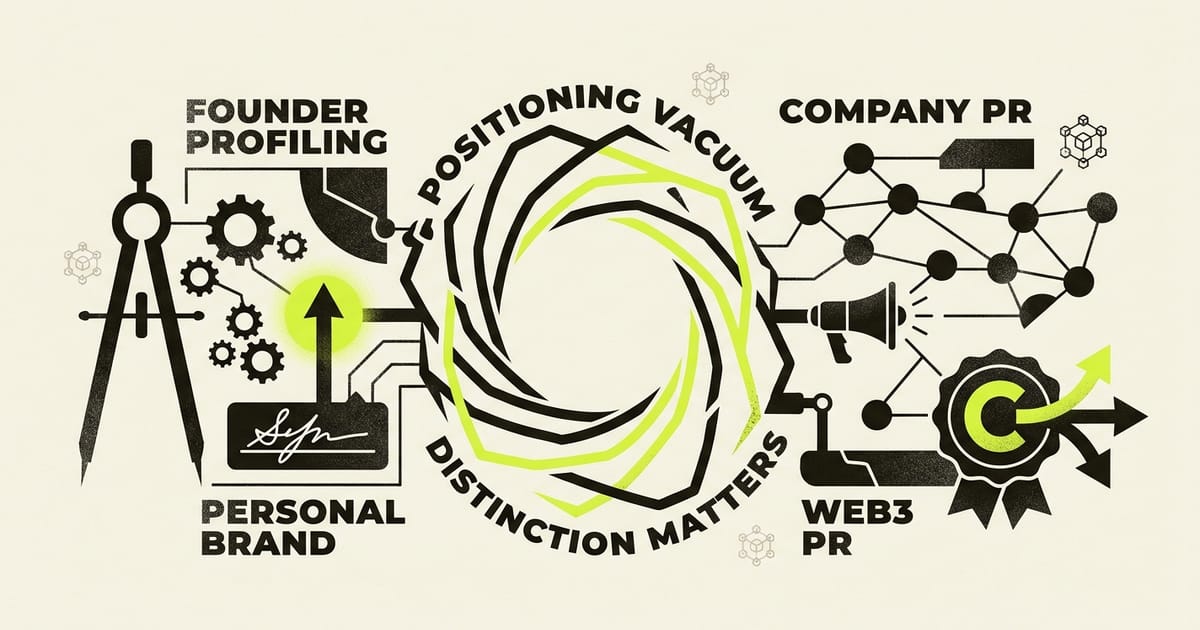
Run them together with the same strategy and you get neither. The founder sounds promotional in every quote, so journalists stop calling. The company's coverage reads like a personality cult, so enterprise buyers disengage. That's the positioning vacuum.
Why the objectives are fundamentally different
Company PR serves one master: the company's commercial milestones. A product launch needs CoinDesk. A funding round needs Decrypt and The Block. A listing needs Cointelegraph. Every placement is tied to a specific outcome within a defined window, usually 2 to 4 weeks of active outreach around an event.
Founder profiling has a different north star entirely. It builds a documentary record that exists independently of any single company milestone. The goal is that when a VC searches the founder's name before a meeting, when a tier-1 journalist considers who to call for an expert quote on a regulatory development, when a potential co-hire evaluates whether to leave their current role, they find 12 months of substantive, consistent signal.
I've said this before and I'll keep saying it:
the only web3 companies that should do PR: who understand what PR actually is (earned v/s paid), who understand how to create a long term narrative & build a brand, who understand that PR is news heavy, who understand that web3 PR is different than Web2 Shilika Jain on X, 19 Jan 2024
That "long-term narrative" piece is exactly what founder profiling is. The company brand owns product milestones. The founder's brand owns intellectual territory.
What mixes badly and why
The single most common mistake: a founder does a podcast appearance tied to a funding announcement. The announcement generates 3 days of coverage. The podcast goes live the same week. Both serve the funding round, not the founder's long-term profile.
Three months later, there's nothing in the documentary record that makes a journalist think of this founder when they're writing about DePIN or AI agents or RWAs. The coverage spike happens, the founder's profile doesn't move, and the next launch starts from zero again.
The second common mistake is using the same narrative for both tracks. Company PR messaging is designed for press releases and media briefings. It's specific, factual, announcement-adjacent. Founder profiling messaging has to be broader, more opinionated, sometimes counterintuitive. A press-release-trained founder sounds defensive and over-qualified in a podcast or op-ed. A freewheeling founder thesis sounds like noise in a product announcement.
I think about it as:
your business needs to have a personality & your personality is built when you deliver your promises. Shilika Jain on X, 26 Oct 2022
The business's personality and the founder's personality are related. They're not the same thing.
The mechanics: how company PR actually works
Company PR runs on a milestone calendar. Six weeks before a raise announcement: start building the narrative with 2 to 3 background briefings with key reporters. T-minus 2 weeks: embargo coordination, confirm placement commitments from 4 to 6 tier-1 trade outlets. T-minus 48 hours: final press materials to reporters under embargo. Lift day: coordinated drop, social amplification, founder quote included in releases but not primary.
The outlets change depending on the announcement type. A DePIN infrastructure raise goes to CoinDesk, Decrypt, and Blockworks first, then trade press. An AI agent project goes to Decrypt's AI desk, Forbes tech contributors, and AI Magazine. A token listing announcement goes to Cointelegraph, CoinDesk, and the exchange's own PR infrastructure.
What all of them share: the story window closes within 72 hours. You execute the plan or you miss the cycle. There is no compounding here. The next announcement starts fresh.
The mechanics: how founder profiling actually works
Founder profiling runs on a cadence, not a calendar. The work doesn't accelerate into a launch window. It runs in the background, consistently, for 6 to 12 months.
The three primary surfaces are:
Op-eds and bylined commentary. One thoughtful, well-argued piece per month in a relevant outlet builds the documentary record that journalists and investors find. A CoinDesk op-ed on DePIN compute isn't an announcement. It's an intellectual staking of territory. I placed Tom Trowbridge from Fluence in CoinDesk with exactly this logic: his piece "Not a meme: DePIN can take crypto mainstream" (April 2025) was not tied to any Fluence milestone. It was his point of view on a category. That kind of coverage compounds because it gets cited, linked back to, and referenced when a reporter is looking for a named expert source on DePIN six months later.
Podcasts and long-form interviews. The purpose isn't distribution to the podcast audience, though that matters. The purpose is to generate a library of articulated, searchable, citable founder thinking. When I ran founder profiling for GAIA's CEO Matt Wright and COO Shashank Sripada from December 2024 through April 2025, the podcast cadence across Rug Radio, Web3 with Sam Kamani, Crypto Coin Show, and Blockster wasn't about one-off audience reach. It was about building a body of evidence that they had a consistent, nuanced, credible point of view on decentralized AI agents. That evidence base made the Forbes placement and the Decrypt "Living Knowledge Systems" piece easier to land.
Expert commentary and reactive pitching. When a regulatory event, a market movement, or an industry controversy breaks, a founder with an established thesis gets called. A founder without one doesn't. The Fluence team's newsjacking of the global Microsoft outage in July 2024, tied to the DePIN compute narrative, landed an e27 placement that a company press release would never have achieved. That placement came from having built the founder's point of view in advance.
How I run both in parallel without conflating them
On a fractional retainer, I maintain two separate editorial calendars. One is the company's milestone calendar: what's launching, when, which outlets need briefing in advance, what the embargo window looks like. The second is the founder's thesis calendar: what's the commentary angle this month, which podcast outreach is in flight, which op-ed is in draft.
The two calendars inform each other. When a company announcement drops, the founder commentary around it gets framed as category context, not product promotion. When the founder does a podcast, the talking points are drawn from the thesis calendar, not the press release. The briefing a reporter gets from the founder is different from the briefing the reporter gets from the company account team. One is about the product milestone. The other is about the founder's point of view on why the category is going the direction it's going.
The separation keeps the founder out of the "company promoter" trap. If every piece of founder commentary is tied to a product update, journalists stop treating the founder as an independent expert voice. And once that happens, you lose the most valuable thing founder profiling produces: a quote source relationship with tier-1 reporters that exists whether or not the company is actively in a campaign.
What stage you run each depends on
Pre-seed and seed: founder profiling is usually more valuable than company PR at this stage because you don't have enough milestone cadence to sustain a company PR program. One raise announcement does not a PR strategy make. Start building the thesis now. Op-eds, podcast appearances, expert commentary on industry developments. This takes 6 to 9 months to compound into something durable.
Series A with active roadmap: both tracks running in parallel. Company PR owns the funding announcement, mainnet, and partnership beats. Founder profiling runs between the announcements to make sure the founder isn't invisible in the 10 weeks between milestones. That's the window where most competitors capture share of voice by default.
Token launch (TGE window): company PR takes the wheel. The embargo coordination, exchange listing comms, exchange listing pickup, and KOL amplification are all company-level work. The founder's role here is press briefings, not op-eds. Founder profiling picks back up 4 to 6 weeks after the TGE when the campaign noise settles.
Bear market or pivot: this is where founder profiling earns its keep over company PR. When there's no hard news to announce, the company account goes quiet. Founders with a durable thesis don't go quiet. They keep the commentary running, keep showing up in the trade press on category-level questions, and maintain share of voice through the trough. That's the founder who gets the first Decrypt call when the market turns.
The positioning vacuum no one talks about
When you mix the two tracks together, you don't just dilute both. You create a specific problem: no one knows what the founder stands for independently of the product.
Ask a journalist who covers DeFi to describe the founder of a mid-tier protocol they've covered twice. If the only thing they can say is "the founder of Protocol X," the profiling work hasn't been done. The founder has been a spokesperson, not a source. That's a fine use of PR. It's not founder profiling.
The founders I've seen earn durable tier-1 relationships, the kind where a reporter proactively reaches out when they're writing a category piece, are the ones who took 12 months to build a point of view that stands alone. Not "the CEO of Fluence" but "a founder who argues DePIN can absorb the compute demand that centralized cloud can't."
The company PR keeps the product visible. The founder profiling keeps the person quotable. Both matter. Neither works as a substitute for the other.
---
Ready to separate the two tracks? Book a 30-min teardown with Shilika and I'll map out what each calendar should look like for your stage.