
On this page10
- The Four Surfaces and Why You Need All of Them
- The 12-Month Calendar
- Q4 (October to December): Build the Foundation
- Q1 (January to March): Get on Stage
- Q2 (April to June): Podcast Season and RSA Week
- Q3 (July to September): Black Hat Week and Content Flush
- Q4 (Year Two): Compound the Stack
- The Repurposing Framework
- The Pitfalls That Kill Cybersecurity Thought Leadership Programs
- The Founder With a Cybersecurity x Blockchain Company
The Cybersecurity Founder Thought Leadership Stack
Most cybersecurity founders treat thought leadership as a single tactic: write one op-ed when a reporter calls, submit one conference talk on a whim, record one podcast episode when a friend asks. Then wonder why nobody knows their name six months later.
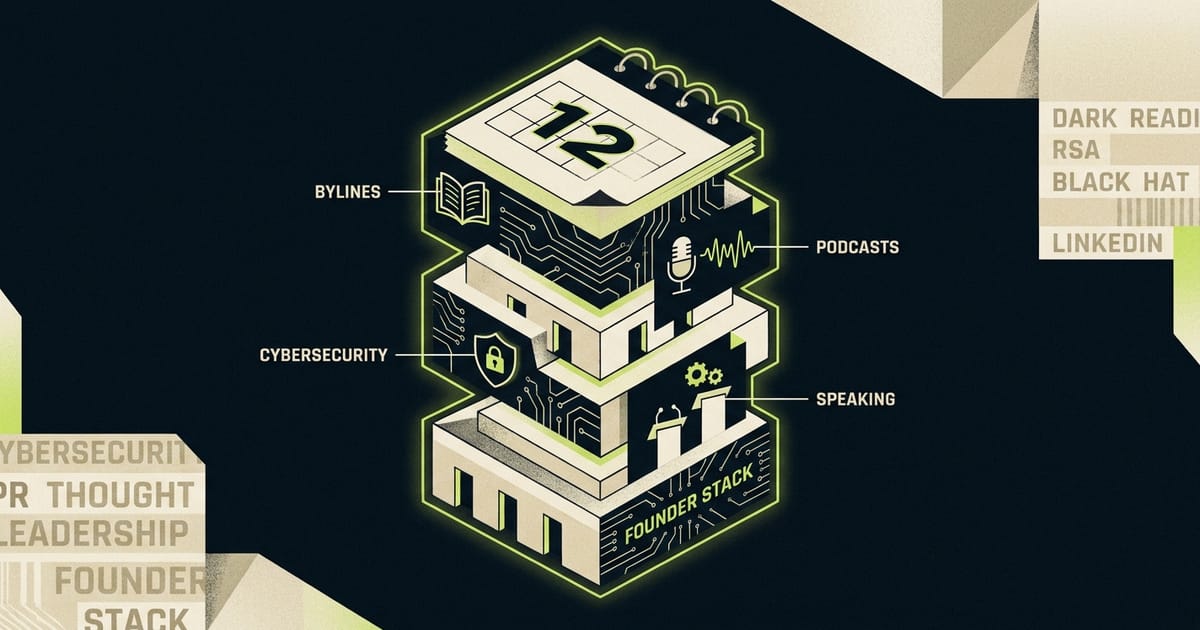
Category authority in security doesn't come from a single hit. It comes from a coordinated stack of bylines, conference speaking, podcast appearances, and LinkedIn content that compounds over 12 months. Each surface reinforces the others. A Dark Reading column gives you a credibility signal when you pitch an RSA session. An RSA slot gives you a hook when you pitch a podcast. The podcast episode gives you content for LinkedIn. LinkedIn content warms the next byline pitch. The loop closes, then repeats.
I've been helping a cybersecurity x blockchain team get initial coverage for their protocol and technology, and the challenge is always the same: too much product thinking, not enough positioning work done in public before the launch window opens. This post maps the full 12-month calendar so you can stop doing one-off tactics and start running a program.
The Four Surfaces and Why You Need All of Them
Before the calendar, understand what each surface does:
Dark Reading and SC Media bylines reach the practitioner audience — CISOs, security architects, and DevSecOps leads who buy tools and recommend vendors. A byline in Dark Reading isn't marketing copy. It's the credential that makes the next PR pitch land faster.
RSA Conference and Black Hat speaking reach the community of communities. RSA is where enterprise buyers congregate. Black Hat is where researchers and technically-minded security professionals go. Speaking at either signals that your thinking passed peer review, which is worth more than a sponsored session or a booth.
Security practitioner podcasts reach the commuter audience — practitioners who consume content while traveling, training, or otherwise away from a screen. SC Media's Security Weekly network, the SANS Cyber Leaders podcast, and similar shows deliver engaged, niche audiences that trade publications can't replicate.
LinkedIn content is the connective tissue. It's where journalists see what you're saying between placements, where conference program chairs find speaker candidates, and where potential customers form an opinion before they ever visit your site.
The mistake most founders make is treating these as separate activities. They're not. One core idea, published across all four surfaces in a single quarter, does more than four separate ideas published once each across four separate years.
The 12-Month Calendar
Q4 (October to December): Build the Foundation
This is planning season. It's also RSA Conference CFP season, which most founders miss entirely.
October (deadline-critical): The RSA Conference 2027 CFP closed October 15, 2026. If you missed it, note it for next year: the CFP opens in mid-summer and closes in mid-October, with speaker notifications in January. Last year, more than 2,900 proposals went in front of over 80 program committee members. Over half of the speakers selected were new to RSAC. That statistic matters — RSAC isn't a closed club. Your proposal needs a clear argument, a non-vendor angle, and data or case study evidence behind it.
Black Hat Asia 2027 CFP for Briefings closes October 20, 2026, with notifications by January 5, 2027. Black Hat USA 2027 runs July 31 to August 5 at Mandalay Bay in Las Vegas — its CFP typically opens in November and closes in January. Set a calendar reminder now.
November: Build your topic inventory. Your 12-month thought leadership program needs 3 to 4 core ideas — not 12. The ideas should reflect genuine research, operational experience, or a contrarian position on a trend. Each idea will get published across multiple surfaces. You're not producing new ideas every month; you're publishing the same ideas in different formats to different audiences.
December: Write your first Dark Reading submission. Dark Reading takes contributed Commentary in three formats: Opinion, Tech Talk (how-to), and Ask the Expert (Q&A). Tech Talk and Ask the Expert pieces should be 700 to 800 words. Opinion pieces run up to 1,000 words. Submit to darkreadingsubmissions@informa.com as plain text pasted into the email body — not as an attachment. They do not publish AI-generated content and they will know if you try. Allow three weeks for a response.
Q1 (January to March): Get on Stage
Conference speaking season starts with RSA notifications arriving in January. If you submitted in October and got accepted, this is when prep begins.
January: If your RSA CFP was accepted, draft your session. Track sessions at RSA run 50 minutes including Q&A, in either solo or panel format. If you submitted a panel, confirm your co-speakers now. The program committee watches for first-time speakers who drop commitments close to the show.
If you weren't accepted at RSA, pivot to satellite events. RSA week in San Francisco runs dozens of side events, partner briefings, and adjacent gatherings where speaking slots are easier to secure. A strong session at an RSAC side event in front of 80 practitioners often delivers more business value than the main stage in front of 40,000 attendees you can't filter.
February: Your first Dark Reading byline should be live or close. Use the publication to warm your Black Hat USA submission in March. Black Hat's review board looks for original, unpublished research. If your Dark Reading piece introduces a concept, the Black Hat submission goes deeper — technical breakdown, tooling, data. The byline is the public abstract; the Black Hat session is the proof.
March: Black Hat Asia 2027 runs March 2-3 at Marina Bay Sands, Singapore. If you're APAC-positioned, this is a tier-1 stage. The APAC security community is different from the US one — more government and critical infrastructure representation, different threat model conversations. A Black Hat Asia slot gives you regional credibility that a Las Vegas session can't replicate.
Q2 (April to June): Podcast Season and RSA Week
April: RSA Conference 2027 is April 5-8 in San Francisco. Whether you're speaking or attending, book podcast interviews to publish in the surrounding two weeks. Security show hosts record live at RSAC and fill their editorial calendars around the conference. SC Media runs CyberRisk TV live from the venue. Pitch two to three shows targeting an interview window of April 1-15.
The pre-RSA window (two to three weeks out) is one of the best podcast pitch windows of the year. Hosts are looking for guests with a perspective on conference themes. You don't need to be a speaker to get a podcast slot around RSAC — you need a clear opinion on a topic the host's audience cares about.
May: Write your second Dark Reading piece. The best cadence for Dark Reading is one submission per quarter. More than that and you risk appearing repetitive; less and the editorial relationship doesn't develop. Use Q2's piece to newsjack a trend that emerged from RSA week. Commentary tied to a recent industry conversation gets faster responses from the editorial team.
June: Black Hat USA CFP typically closes in late January for the August show. If you submitted in January, notifications come in late March or early April. By June, you should be in session prep. The Black Hat review board favors submissions with original research, new tooling, vulnerability disclosures, or white papers attached. If your submission is purely narrative, it's competing against researchers with technical proof of work.
Q3 (July to September): Black Hat Week and Content Flush
July/August: Black Hat USA 2027 runs July 31 to August 5 at Mandalay Bay. If you're speaking, record your session video for LinkedIn in the week before. Dark Reading's News Desk runs live from the floor — it's a media window comparable to RSAC. Pitch a briefing or interview slot with the Dark Reading team even if you're not a speaker. Their editorial team schedules on-floor conversations weeks in advance.
If you're not speaking, attend anyway. The networking value of Black Hat's Business Hall and Arsenal is significant for early-stage security founders. More important: use the week to pitch your Q4 Dark Reading piece. Conference season gives you a natural hook. "What I saw at Black Hat and why it changes how we think about X" is an editorial angle editors accept.
September: Your podcast cadence should be two to three appearances per quarter by now. SC Media's Founder Stories is a direct-to-audience format worth targeting for cybersecurity startup founders. SANS Cyber Leaders covers practitioners. Security Weekly (now part of SC Media) covers technical topics for the practitioner audience. Each show has a different audience profile — don't pitch the same angle to all three.
Q4 (Year Two): Compound the Stack
By October of year two, you have a track record: two to three Dark Reading bylines, one to two conference credits, six to nine podcast appearances, and a LinkedIn content trail. That's the credibility stack that makes the next RSA CFP submission a warm pitch rather than a cold one.
The Repurposing Framework
One idea, four surfaces, one quarter:
- Dark Reading commentary (700-800 words) — introduce the argument, practitioner-focused, no product mentions
- RSA or Black Hat CFP abstract (300 words) — same argument, framed as a session with data backing
- Podcast talking points (3 to 5 bullets) — same argument, conversational, with one counterintuitive takeaway for the host
- LinkedIn thread (5 to 8 posts over 2 weeks) — same argument, serialized, with engagement bait at the end of each post
The LinkedIn thread runs first, two weeks before the Dark Reading piece goes live. It warms your audience and gives you engagement data. If one angle in the thread gets strong responses, that's the angle you lead with in the Dark Reading submission.
The Pitfalls That Kill Cybersecurity Thought Leadership Programs
Vendor-washing your bylines. Dark Reading's editorial guidelines are explicit: no product pitches, even indirect ones. A column about "why zero-trust matters" that conveniently supports your product category will get rejected. Write about the problem your customers face, not the solution you sell.
Missing the CFP windows. RSA CFP closes in mid-October for an April conference. That's a six-month lead time. Black Hat USA's CFP closes in January for an August show. These are not forgiving deadlines. Build CFP submissions into your October and November calendar as fixed commitments, not aspirational goals.
Confusing activity with strategy. One podcast appearance, one byline, and one conference submission in a year is activity. A coordinated program where each surface feeds the others is strategy. The compounding only happens when you run all four surfaces simultaneously.
Skipping LinkedIn because it feels beneath you. Security founders who post consistently on LinkedIn don't just build audiences — they signal to journalists, program chairs, and podcast hosts that they have something to say. Dark Reading's editorial team reads LinkedIn. RSA program committee members are on LinkedIn. Your next podcast host is on LinkedIn. The platform is distribution infrastructure, not a vanity metric.
The Founder With a Cybersecurity x Blockchain Company
The challenge is sharper when your company sits at an intersection — cybersecurity and blockchain, security and AI, or any other compound category. You're pitching to two editorial communities with different vocabularies and different trust signals.
At Dark Reading, the blockchain context is background. The security argument is the foreground. At Decrypt or a crypto-native outlet, it's reversed. Running both simultaneously means two sets of talking points, two sets of media relationships, and two LinkedIn content tracks. It's doable. I'm working through exactly this with a security protocol team right now.
The principle holds regardless of the compound: map your audience, assign a surface, build the calendar, and don't skip the CFP windows.
---
Book a 30-min teardown with Shilika — we'll map your thought leadership calendar, identify which surface to lead with, and figure out which CFP you should be submitting to right now.