
On this page8
- The one rule that runs across every stage
- Pre-seed: what PR can and cannot do
- Seed: start building the media footprint, not the press release cadence
- Series A: now you need a proper PR program
- TGE: an entirely different animal
- The cost map in one place
- The five signals that tell you you're ready
- Fractional vs full agency: the honest version
When to Hire PR for a Web3 or AI Startup: A Stage-by-Stage Decision Framework
Most founders ask the wrong question. They Google "best crypto PR agency" when they should be asking whether they need a PR retainer at all right now, and if so, what shape it should take.
I've run PR for 50+ Web3 and AI protocols across every stage from pre-seed to post-TGE. The founders who waste budget share a single trait: they hired PR before they had a story worth placing, or they hired the wrong type of operator for their stage. Both are fixable. Neither is obvious until you've watched it go wrong a few times.
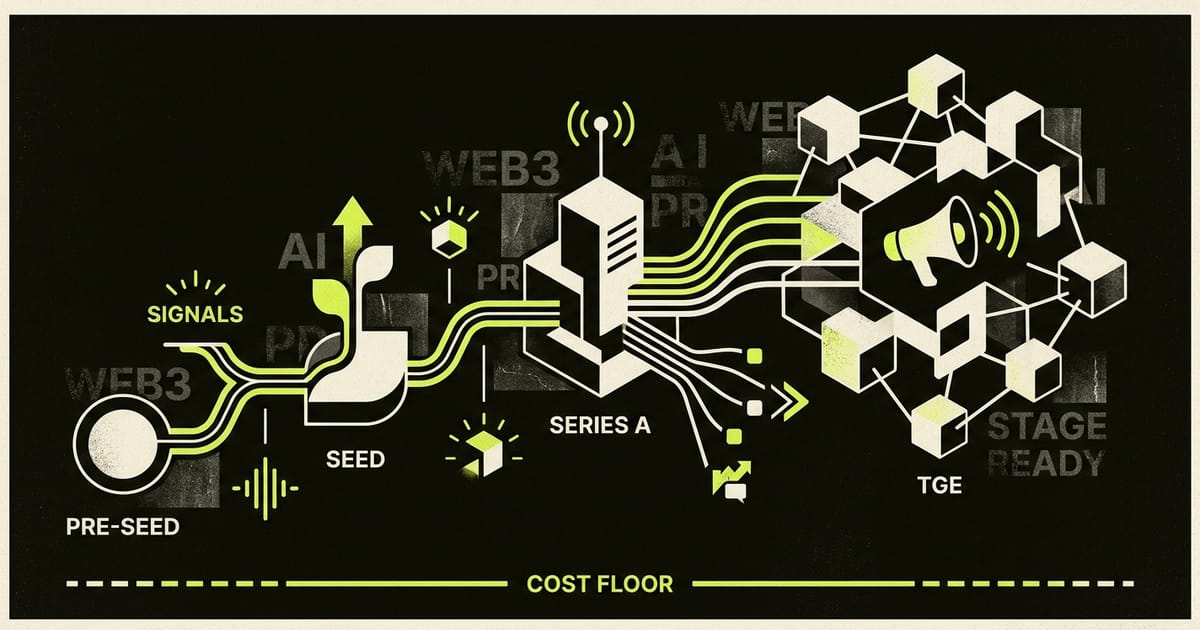
This framework maps what PR can actually accomplish at each stage, what the cost floor looks like, and the specific triggers that signal you're ready. Skip ahead to your current stage if you want the fast answer. Read all four sections if you're planning six to twelve months out.
---
The one rule that runs across every stage
PR is a force multiplier, not a foundation. It amplifies what already exists. If you don't have a distinct point of view, a concrete announcement, or a product worth writing about, no amount of outreach changes that. The best a consultant can do in that situation is generate noise, which actively hurts you by burning journalist relationships on a story that doesn't land.
What you need before any PR engagement, regardless of stage: a clear narrative, something specific to announce or prove, and a founder who can commit four to eight hours a month to briefings, interviews, and approvals. Without those three inputs, the money is better spent on product.
---
Pre-seed: what PR can and cannot do
At pre-seed, you're building the MVP and hunting your first design partners. The median Web3 pre-seed round in 2026 is around $2.5M. Your audience is a handful of angels, ecosystem grant committees, and the first 100 users, not journalists.
What PR cannot do at pre-seed: It can't generate earned coverage in CoinDesk or The Block on a product that hasn't shipped. Tier-1 trade reporters don't write about concepts. They write about traction, disruption, and news. A pre-product deck is none of those.
What PR can do at pre-seed: Founder positioning. If you as the founder have a credible point of view on a category that's actively being written about, a PR consultant can place one or two op-eds in trade publications that establish you as a voice before the product launches. That's different from product PR. It's building the media footprint that makes your Series A conversation easier later.
The other thing that works at pre-seed is X and LinkedIn content strategy. It costs almost nothing and compounds in ways that paid wire distribution never does. I've watched founders build more credibility through a sharp thread on an industry debate than through three months of press releases.
What to spend: Nothing on a retainer. If you want to run a few strategic founder placements, hire a consultant for a one-off sprint, not an ongoing engagement. A defined six-week op-ed and podcast push runs $5,000 to $10,000 and produces concrete assets you can reuse.
The pre-seed trap: I've talked to three or more early-stage Web3 founders who were paying wire services because it felt like "getting coverage." It's not. A wire distribution is not PR, it's syndication. The articles it produces don't rank, don't build relationships with journalists, and don't convert to investor credibility. Ecosystems and VCs should be educating their portcos on this before it wastes budget that should go to product.
---
Seed: start building the media footprint, not the press release cadence
At seed ($1M to $5M raised), you have a shipped product, early traction, and probably a partnership or two worth talking about. This is when a fractional PR engagement starts to make sense, with a specific caveat.
The caveat: the goal at seed is not coverage volume. It's building the media relationships and narrative clarity that make your Series A announcement land in tier-1 outlets, not just mid-tier ones. That 12 to 18 month runway before your Series A matters. The founders who walk into a Series A with a clean press slide did not arrange it in a sprint.
What PR should do at seed:
- Lock the messaging. A clear, jargon-minimal narrative that a generalist journalist can summarize in two sentences. Most Web3 projects have an explanation problem. Fix it now.
- Start the founder profiling engine. Two to three podcasts per quarter, one bylined op-ed every six to eight weeks in a relevant trade publication, and consistent commentary on industry moves in your category. This is the work that doesn't show up immediately but compounds into the "as seen in" slide.
- Selectively pitch one or two significant milestones. A notable partnership, a key protocol integration, a first institutional user. Not every update is PR-worthy. A good consultant tells you which ones are.
What to spend: A fractional PR retainer at seed runs $5,000 to $8,000 a month. That covers strategy, active media relations, pitch writing, and founder content support. It does not typically cover wire distribution or KOL fees, which are separate line items. You're not ready for a full agency at this stage, and you don't need one.
I said it on X in August 2023 and it holds:
Early stage startups should growth hack in following ways: quality partnerships, brand building initiatives, community building & growth, strategic paid press + content, influencer marketing. Shilika Jain on X, 28 Aug 2023
The key phrase there is strategic. Not high-volume. Not automated. Selective placements in outlets your investors actually read.
---
Series A: now you need a proper PR program
At Series A ($10M to $20M+ raised), the game changes. You're entering a competitive category, competing for talent, and being evaluated by institutional capital. Media presence is now part of your due diligence package.
This is the first stage where a full-service agency retainer genuinely makes sense, though a fractional operator with a direct line into tier-1 press is still a sharper option for most teams with under 30 employees.
What PR must do at Series A:
- Announce the round with coordinated embargoes across 4 to 6 tier-1 outlets. Not a wire blast. Real pitches to real journalists with a 48 to 72 hour embargo window and a founder available for briefings. The announcement window is narrow. A consultant who has already built those relationships over the previous 12 months maximizes it.
- Establish category ownership. At this stage, your competitors are getting coverage. If you're not actively positioning in that narrative, someone else is. A Series A is the moment to claim the frame.
- Run a podcast tour. Three to five shows in the 60 days after the announcement keeps the narrative alive when the initial coverage cycle ends.
What to spend: A fractional operator for a Series A announcement sprint runs $15,000 to $30,000 over four to six weeks, covering strategy, embargo coordination, press materials, and post-announcement thought leadership. An ongoing fractional retainer post-announcement runs $8,000 to $12,000 a month.
If your raise involves multiple geographies, APAC exchange listings, or simultaneous enterprise and consumer narratives, that's when a boutique agency at $15,000 to $25,000 a month earns its cost. The bandwidth difference matters when you're running five parallel narrative tracks across three time zones. For a single canonical story in under six markets, the fractional operator wins on both cost and senior attention.
---
TGE: an entirely different animal
A Token Generation Event is not a product launch. It's a financial instrument with regulatory surface area, a community that's been watching for months, and a 48-hour window where the narrative either sets or collapses. I've coordinated TGE comms enough times to know that doing this without a specialist is a genuine risk.
What's different about TGE PR:
- The timeline is non-negotiable. The 90-day pre-TGE comms plan exists because you cannot compress this work. Phase 1 is narrative lock and asset production. Phase 2 is background briefings with journalists, four to eight relationship-warming calls before a single embargo is sent. Phase 3 is embargo coordination, locked commitments, and the day-of execution window.
- Major placements should land seven to ten days before the launch date, not on it. On launch day, editors are already covering the event. Pre-launch coverage shapes the narrative investors and community read before they decide.
- KOL coordination runs in parallel, not instead of press. Three-wave sequencing across a network of vetted creators hits different audiences than press coverage alone. The two reinforce each other when sequenced correctly.
What to spend: A full TGE PR and KOL program at seed-stage scale runs $30,000 to $60,000 across the 90-day window, depending on the number of markets and whether you need APAC localisation. Series A protocols with major VC backing and global exchange listings are typically budgeting $100,000 to $150,000 for the PR and comms layer alone. Anyone quoting significantly below these ranges is either running a wire-distribution service or outsourcing the execution.
---
The cost map in one place
| Stage | PR format | Monthly cost | What it covers |
|---|---|---|---|
| Pre-seed | Sprint only, no retainer | $5K–$10K one-off | Founder op-eds, narrative lock |
| Seed | Fractional retainer | $5K–$8K/month | Media relations, founder profiling, selective pitching |
| Series A | Fractional or boutique agency | $8K–$25K/month | Round announcement, category ownership, ongoing trade press |
| TGE | Specialist campaign | $30K–$150K total | 90-day program, embargo coordination, KOL waves, APAC |
Full-service agency retainers in Web3 and AI run $15,000 to $45,000 a month. The gap between that and a fractional operator at $5,000 to $12,000 is not a quality gap. It's a team-layer gap. A mid-tier agency at $25,000 a month is allocating 30 to 40 percent of that to senior director time, 40 to 50 percent to account management, and the rest to ops. You're funding a team structure. A fractional retainer removes the middle layer entirely. You're paying for one senior operator doing the work directly, which is what you actually need at pre-Series A.
---
The five signals that tell you you're ready
You don't need all five, but you need most of them:
- You have a concrete announcement. A raise, a launch, a significant partnership, a node count milestone, a protocol integration. Not a roadmap update.
- You have a narrative that doesn't require a glossary to understand. If explaining your product takes five minutes, PR won't fix that. Narrative clarity comes before press outreach.
- You're within 90 days of a milestone that compresses timelines. A TGE, a Series A close, a mainnet launch. PR needs a runway.
- You have competitors getting coverage you should be getting. This is a real urgency signal, not just a vanity metric.
- You can commit founder time. Four to eight hours a month minimum. More around announcement windows. Journalists want the founder, not the account manager.
---
Fractional vs full agency: the honest version
I've placed founders in Forbes, CoinDesk, Cointelegraph, Decrypt, Blockworks, and AI Magazine from a fractional model with no account team underneath me. The question is not whether a fractional operator can deliver tier-1 coverage. It's whether your launch requires the bandwidth of a full team or the quality of a single senior operator who is fully invested in your story.
I wrote this in 2022 and it still holds:
Funded web3 projects run behind mainstream PR agencies so that they can get substantial coverages. But what they don't realise is that these PR agencies are at max capacity with clients & already diluting the attention of their journalists. Work w boutique agency or freelancers! Shilika Jain on X, 16 Dec 2022
The worst outcome I see repeatedly: a founder signs a six-month agency retainer before they've nailed their narrative, gets steady coverage in mid-tier outlets, and arrives at their Series A with a press slide full of names that don't move the needle with institutional investors. The agencies delivered. The founders just hired too early, in the wrong format, before the story was ready to be told.
Your PR consultant's job is to tell you when you're not ready. If they don't do that, they're selling you a retainer, not solving your problem.
---
Book a 30-min teardown with Shilika and walk away with a clear read on your stage, your story, and whether now is actually the right time. Grab a slot here.