
On this page6
- The on-the-record line is not where you think it is
- How to deflect a token price question without sounding evasive
- How to correct a factual error mid-interview without creating a worse headline
- The two phrases that reliably kill a tier-1 interview
- What the brief looks like in practice
- After the interview ends, the record is not closed
The Web3 Founder Pre-Interview Brief for Tier-1 Media
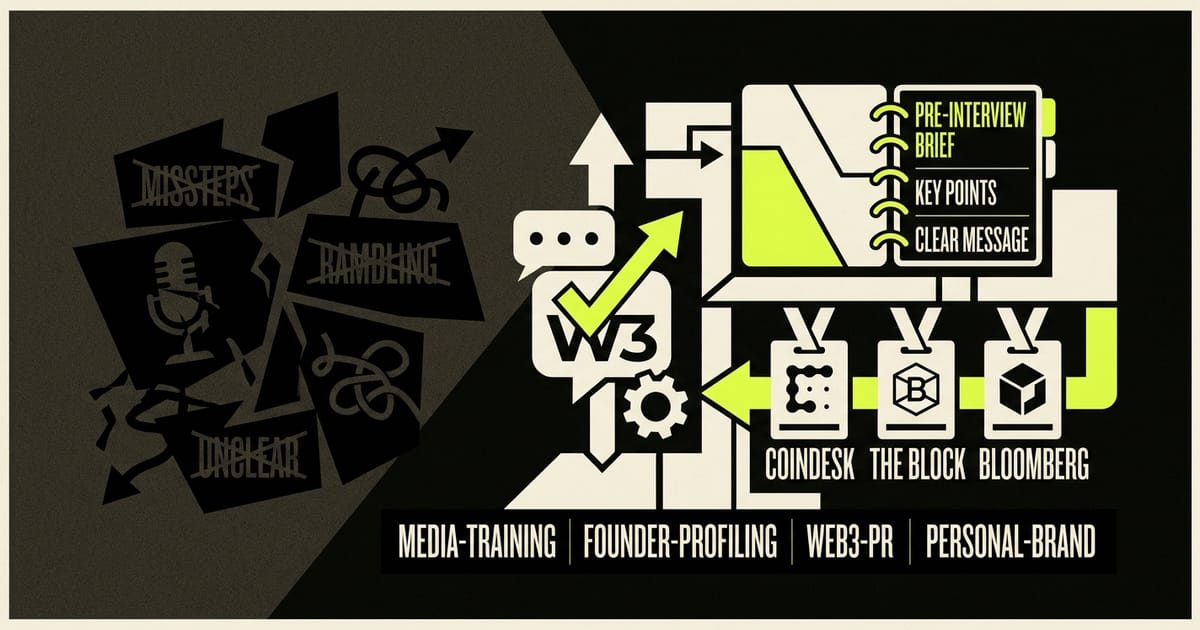
A tier-1 interview is not the time to figure out what you believe. It is the time to deliver what you already prepared. The founders who walk out of a CoinDesk, The Block, or Bloomberg session with a clean story and no regrets spent two hours the night before doing something most founders skip entirely: the brief.
This is not the full media training curriculum. That exists elsewhere. This is the document you run through the night before the call — the five things that kill tier-1 interviews, the precise language to use when the conversation goes sideways, and the two phrases that will end your relationship with a reporter faster than any bad story will.
I have run hundreds of pre-interview briefs across APAC and global campaigns, from early-stage DePIN protocols to AI infrastructure companies chasing Forbes placement. The mistakes are almost always the same ones. And almost none of them are about the content.
The on-the-record line is not where you think it is
Most founders believe the interview starts when the journalist asks the first question. It starts the moment you and the journalist are in the same room, channel, or call. That includes the two minutes of small talk before the recording is flagged as live, the hallway after the session, and the Telegram DM you send the next morning to "clarify something."
There is no ambient off-the-record zone. If you say it to a journalist in any medium after you have been introduced as the person being interviewed, assume it is on the record.
The off-the-record designation is also not something you can declare unilaterally after the fact. It requires the journalist to agree to it before you say the thing. If you share a sensitive detail and then add "that was off the record by the way," you have given the journalist a fact they now know. Whether they publish it depends on their judgment, their outlet's editorial policy, and the relationship you have with them. You cannot retroactively invoke a rule the other party never agreed to.
The working rule: if you do not want to see it in the article, do not say it. Not as colour, not as background, not as "just between us."
Before the interview, brief yourself on three things:
- What is the single story I want this article to tell?
- What are the three facts or claims I will not give a number on because I can not fully defend them in print?
- What is the one topic I will redirect if asked?
That last one matters more in crypto than in any other sector, and it takes us directly to the second mistake.
How to deflect a token price question without sounding evasive
A CoinDesk reporter or a Bloomberg markets journalist will ask about token price. Not always directly, but it will arrive — as "what do you think this development means for token value," or "how has the market responded," or "investors are clearly watching the price action, what's your read?"
The wrong answer is a prediction. Any price figure you put on record reads as promotion and can attract regulatory attention regardless of how it was framed. The question is not really about what to say. It is about how to redirect without looking like you are hiding something.
The pattern that works is acknowledgment plus category frame. You are not ignoring the question. You are answering the question you should have been asked.
A workable structure: "Token price reflects market sentiment at a specific moment, and that moment changes. What I can speak to is the underlying metric that actually validates whether this protocol is working — [insert your real number: active nodes, daily active developers, TVL growth rate, revenue, whatever your proof point is]. That's the signal I track."
You have answered the spirit of the question (is this real?) without speculating on price. The journalist gets a number they can use. You stay on the right side of securities-adjacent language.
What does not work: "I can't comment on price." Full stop. That reads as evasive because it is evasive. The journalist hears "the founder knows something uncomfortable about price." You have created the exact implication you were trying to avoid.
What also does not work: the philosophical detour. Three sentences about why price is the wrong metric for crypto projects, followed by a pivot to your vision. Reporters at The Block and CoinDesk have heard this speech. It does not land. It burns thirty seconds of interview time and generates zero quotable material.
Acknowledge the question. Give them a better number. Move on.
How to correct a factual error mid-interview without creating a worse headline
This is the scenario nobody prepares for: the journalist states something as background context — about your protocol, your raise amount, your team, your category — and they have it wrong. Not opinion-wrong. Fact-wrong.
The instinct is to let it go, to not seem difficult, to not disrupt the flow of the interview. That instinct will cost you. The journalist has now incorporated a wrong premise into the story frame, and their follow-up questions will build on it. By the time the article publishes, the wrong fact is scaffolded into several paragraphs you had no chance to correct.
The correction has to happen in the moment. The framing that works is additive, not adversarial: "One thing worth getting exactly right here — [correct fact]. I want to make sure you have the precise figure because the distinction matters for the story."
You are not accusing them of being wrong. You are positioning yourself as a helpful source who cares about accuracy. That is a role reporters welcome. A factual correction offered that way almost always gets received well. The same correction delivered as "actually that's not right" tends to create friction and occasionally becomes the story.
The harder scenario is when the journalist mischaracterises a quote mid-interview — they paraphrase back to you something you said earlier in the session, but the paraphrase has shifted the meaning. Same approach: correct it immediately, additive framing. "I want to make sure I was clear — what I meant was [restatement]. Let me say that again so you have the precise version."
The version you cannot take back is the one you let stand.
The two phrases that reliably kill a tier-1 interview
These are not dramatic. They do not generate controversies like the one that happened to Charles Hoskinson on a Block podcast earlier this year, where his mid-interview outburst over a question about his Ethereum history generated more coverage than the interview itself. They are quieter failures.
Phrase one: "We don't comment on that."
This is a PR agency reflex, and it has no place in a founder interview. Founders who use it at tier-1 outlets get characterised in the story as reluctant or guarded. The reporter's instinct is to write around it, which usually produces a worse result than if you had just answered. If there is a legitimate legal or regulatory reason you cannot speak to something, say so: "Legal has us constrained on that specific point until [date/milestone]." That is a real answer. "We don't comment on that" is a signal you have something to protect.
Phrase two: "What I'd really like to talk about is..."
This is the pivot bypass — the attempt to skip the journalist's question entirely and jump to your talking point. It works in a press conference with fifty cameras. It does not work in a one-on-one with a reporter who has done their research. The journalist notices the skip. They log it. And in my experience, they often come back to the skipped question at the end of the interview, framed harder.
The discipline is to answer the question that was asked, briefly and directly, and then bridge. Not to reroute before you arrive.
"there are no tier 1 companies in web3, it's all tier 1 founders" Shilika Jain on X, 30 Dec 2024
This matters for the interview brief because a tier-1 reporter at CoinDesk or Decrypt is not primarily writing about your protocol. They are writing about you — your thesis, your credibility, your willingness to be direct about hard questions in your category. The product is evidence. You are the story.
That means "We don't comment" and "What I'd really like to talk about" both commit the same fundamental error: they signal that the founder is not actually present in the conversation.
What the brief looks like in practice
Twenty-four hours before the interview, run through five checks:
1. Read the journalist's last ten bylines. Not their profile. Their actual published work in the last 60 days. What beat are they working? What is the angle that seems to interest them right now? The interview you are preparing for is a function of where they are editorially today, not what their title says.
2. Identify your three owned proof points. These are the three specific, defensible claims that support your narrative. Not mission statements. Not vision. Hard numbers or specific events: user count you can verify on-chain, TVL figure with a source, strategic partnership that is already announced, a specific regulatory filing. You need three. If you cannot produce three, the interview will drift to speculation.
3. Know your two no-go zones. Token price speculation. Any unannounced detail that would constitute material non-public information. Write these down. Practice saying "that is something we will announce formally when [milestone]" out loud until it is automatic.
4. Prepare your misquote correction phrase. Literally write it down. "One thing worth getting exactly right here" or "Let me make sure I was clear on that point." Practise saying it without defensiveness. The first time you use it under pressure it will feel strange. The second time it will feel like control.
5. Decide on your one pivot. One topic you will acknowledge and then redirect from, with a specific bridge to a proof point. Not three topics. One. Three is a politician's answer. One is a founder who knows what matters.
After the interview ends, the record is not closed
The conversation does not close when the journalist says thank you. The follow-up email asking you to confirm a figure is still on the record. The LinkedIn message two days later where they flag they are adding context to the piece — still on the record. The off-the-cuff reply you send from your phone at 11pm — still on the record.
Send a brief post-interview note. Something like: "Good to connect. Happy to verify any figures or add context before you file — just send them over." Two sentences. This is not asking to review the article. Reporters will decline that request and you will have used up goodwill. This is positioning yourself as a helpful, accurate source. Reporters come back to helpful, accurate sources.
And when the piece runs and something is wrong — factually wrong, not just framed in a way you do not prefer — reach out the same day. Not to argue the framing. To offer the correction with evidence. A short email, professional tone, specific error, specific correct figure. Most tier-1 reporters at CoinDesk, The Block, and Bloomberg will correct a provable factual error. None of them will rewrite a frame they have already chosen.
The brief is not a guarantee of a good story. It is the removal of the self-inflicted errors that turn a neutral story into a damaging one.
---
Book a 30-min teardown with Shilika to run a pre-interview brief before your next tier-1 session: calendly.com/shilikajain/30min