
On this page12
- What Blockworks Actually Was (And Why Its Loss Matters to You)
- The Second Domino: DL News Closes in May 2026
- The 2026 Outlet Map: What You're Actually Working With
- Tier 1: The Core Four
- Tier 1.5: The Institutional Hole-Fillers
- The Investigation Layer
- Mainstream Crossover
- What This Means for Your Outreach Sequencing
- The Pitch Volume Trap
- What About Blockworks' Remaining Surfaces?
- The AI Citation Layer You're Probably Missing
- The Honest Summary
Crypto Media Map 2026: Where to Pitch After Blockworks Shut Its Newsroom
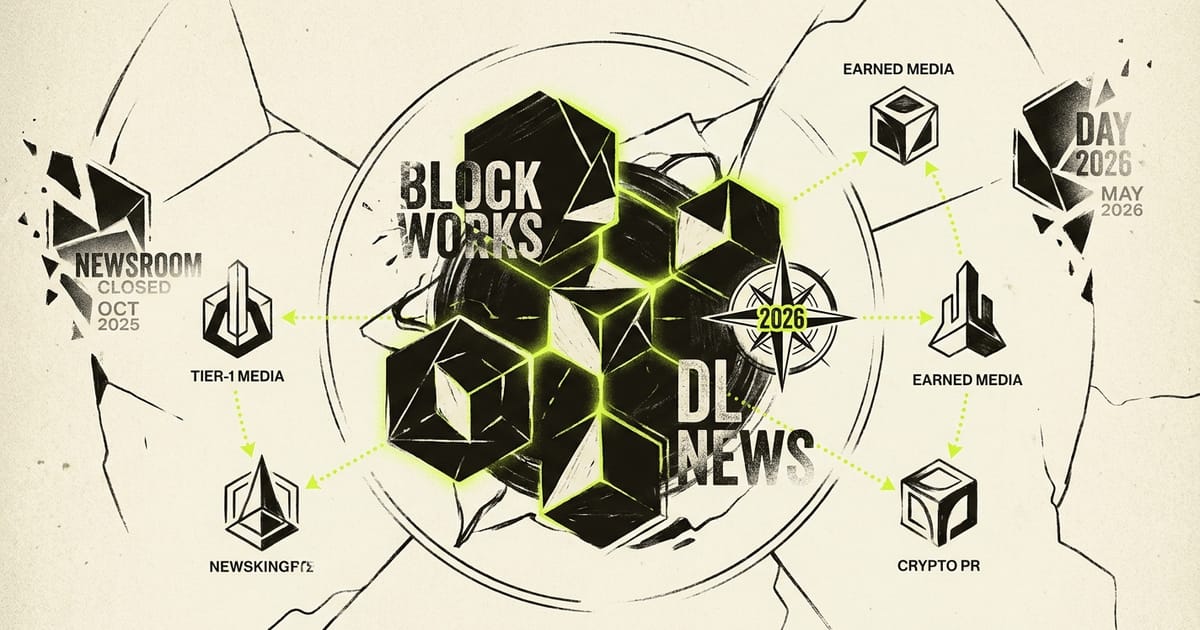
If you built your PR strategy around a 2024 outlet map, it's broken. Two of the most distinctive newsrooms in crypto journalism are gone within eight months of each other, and the coverage gap they left is not being filled the way most founders assume.
On October 29, 2025, Blockworks co-founder Jason Yanowitz announced the closure of the company's news division and the layoff of its journalism team. The newsroom had launched in 2021 and quickly built a reputation for institutional-grade reporting that earned citations from Bloomberg, Reuters, and The Wall Street Journal. Then in May 2026, DL News — the investigative outlet built alongside DefiLlama — announced it was also closing, citing AI-driven search collapse and the commercial impossibility of running journalism at scale without meaningful audience distribution.
Two quality newsrooms. Gone within one cycle. Your media strategy needs an update.
What Blockworks Actually Was (And Why Its Loss Matters to You)
Blockworks was not just another crypto outlet. It was the publication that translated DeFi and institutional macro for a reader who came from traditional finance. The Empire newsletter, the Unchained-adjacent podcast network, the Digital Asset Summit — these built a genuinely distinct audience: allocators, analysts, and senior operators who did not read Cointelegraph for their primary market context.
When I was placing clients like Web3Auth and Fluence, Blockworks occupied a specific slot in the sequencing. A Blockworks placement signalled to institutional readers and crypto-native VCs in a way that CoinDesk or Cointelegraph alone did not. It was the outlet that made a story feel legitimate to TradFi-adjacent readers without requiring a Bloomberg pick-up.
The company chose to exit the newsroom while it was still profitable — Yanowitz confirmed record revenues in 2025 and projections for another record year in 2026 — because the data and analytics business had grown faster and commanded a higher multiple. The move was rational for Blockworks. For your media strategy, it created a real hole.
Senior news editor Katherine Ross, crypto policy reporter Casey Wagner, and senior reporter Ben Strack were among the journalists who confirmed their departures. Yanowitz publicly encouraged the industry to hire them. That talent is now scattered — some at other outlets, some at protocols, some building independent platforms.
Blockworks itself is still alive. Its newsletters, its Empire podcast, and the Digital Asset Summit (now expanding to Abu Dhabi) continue. But you can't pitch a newsroom that no longer has reporters.
The Second Domino: DL News Closes in May 2026
DL News launched in 2022 as the news arm of DefiLlama. It built a reputation for investigative DeFi coverage that other outlets did not do with the same rigour. In May 2026, it announced closure, stating bluntly that traffic across crypto and tech media had "contracted severely" and that AI had "accelerated the collapse of search distribution."
The shutdown was not for lack of journalism quality. DL Research, its commercial research arm launched in 2024, grew revenue 270% in 2025 and crossed seven figures in annual sales. The editorial side could not carry itself without the distribution scale.
This matters for your pitch sequencing because DL News occupied a specific lane: serious investigative reporting on DeFi protocols, enforcement actions, and ecosystem failures. That coverage was harder to replicate than a news brief. The outlets that remain are largely not investing in that same beat at the same depth.
The 2026 Outlet Map: What You're Actually Working With
Here is the honest picture of where to pitch in 2026, by tier and use case.
Tier 1: The Core Four
CoinDesk remains the institutional benchmark. It's the oldest and most credible publication in the space, owned by Bullish, and it covers regulation, markets, policy, and Ethereum ecosystem with editorial standards that most outlets don't match. If your story has a regulatory angle, a major funding round, or institutional adoption, CoinDesk is your first call. Reporters including Ian Allison, Danny Nelson, and Nikhilesh De are worth tracking specifically.
The Block has explicitly moved to fill the institutional coverage gap. In April 2026, it appointed Steve Chung as CEO to accelerate what it describes as "institutional expansion at the intersection of crypto, finance, and AI." Larry Cermak, previously CEO, moved to President and now oversees research and product. The Block is positioning itself as the primary information platform for institutional investors, market participants, and policymakers — exactly the space Blockworks vacated. Foresight committed an additional $10 million in growth capital to support this phase. For founders raising from institutional players or launching products aimed at TradFi crossover, The Block is now your Blockworks replacement.
Cointelegraph is the highest-traffic crypto outlet in the world by most measures. Volume, reach, and time-zone spread are its strengths. It covers altcoins, Layer 2s, regulation, and DeFi with a publishing cadence that no other outlet matches. The editorial bar for news coverage is real. The bar for op-eds and expert commentary is lower than many founders assume — they run several contributed pieces per week, and a good DeFi or infrastructure angle can get through.
Decrypt sits at the intersection of crypto and culture. Consumer apps, NFTs, gaming, ecosystem adoption, and the Decrypt AI desk (which I've placed Fluence commentary through) are its natural homes. If your story is about real-world usage rather than institutional market structure, Decrypt is often the right primary outlet.
Tier 1.5: The Institutional Hole-Fillers
Bitcoin Magazine — Bitcoin-only, deep on policy and adoption, increasingly relevant as treasury allocation stories dominate the institutional narrative. If your story touches BTC in any meaningful way, Bitcoin Magazine belongs in your pitch sequence.
Unchained (Laura Shin) — long-form investigative journalism, podcast with genuine reach among sophisticated readers. This is not where you pitch a product launch. It's where a founder goes to explain a complex narrative, respond to a controversy in depth, or establish an investigative track record. Laura Shin and her team are genuinely selective. A pitch that wastes their time once ends the relationship.
The Defiant (Camila Russo) — the strongest DeFi-native outlet still operating. Founded in 2019, it's the publication that covers liquidity crises, governance attacks, and protocol deep-dives before mainstream crypto media gets there. If you're building in DeFi, The Defiant needs to be on your list. Its newsletter, podcast, and video content each reach different segments of the DeFi participant audience.
The Investigation Layer
Protos covers the stories other outlets soften: scam allegations, exchange controversies, protocol failures, and media criticism. For a PR operator, this matters in two ways. One, never underestimate them — their coverage of negative stories travels fast. Two, their presence in the ecosystem means the community has a skepticism-first outlet that can verify your claims independently. Build your narrative to hold up under their scrutiny.
Mainstream Crossover
Bloomberg Crypto, Reuters Digital Assets, and TechCrunch remain the mainstream crossover targets for significant funding rounds, regulatory moments, or AI startup angles. These are not pitches you send on a timeline. They come from a relationship built over months and a story angle that genuinely serves a non-crypto reader.
What This Means for Your Outreach Sequencing
The structural change is this: the institutional-trade press tier has consolidated from four credible outlets (CoinDesk, Blockworks, The Block, DL News) to two (CoinDesk and The Block). Every founder building a 2026 media strategy needs to account for that.
In practice, the sequencing I run for clients now looks like this:
Funding rounds and major protocol launches: CoinDesk or The Block as the primary (embargo, one exclusive), Cointelegraph and Decrypt for same-day tier-2 simultaneous release, Bitcoin Magazine if the story has BTC adjacency.
DeFi protocol stories: The Defiant as the primary, with Unchained for long-form follow-up if the story has investigative depth. Cointelegraph for broader distribution.
Founder thought leadership / op-eds: CoinDesk opinion desk, Decrypt, Cointelegraph. Unchained for podcast placement if the founder has a genuine point of view on something the market is debating.
Institutional crossover stories (RWA, ETFs, treasury adoption): The Block as primary, Bloomberg Crypto and Reuters for simultaneous mainstream outreach.
One thing I've said publicly and still believe:
me when my web3 PR clients ask me if i can get them earned coverage on Cointelegraph, Coindesk, TheBlock, Bloomberg, Blockworks, Forbes in next 1 month Shilika Jain on X, 31 Aug 2023
That post was about timeline, not about the outlets themselves. A month is not enough time to build the relationships that make tier-1 pitches land. But with Blockworks gone from the pitching map, the timeline pressure at The Block has intensified. Fewer doors means each relationship matters more.
The Pitch Volume Trap
The response most founders have to a smaller outlet pool is to pitch more aggressively to the outlets that remain. This is exactly wrong.
CoinDesk and The Block both have fewer editorial desks than they did two years ago, but their inbox volume has not gone down — it's gone up, because every founder who used to pitch Blockworks is now redirecting to them. The signal-to-noise ratio for undifferentiated pitches has gotten worse.
What cuts through in 2026 is the same as what always cut through: a specific reporter who covers your beat, a story angle they haven't written, and a source relationship that makes your founder the go-to when that angle needs a quote. That's not a mass-pitch problem. It's a relationship problem.
builders build, PR's pitch lol Shilika Jain on X, 28 Mar 2025
The Blockworks shutdown matters to your strategy. But the more important variable is whether you have a reporter at The Block or CoinDesk who knows your founder's name before the announcement goes out.
What About Blockworks' Remaining Surfaces?
The company is not dead. Its newsletters and podcasts continue. The Empire newsletter and Blockworks-branded content still reach the institutional-adjacent audience that made the brand valuable. The Digital Asset Summit is expanding to Abu Dhabi in 2026.
For PR purposes, these surfaces are now more like sponsorship and content partnership opportunities than earned media. The Empire newsletter takes guest content and the podcast network takes guests. These are not free placements — they're either paid partnership slots or relationship-driven bookings — but if you're targeting institutional crypto readers, they're still worth understanding.
The AI Citation Layer You're Probably Missing
One outcome of the Blockworks closure is that its URLs still exist in the training data of every major AI assistant. Stories placed on Blockworks.com between 2021 and 2025 still get cited. The domain has not been wiped from Perplexity or ChatGPT's context window.
This matters because your 2024 Blockworks coverage is still generating citations in AI-assisted searches. And it means that getting placed in The Block, CoinDesk, and The Defiant today is not just about the immediate readership — it's about building the source record that AI assistants pull from in six to twelve months. Coverage you place this quarter will be cited as context in founder and investor research queries well into 2027.
The Honest Summary
In 2026, the institutional-trade press tier for crypto PR has two primary outlets where it had four. The Block explicitly wants to be the Blockworks replacement and has the capital to execute it. CoinDesk remains the broadest institutional benchmark. The Defiant owns DeFi. Unchained owns long-form. Protos owns skepticism.
Your pitch list is shorter. Your relationships with individual reporters matter more. The timeline pressure to build those relationships before your next announcement is higher than it has ever been.
If you're running a campaign right now without a reporter relationship at The Block or CoinDesk, that's the gap to close first — before you write a press release, before you brief your investors, before you set an announcement date.
---
Book a 30-min teardown with Shilika to map your current media strategy against the 2026 outlet landscape and identify exactly which reporter relationships you need to build before your next announcement: calendly.com/shilikajain/30min