
On this page9
Crypto KOL Waves: The Whisper-Tease-Shout Sequence That Actually Drives Wallet Activations
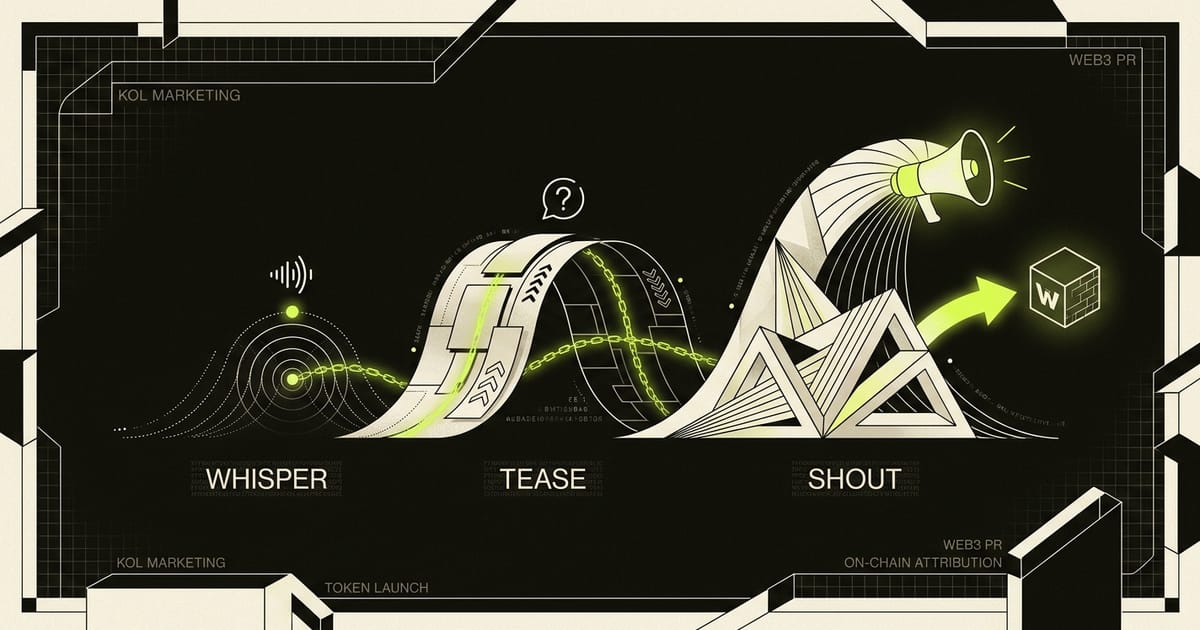
The whisper-tease-shout framework is not a new idea. Surgence Labs wrote it up cleanly; a handful of other agencies have borrowed the framing. What those write-ups skip is the operational layer: which tier posts in which wave, what the brief contains, how the KOL sequence meshes with the press embargo, and how you attribute a wallet activation back to a specific creator rather than to "the campaign."
That's what this post covers.
I've run influencer and KOL coordination for 50+ Web3 protocols across six years, including APAC activations across Korea, Japan, Vietnam, Singapore, India and the UAE. My network sits at 200+ vetted creators. The operational notes below come from that work.
Why One Drop Doesn't Convert
The instinct on most launch teams is to synchronize everything: every KOL posts on the same day, the press release goes out at the same moment, the community manager pins an announcement, and the Discord lights up. It feels coordinated.
The problem is that a potential buyer who sees fifteen creators mention the same token in the same 12-hour window reads that pattern as a paid push, not organic interest. They're right. Noise without prior context doesn't convert.
I posted something similar after watching this play out repeatedly:
crypto marketers will launch another massive marketing campaign but can't tell if the product they're marketing will actually bring adoption or not lol Shilika Jain on X, 23 Dec 2024
The three-wave model works because it mirrors how credibility actually forms. Wave 1 builds the frame. Wave 2 amplifies a launch that already has context. Wave 3 converts attention into committed community. Compress them and you lose the sequencing that makes the thing work.
Wave 1: Whisper (T-72h to T-24h)
Who posts: 3 to 5 technical credibility anchors. Not the biggest follower counts on your list. The voices your target buyer set already trusts: a named protocol researcher, an ecosystem lead at a partner chain, the founder of a complementary project. These aren't paid impressions in the traditional sense; they are weighted-credibility posts that set the interpretive frame the rest of the launch lands inside.
What they publish: A genuine deep-dive. Thread analysis of the architecture. An honest take on what's interesting and what still needs proving. This content should feel like something the creator would have written unprompted.
This is why I have deep respect for creators who actually do the work:
massive respect to influencers who research the f**k out of protocols! consumes a lot of time, energy and needs patience! Shilika Jain on X, 12 Jan 2024
The brief: Give Wave 1 creators an embargoed read of the whitepaper, tokenomics, and one exclusive piece of context the public doesn't have yet. Make the brief a conversation, not a script. Creator briefs that require draft-by-draft approval slow the campaign and dilute the creator's voice. Tell them the narrative you're building; let them express it in their own register.
The embargo coordination: Wave 1 posts sit under a soft embargo until T-24h. That gives the press cycle room to run first if you have a CoinDesk or Cointelegraph exclusive dropping at T-0. The credibility anchors confirm what the journalists just published; the journalists don't get undercut by influencer posts that went live 48 hours early.
APAC note: If Korea is in scope, the Wave 1 brief needs to be ready in Korean. Korean retail crypto is among the most narrative-sensitive audiences in the world, and Korean outlets on BloomingBit or TokenPost won't pick up a translated English release and call it a scoop. Budget 7 to 10 working days of lead time for Korean localization before Wave 1 even begins.
Wave 2: Tease (T-24h to T+4h)
Who posts: 10 to 20 mid-tier creators, 50K to 500K followers, in the niches adjacent to your protocol. This is where most "micro vs macro" content on the internet starts and stops: engagement rate is more important than follower count. A DeFi educator with 80K highly engaged followers in your sector is worth more at this wave than a general crypto account with 400K passive followers.
What they publish: Comparative analysis, AMA previews, specific product mechanics explained. The content should be specific but incomplete. Signal that something is happening; leave questions that turn into signups and pre-deposits.
Timing: Posts stagger across the 24-hour window before launch, not all at once. A follower in Seoul who sees a creator they trust post about the project at 09:00 KST, then sees a different creator pick it up at 14:00 KST, reads that as two independent validations. That's the effect you're building.
What to brief for Wave 2:
- The core narrative in one sentence (not the tagline, the actual differentiating claim)
- Two or three specific product mechanics they can explain in their own words
- The launch date and how to participate
- A unique tracked claim URL or referral code — one per creator, set up before the first post goes live
- Disclosure language that matches jurisdiction requirements (SEC in the US, MiCA in EU, FCA in UK)
Common mistake: Teams brief Wave 2 with the same document they gave Wave 1. The audiences are different. Wave 2 is broader and needs more context on why the product matters to a mid-level DeFi user, not just a protocol architect.
Wave 3: Shout (T+0 to T+7d)
Who posts: The full roster. Launch-day broad activation from the macro accounts you've been holding back, plus 5 to 10 long-form creators who ship deep-dives in the seven days after launch.
The launch-day layer: One or two macro accounts (200K+ followers) post at or within hours of TGE. The macro post's job is reach, not depth. It should link out to the Wave 1 credibility content and the Wave 2 comparative threads that are already live. It confirms what the buyer has already been hearing; it doesn't arrive cold.
The post-launch deep-dive layer: YouTube creators with research-grade audiences, podcast appearances tied to the launch, one or two long-form Substack pieces that anchor the citation graph. This content is what AI engines index against in the weeks after launch. If you skip Wave 3's long-form layer, you get a price chart with no tail.
The brief for Wave 3: Macro accounts need a punchy one-liner, the tracked link, and the disclosure. Long-form creators need the full technical brief plus the Week 1 performance data if you can share it. Showing early wallet activation numbers in the creator brief converts a "here's a sponsored post" into "here's a narrative with proof."
On-Chain Attribution: The Part Everyone Skips
Most KOL campaigns are measured on vanity metrics: likes, retweets, impressions. None of those map to wallet activations or protocol revenue. The attribution setup has to be live before the first Wave 1 post goes up.
The mechanics that work:
- Unique tracked claim URLs per creator. Routes the click to a landing page with a source parameter attached, captures wallet address and downstream on-chain behavior. Tools like Cookie3 and Spindl handle the off-chain-to-on-chain stitching.
- Referral codes for CEX-adjacent campaigns. If the launch includes an exchange listing, mirror the attribution into the exchange's native referral program. The CEX handles the conversion event reporting.
- Wallet cohort analysis after the campaign. Pull wallets that interacted with the protocol during the campaign window on Nansen or Dune. Cross-reference against the referral-tracked wallets to catch assisted conversions: buyers who discovered the project through a KOL post but claimed via a different path.
The metric that matters is cost per qualified wallet: total KOL spend divided by wallets that completed their first meaningful on-chain action. Not cost per click. Not cost per impression. First action.
A useful secondary metric: retention cohort by creator. Which creators drove wallets that came back in 30 days versus wallets that connected once and vanished? The creators who drive retained users are the ones to lock into your next campaign under long-term deal structures.
The APAC Layer Most Western Campaigns Miss
Running the whisper-tease-shout sequence exclusively on English-language X and YouTube leaves a significant portion of the addressable crypto retail market untouched. Korea alone accounts for roughly 50% of APAC crypto-native traffic. Japan's on-chain value received grew over 100% in the twelve months to mid-2025.
The APAC KOL market is structurally different from English CT:
- Korean coverage runs through Kakao channels, Naver blogs, and Korean crypto YouTube, not just X
- Japanese coverage runs through BloomingBit, TokenPost Japan, and CryptoTimes JP
- Korean and Japanese audiences are skeptical of obvious promotion; Wave 1 credibility anchors matter more here than anywhere else
Korean KOL rates for comparable audience size run 20 to 40% above US baseline because the content must be native-language and because the audience is highly retail-active. Budget accordingly. A Wave 2 mid-tier Korean creator costs $1,000 to $8,000 per coordinated post; a Japanese macro account runs $10,000 to $30,000. Those are separate line items from your English CT roster.
There's also a compliance wrinkle. Singapore's MAS has explicitly restricted crypto marketing to the general public, including through social media influencers. A KOL campaign that works across Southeast Asia is a compliance problem the moment it reaches Singapore audiences if it isn't structured correctly. Know the jurisdiction of every creator's primary audience before you brief them.
Vetting Before You Brief
None of the above sequencing works if the creators are inflating their metrics. Bot rates on mid-tier crypto accounts are not a fringe problem. A credible vetting process checks:
- Engagement rate on the last 20 posts (under 0.5% on an account above 100K followers is a flag)
- Comment quality: real communities ask technical questions, push back, and argue. Comments that read "Great project!" in a row are a signal.
- Follower growth curve: organic accounts grow steadily with spikes tied to viral content. A sudden gain of 50,000 followers with no obvious catalyst is a flag.
- On-chain wallet verification: ask the creator to sign a message from a wallet with transaction history. Creators who stall or send a fresh empty wallet usually don't have a real on-chain audience.
- Past campaign performance: referral link click-through data and wallet counts from recent campaigns. Creators who won't share this data typically don't have data worth sharing.
Vetting takes 3 to 7 days per creator when done manually. At 200+ vetted relationships built over six years, the time-to-brief is materially shorter because the due diligence is already done.
What the Brief Template Actually Contains
Every creator brief, regardless of wave, has the same five sections:
- The narrative in one sentence. Not marketing copy. The actual differentiating claim: "A perp DEX where idle margin earns yield" is useful. "The most innovative DeFi solution" is not.
- Product mechanics in plain language. Two to three specific things the creator can explain in their own words.
- The participation mechanic. What should their audience do: connect wallet, join waitlist, pre-deposit, claim allowlist.
- The tracked link or referral code. One per creator. Non-negotiable.
- Disclosure language. Jurisdiction-specific, written out in full. Don't leave this to the creator's interpretation.
The wave dictates depth, not structure. Wave 1 gets the full technical brief plus embargo context. Wave 2 gets narrative and mechanics. Wave 3 macro gets a punchy one-liner and the tracked link. Wave 3 long-form gets the full technical brief again plus Week 1 performance data.
Two Launch Scenarios
Pre-seed or early-stage protocol: Skip the macro accounts entirely. Run Wave 1 with 3 technical credibility anchors (protocol researcher, adjacent ecosystem lead, one respected educator in your sector). Run Wave 2 with 8 to 12 mid-tier creators. Skip Wave 3's macro layer and put the budget into two or three long-form deep-dives that build the citation graph. Total creator spend in the $15K to $40K range. Attribution setup via Cookie3 or Spindl. Expect 300 to 800 attributed wallet activations if the product is real.
Series A / TGE with exchange listing: Run all three waves with the full roster. Wave 1: 5 credibility anchors under embargo. Wave 2: 15 to 25 mid-tier creators across English CT, Korean, and at minimum one more APAC market. Wave 3: 2 macro posts at TGE window, 7 to 10 long-form deep-dives over the following week. Budget $80K to $200K+ depending on tier and region. Attribution setup must include exchange native referral program integration. Expect wallet activations in the thousands if the narrative holds.
The difference between those two scenarios isn't ambition. It's the available narrative surface area and the size of the audience that already knows the project exists. Spending macro KOL budget on a project with no prior community is how you generate an impressive launch-day spike and a 90% chart decline in Week 2.
---
If you want a read on whether your current KOL plan matches your launch stage and narrative, book a 30-min teardown. I'll tell you what's missing before the first brief goes out, not after.