
PLAYBOOKAll posts

Crypto KOL Disclosure Rules: FTC, SEC, and MiCA in 2026

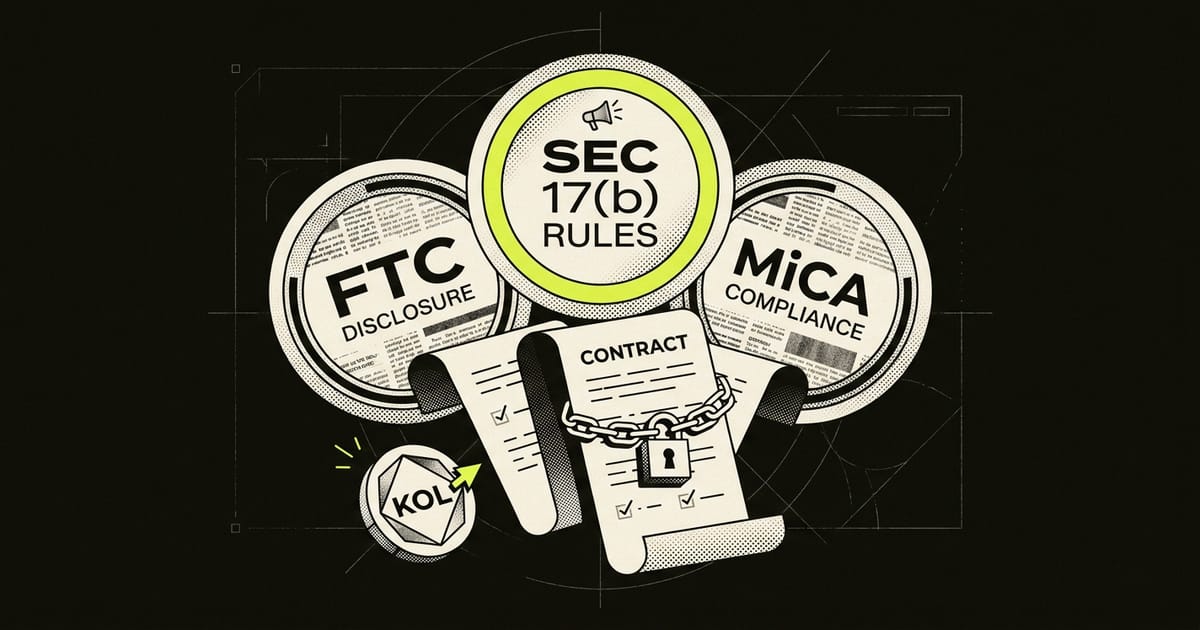
Three regulatory regimes overlap on every crypto KOL campaign. Here's what FTC, SEC Section 17(b), and MiCA actually require — plus the contract language founders must include.

Crypto KOL Disclosure Rules: FTC, SEC, and MiCA in 2026

Crypto KOL Disclosure Rules: FTC, SEC, and MiCA in 2026

Most founders I talk to treat KOL compliance as someone else's problem. They hand the creator brief to an agency, the agency sends it to a KOL manager, and the KOL posts whatever they want. If a regulator comes knocking, the theory goes, the creator is the one on the hook.

That theory is wrong, and it keeps getting founders into trouble.

The firm is responsible for any promotion made on its behalf, regardless of who pressed publish. That principle is consistent across the SEC, FTC, FINRA, FCA, and MiCA. Where a firm pays, sponsors, gifts, provides affiliate links, supplies talking points, or otherwise materially benefits from a third party's content, the regulator treats the content as the firm's communication.

Keep reading

Similar playbooks

01

What to Know Before You Hire a Web3 PR or Marketing Agency

A fractional PR consultant's field notes on hiring a Web3 agency, covering who really does the work, big vs boutique, questions to ask and KPIs to set.

Read playbook
02

Web3 Startup Marketing Checklist: Pre-Launch to Post-TGE

A phase-by-phase Web3 marketing checklist: community, docs, X, KOL vetting, PR, exchange listing comms, MiCA and VARA checks, and on-chain analytics to TGE.

Read playbook
03

The Wire Service Trap: A Press Release Is Not PR

Why paid press releases and wire distribution do not count as coverage, what they cost crypto founders in credibility, and the launch plan I use instead.

Read playbook
All playbooks