
On this page8
- The four-window calendar at a glance
- Window 1: WebX Tokyo (July 13–14)
- Window 2: Korea Blockchain Week (September 29–October 1)
- Window 3: Token2049 Singapore (October 7–8)
- Window 4: India Blockchain Week (November 1–2)
- Chaining the windows: the compound media play
- The three pitfalls that collapse APAC conference PR
- What the APAC calendar looks like from a planning perspective
APAC Blockchain Conference PR Calendar: KBW, WebX, Token2049, and IBW
Four conferences. Four distinct press cycles. One continuous earned media programme, if you sequence them correctly.
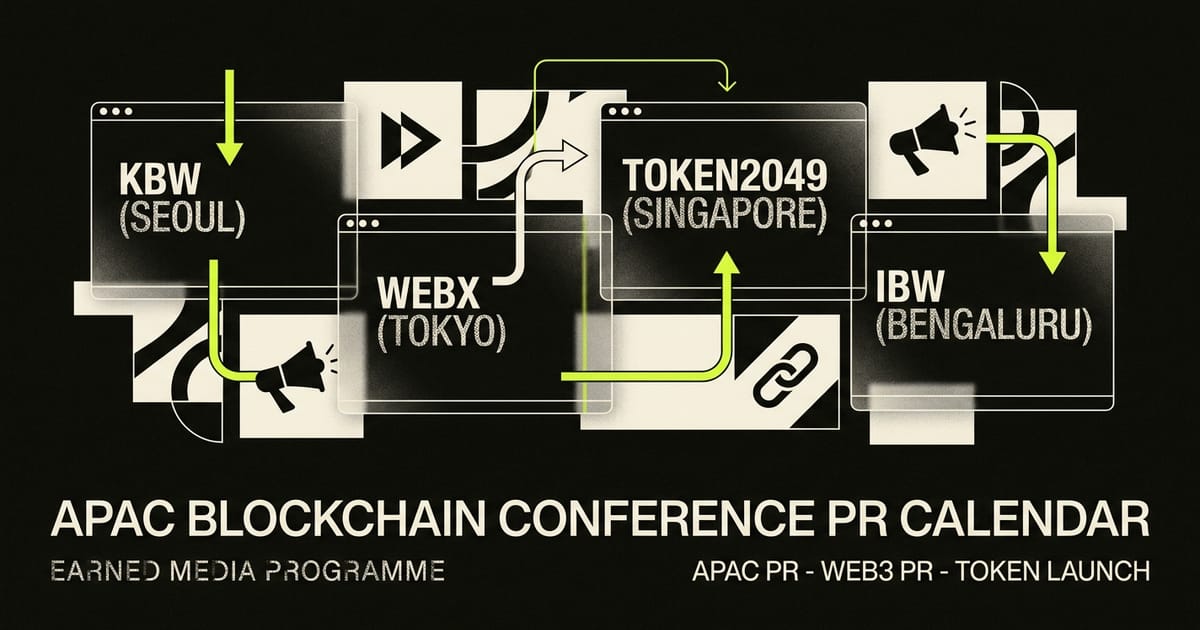
Most Web3 founders treat APAC conferences as one-off networking events with a press release bolted on at the end. That is the wrong mental model. Korea Blockchain Week (Seoul, September 29 to October 1), WebX (Tokyo, July 13 to 14), Token2049 Singapore (October 7 to 8), and India Blockchain Week (Mumbai, November 1 to 2) are not four separate moments. They are four windows in a single year-long media calendar, and the tail of each one feeds directly into the pre-event build for the next.
I spoke at India Blockchain Week 2024 on crypto media narrative and have been running APAC PR campaigns across Korea, Japan, India, and Singapore for six years. What I see year after year: projects show up at KBW with no Korean coverage, at WebX with no Japanese-language assets, and at Token2049 with a press release they wrote on the flight over. Then they wonder why the coverage is thin.
This post maps the press cycle for each conference, names which outlets have reporters on the ground, explains how to secure pre-event embargoed coverage, and shows how to chain the post-event tail from one window into the pre-event positioning for the next.
---
The four-window calendar at a glance
| Conference | Dates | City | Press window opens |
|---|---|---|---|
| WebX | Jul 13–14, 2026 | Tokyo | Mid-May |
| Korea Blockchain Week | Sep 29–Oct 1, 2026 | Seoul | Early August |
| Token2049 Singapore | Oct 7–8, 2026 | Singapore | Early August |
| India Blockchain Week | Nov 1–2, 2026 | Mumbai | Mid-September |
Notice the cluster. KBW ends October 1. Token2049 starts October 7. IBW opens November 1. You have a six-day gap between Seoul and Singapore, and five weeks between Singapore and Mumbai. That gap is not downtime. That is when post-event coverage from KBW turns into the pre-event angle for Token2049.
---
Window 1: WebX Tokyo (July 13–14)
WebX is produced by CoinPost, Japan's largest Web3 media platform, which means the conference has a direct editorial relationship with the outlet most likely to cover your announcement in Japanese. That is unusual. Most conferences have no such tie. It means your pre-event outreach to CoinPost carries a different weight here than it would at a neutral venue.
The 2026 edition drew over 13,500 attendees and was headlined by Japan's Prime Minister Sanae Takaichi pledging stronger government support for Web3 startups. That is the policy context WebX operates in: Japan is in an active regulatory reform cycle, and journalists at this conference are tracking licensing, stablecoin legislation, and FIEA reclassification. If your story does not have a Japan regulatory angle or a Japanese enterprise partner named in the release, a Tokyo journalist will not prioritize it over the stories that do.
Outlets with on-site or strong pre-event presence: CoinPost (organiser), Cointelegraph Japan, CryptoTimes JP, BeInCrypto Japan, Nikkei Asia, Bloomberg (Alice French attended the 2026 edition as a confirmed speaker), Iolite.
Pre-event window: mid-May to July 1. WebX press cycles open roughly six weeks before the conference. That is when you should have your Japanese-language release ready and your Cointelegraph JP pitch drafted. Not July 12.
The embargo play at WebX: Japan's media culture values exclusivity more than most APAC markets. A single Cointelegraph Japan exclusive placed under a 48-hour embargo that lifts on the morning of day one will do more for your Tokyo presence than five simultaneous drops. The Japanese crypto press community is smaller and tighter than Korea's, so an exclusive feels proportionately larger.
Post-WebX tail: Domestic Japanese pickups from CoinPost, BeInCrypto JP, and smaller outlets typically run for seven to ten days after the conference. Use that coverage to build a Korean-language asset for the KBW cycle, framing your Japan traction as regional proof point.
---
Window 2: Korea Blockchain Week (September 29–October 1)
KBW is the most commercially important conference in this calendar for any project with a token generation event on the radar. Korea has among the highest crypto retail adoption globally, and Korean retail is what moves token price in the first 72 hours post-TGE. Missing KBW is not just a PR miss. It is a distribution miss.
I said this after KBW 2025 and it still holds:
biggest ick from my finds at KBW is: projects don't know how to GTM market in Korea, huge problem but also huge opportunity! Korea is the market for retail traction, specifically for the ones that have TGE on the radar. Shilika Jain on X, 30 Sep 2025
The 2026 edition runs September 29 to October 1 at Walkerhill Hotels and Resorts in Seoul. Day one (September 29) is an invite-only Upbit Institutional Summit for policymakers and senior industry leaders. The public main conference runs September 30 and October 1. If you have the institutional angle, the September 29 access matters. If you do not, plan around the main conference days.
Korean press does not work the way global press works. Korean reach comes from two channels: Naver-syndicated mainstream outlets and Telegram-driven apps. The mainstream outlets to care about are Hankyung (37.7 million monthly visitors via Naver), E-Daily (11.3 million), Bloomingbit (5 million), Tokenpost (2.6 million), CoinReaders (5.5 million), and Blockmedia. CoinNess is the largest active-user Korean Web3 news app and drives significant Telegram channel pickup. ZDNet Korea (4 million) and Digital Times (2 million) cover the broader tech angle.
Translating an English press release into Korean and sending it to these outlets does not work. Korean journalists want your Korean exchange listing status, a note on FSC regulatory positioning, and a Korean-language headshot with a Korean bio. That is the baseline, not a differentiator.
Pre-event window: early August. KBW's press cycle opens roughly eight weeks before the conference. August is when you build the Korean-language narrative assets and start warming up your Korean media contacts. If you are planning a token announcement at KBW, the embargo should be set to lift on the morning of September 30, with outreach to Korean outlets going out T-72h.
On-site tactic that actually moves coverage: Korean journalists cover side events heavily, often more than the main stage. Hosting a branded dinner or a 30-person panel the night of September 30 in Gangnam gives you a distinct news hook that separates your story from the 50 other announcements happening on the main stage that day.
---
Window 3: Token2049 Singapore (October 7–8)
Token2049 Singapore is the highest-global-reach conference in this calendar. The 2026 edition sold out at 25,000 attendees from 160 countries, with 250 speakers across six stages. The attending media list included Bloomberg, CNBC, the Wall Street Journal, Financial Times, Al Jazeera, Nikkei Asia, Fortune, The Block, Cointelegraph, and Blockworks. That is the only APAC conference where you can realistically land a Wall Street Journal or FT placement from a single on-site interview.
The 2026 edition also launched Token2049 Institutional on October 8, a private gathering of 250 senior leaders from Goldman Sachs, BlackRock, Morgan Stanley, Solana Foundation, and Franklin Templeton. If your story has a TradFi or institutional DeFi angle, that context makes it far more pitchable to the FT or Bloomberg reporters on the ground.
The critical timing note: Token2049 starts October 7. KBW ends October 1. You have six days. Projects that use those six days to turn KBW post-event coverage into a Singapore pre-brief show up at Token2049 with momentum. Projects that treat them as separate events show up cold.
A pre-brief at Token2049 means pitching your most strategic story to three to four tier-1 reporters under embargo four to five days before the conference opens. The pitch needs a reason the story is relevant to a global audience, not just to Korea or Japan. Think about what Korea traction proves, what the Japan regulatory angle signals, and how that chains into your global narrative.
Side events matter here too. Token2049 Week extends from approximately October 5 to 11, with 500-plus side events across Singapore. The side event week is where smaller crypto-native outlets like Decrypt, Blockworks, and The Defiant are easier to access than on the main conference floor. A 20-minute sit-down with a Blockworks reporter at a side event breakfast often produces a better story than a rushed booth interview on day one.
I was in Singapore the week of Token2049 2026, speaking to founders across multiple sectors, from privacy protocols to Dubai fintech players to cybersecurity teams. The common thread: the ones who arrived with a pre-brief already locked did the productive interviews in the first two hours. Everyone else spent day one trying to get the same journalists' attention as 500 other projects.
---
Window 4: India Blockchain Week (November 1–2)
IBW is the newest member of this calendar in terms of institutional weight. The 2026 edition moved from Bangalore to Mumbai's Fairmont, hosted by Hashed Emergent, with Binance as title sponsor and an inaugural Institutional Forum added. The move to Mumbai matters: Bangalore is India's tech hub, Mumbai is its financial capital. The IBW shift signals where the Indian Web3 story is heading, and your narrative positioning for IBW should reflect that.
The week around IBW is dense. In November 2026, Mumbai hosts Devcon 8, ETHGlobal Mumbai, Ethereum Cypherpunk Congress, and Unchained Summit within the same period, alongside 90-plus IBW side events. For a PR operator, that means media attention is fragmented across four to five major stories simultaneously. Your window for share-of-voice is narrower than it looks on a calendar.
What works at IBW for earned media: India's Web3 press does not work on the same embargo cadence as global or Korean media. Indian journalists at outlets like The Economic Times, Mint, YourStory, Livemint, and The Block India respond faster to op-eds and founder profiles than to straight press releases. A founder essay published in an Indian outlet two weeks before IBW, framed around India's Web3 opportunity, does more for your conference positioning than a press release dropped on November 1.
I spoke on stage at IBW 2024 on mastering Web3 PR and have watched this play out in real time. The projects that owned the IBW narrative in 2024 were the ones who showed up with a published point of view, not a product announcement.
Pre-event window: mid-September. With KBW running through October 1 and Token2049 through October 8, your IBW pre-event window is genuinely compressed. Start your Indian media outreach in mid-September, before the KBW and Token2049 crunch hits. If you wait until after Token2049, you have roughly three weeks to place a meaningful story before the conference opens.
---
Chaining the windows: the compound media play
The model most projects miss is the chain. Each conference generates coverage that can be used as a proof point to pitch the next conference's story. A structured approach looks like this:
July (WebX tail / KBW build): Use any CoinPost or Cointelegraph Japan coverage from WebX as a Japan market validation angle in your KBW pitch. "Project X expanded to Japan in July with coverage in CoinPost and CoinTimes JP" is a sentence that lands differently in a Korean journalist's inbox than a cold pitch about the protocol.
October 1–6 (KBW tail / Token2049 pre-brief): Use Korean coverage volume as a proof point for global pitch. "We announced X at KBW and picked up placements across Bloomingbit, Tokenpost, and Coinness" tells a Bloomberg or The Block reporter that the market has already validated the story. That is social proof, not PR spin.
October 8–31 (Token2049 tail / IBW build): Turn your Token2049 global coverage into an India-specific narrative. What does your Singapore traction mean for the Indian market? That reframe is your IBW pitch.
This is the same launch PR sequencing that works for any major announcement, applied at the conference level:
Create active thought leadership 1-2 months before the launch. Secure 1-2 podcasts/interviews 1 month before. AMA 15 days before. Embargo press outreach: week before the launch. Shilika Jain on X, 11 Oct 2024
Replace "launch" with "conference" and the timing holds.
---
The three pitfalls that collapse APAC conference PR
Pitfall 1: Single-language assets. I have seen teams with genuinely strong narratives get zero Korean or Japanese coverage because they sent an English release. Korean journalists need Korean assets. Japanese journalists need Japanese assets, with a regulatory angle. Localisation is not translation. It is reframing the story for a different market with different questions.
Pitfall 2: Embargo timing errors. APAC time zones mean a 9 a.m. EST embargo lift hits Tokyo at 10 p.m. and Seoul at 11 p.m. No journalist in those markets is writing a story at that hour. Your embargo times for KBW and WebX stories need to lift between 9 a.m. and noon Seoul or Tokyo time, on a weekday.
Pitfall 3: Treating Token2049 as a Korean or Japanese conference. It is not. The global press at Token2049 is looking for global stories. If your pitch is "we're expanding to Korea," that is a story for Korean outlets, not for Bloomberg. What you need for Token2049 is the global angle that your Korean or Japanese traction proves.
---
What the APAC calendar looks like from a planning perspective
If you are a founder looking at 2027 APAC activations from Q4 2026 right now, the planning timeline that works is:
- December 2026: Confirm your conference selection and narrative arc for 2027. Which of the four windows are you using? All four, or two?
- March 2027: Start building Korean and Japanese media relationships if you do not have them. These take three to four months to warm up.
- May 2027: Japanese-language assets for WebX ready. Pre-event pitch cycle starts.
- July 2027: WebX. Post-event coverage captured and repurposed for KBW build.
- August 2027: Korean-language assets for KBW ready.
- September 2027: KBW. Embargo coordinated. Post-event coverage captured.
- October 2027: Token2049. Global pre-brief in place using KBW traction as proof.
- September to October 2027 (parallel): IBW pre-event Indian media outreach live before Token2049 crunch.
- November 2027: IBW. Op-ed and founder profile already published.
One operator running this calendar is roughly 60 to 80 hours of active PR work per conference window, including asset creation, media relationships, embargo coordination, and post-event coverage capture. That is the fractional model: embedded senior operator across the full APAC cycle, without the agency account-team overhead.
If you want to map your 2027 APAC conference calendar against your funding or token timeline, book a 30-min teardown with me and we will scope which windows matter for your stage.