
On this page10
- Why metrics alone don't pitch themselves
- Outlet-by-outlet: what each desk actually rewards
- TechCrunch AI desk: revenue velocity and category claims
- Forbes AI: enterprise logos and ROI economics
- The Information: the metrics that move institutional capital
- Decrypt and trade press: developer proof and on-chain/API scale
- The four AI metrics that translate across outlets
- The phrasing patterns that convert metrics into pitch leads
- The common pitfalls
- Before you pitch: a one-question filter
AI Traction Metrics as PR Hooks: DAU, API Calls, Enterprise Logos, and What Journalists Actually Find Newsworthy
You've been told to "show traction" before pitching. So you pull the dashboard, pick the number that looks best, drop it in the subject line, and wait. Nothing comes back.
The problem isn't your metrics. It's that you're sending the right data to the wrong outlet, framed as a product update instead of a story.
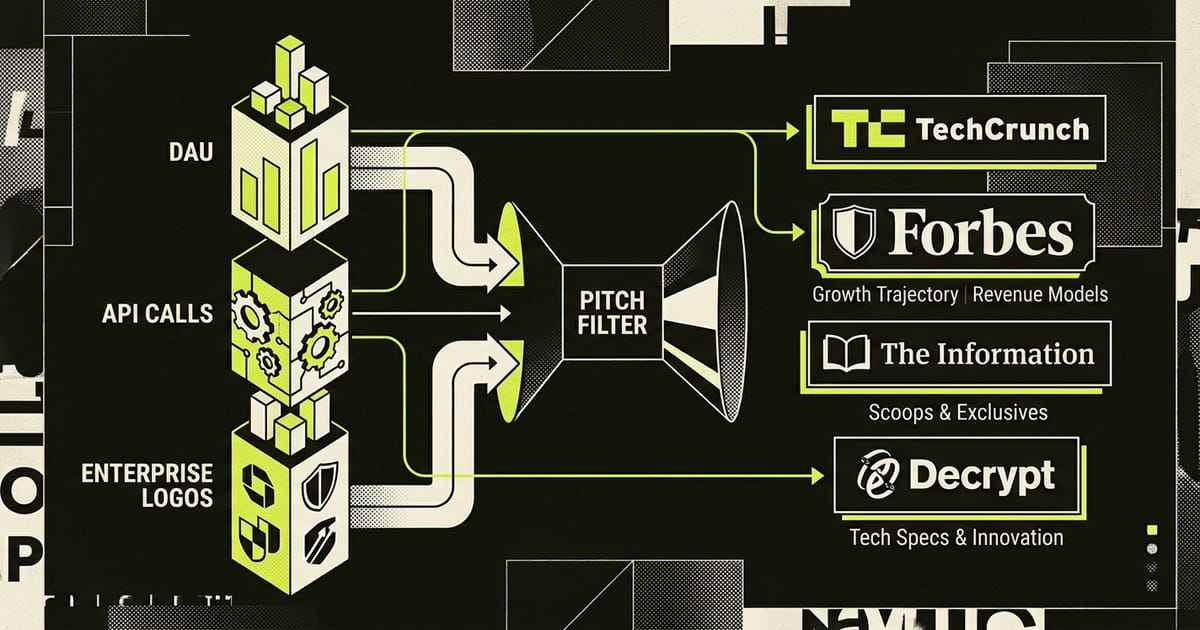
I've placed AI founders into Forbes, Decrypt, TechCrunch, and Blockworks. The single most common failure mode I see isn't bad companies or weak products. It's founders who treat every outlet like a press release distribution list and every metric like a bullet point. A DAU that would excite a TechCrunch AI desk reporter does nothing for a Forbes enterprise contributor. An API call volume that makes an infrastructure journalist's ears perk up reads like noise to a general tech editor.
This post maps which traction signals move which outlet, and shows you the framing patterns that turn a number into a pitch lead.
---
Why metrics alone don't pitch themselves
I put it plainly on X a while back:
"Most crypto companies don't have a product problem, but they have an explanation problem. Brilliant crypto products struggle to gain traction, not because the technology isn't good enough, but because the value isn't communicated clearly enough to customers, investors, and the media!" Shilika Jain on X, 19 Jun 2026
Same rule applies to AI startups. You can have real traction and still get ignored. The metric is the raw material. The framing is what makes it a story a journalist can file.
Every metric answers a different editorial question. Journalists aren't evaluating your business; they're evaluating whether their readers will care. A reporter writing for a developer audience asks "does this prove the technology works at scale?" A Forbes contributor targeting enterprise readers asks "what did this save or make for named customers?" Those are different questions. They need different answers.
---
Outlet-by-outlet: what each desk actually rewards
TechCrunch AI desk: revenue velocity and category claims
TechCrunch AI coverage in 2026 has one dominant axis: are you growing faster than the category baseline, and can you prove it?
The specific metrics that convert a TechCrunch pitch are revenue velocity figures with a time component ("ARR grew from $800K to $3.2M in seven months"), DAU growth rates tied to a product or model change, and pilot-to-paying conversion data that implies product-market fit rather than just pipeline. Notice what those all share: movement, not position. TechCrunch doesn't need to know where you are; it needs to know how fast you got there and whether the vector is defensible.
What doesn't work: a standalone DAU number with no growth context. "We have 40,000 daily active users" is a position. "We went from 4,000 to 40,000 DAU in 90 days after we shipped [specific model improvement]" is a vector with a cause attached. The cause is what the reporter can build a story around.
The other hook that consistently lands at TechCrunch is the category-defining moment: the metric that implies a market shift, not just company growth. "Our inference cost per query dropped 60% quarter-over-quarter, which we think closes the price gap with closed-source models for enterprise workloads" is a story about a market dynamic. "We reduced inference costs" is a press release sentence.
Forbes AI: enterprise logos and ROI economics
Forbes enterprise-focused AI coverage wants one thing: proof that named customers got a measurable outcome, in dollars or in time, that justifies the procurement decision.
The metrics that convert a Forbes pitch are pilot conversion rates paired with named (or clearly described) enterprise accounts, cost reduction figures tied to specific workflows, and time-to-value stats. "Reduced analyst review time by 40% for a Fortune 500 financial services firm" clears the bar. "Improved efficiency for enterprise customers" does not.
Forbes also responds well to logo density as a category signal. Not "we have enterprise customers" but "we've signed 12 enterprise accounts across three verticals in six months, with finance and healthcare each representing 40% of the mix." The distribution tells a story about which buyer is moving first. That's editorial content, not a product announcement.
The Forbes AI 50 list methodology is a useful signal for what the outlet values more broadly: technical rigor, revenue generation capability, customer traction, and quality of leadership. Those four dimensions map directly to the metrics that should anchor a Forbes pitch. Valuation and funding round size alone don't clear the bar. The business outcome attached to them does.
The Information: the metrics that move institutional capital
The Information covers AI companies when the data changes how institutional investors, senior operators, or fund managers think about capital allocation. That's a precise editorial test, and it screens out most pitch attempts.
The metrics that can unlock The Information are the ones that reveal category structure before the market has priced it in: net revenue retention above 120% in a new AI category (implying expansion and not just new logo growth), enterprise seat counts with a defensible competitive moat story attached, or adoption data that shows a workflow shift rather than a feature trial.
What The Information doesn't take: product launches, funding announcements that aren't strategically significant, or any metric that's impressive for your stage but not surprising at the category level. "3x ARR in 12 months" doesn't clear the bar. "10,000 enterprise seats in nine months with 94% net retention in a category that didn't exist 18 months ago" starts to get interesting.
For most early-stage AI startups, The Information is a milestone outlet, not an entry point. Build the record at TechCrunch, Forbes, and VentureBeat first.
Decrypt and trade press: developer proof and on-chain/API scale
For AI founders with a developer-facing product or a Web3 AI angle, the metrics that move Decrypt and trade publications like VentureBeat are API call volumes, developer registrations, and active node or compute utilization figures.
When I was running founder PR for GAIA's CEO Matt Wright and co-founder Shashank Sripada, the node count story was central: the cadence of coverage from Forbes to Decrypt to Benzinga was built around a repeating narrative of decentralized AI agents with node growth as proof. By the time Binance Square covered "Gaia Hits 400K Nodes," the number wasn't just impressive, it was already contextualized within a narrative the audience recognized. That's the compound effect of consistent metric-driven storytelling.
Developer-facing metrics work for trade press because they speak to the actual readers. A VentureBeat AI reporter covering infrastructure knows what 10 million API calls a day means operationally. They don't need you to explain it. Lead with the number, add the context ("that's a 5x increase since we switched from OpenAI to our own model routing"), and let the implication carry the weight.
---
The four AI metrics that translate across outlets
Not all metrics are created equal for press. These four are the most reusable across outlet types, because each one maps to a different reader question.
1. Revenue velocity (not revenue size) Absolute ARR is a position. ARR doubling time is a velocity. Journalists writing for investor-aware readers want velocity. Frame it as: "We went from $X to $Y in Z months" and add the inflection that caused the acceleration if you have one.
2. Inference cost reduction This is an underused hook. If your cost per query has dropped materially, that's a technology story (model efficiency), a business story (improved margins), and a market story (closing the price gap with incumbents) all at once. "Reduced inference cost by 43% through model routing" is three pitches in one sentence depending on which thread a reporter pulls.
3. Pilot-to-paid conversion rate Enterprise journalists and TechCrunch both respond to this. It answers the PMF question cleanly. "We ran 24 pilots in Q4 and converted 18 to paying contracts" implies you're solving a real problem, not just getting trials. Add the average deal size and the conversion rate becomes a unit economics story.
4. Enterprise logo density and vertical concentration Not just "we have Fortune 500 clients" but which verticals are moving first and at what pace. "Healthcare and financial services are converting at 2x the rate of our other verticals" is an editorial observation about which sectors are ready to pay for AI. That's a trend story a reporter can file independently.
---
The phrasing patterns that convert metrics into pitch leads
Most founders write metric-first subject lines. Journalists process stories, not dashboards. The fix is to frame the metric as the consequence of something the reader already cares about.
Weak: "We now have 50,000 DAU" Strong: "50,000 daily active users, up 4x since our model switch off GPT-4, with 68% seven-day retention"
The strong version has a cause (model switch), a velocity (4x), and a quality signal (retention). The reporter can write a story about the model switch decision. They can't write a story about a number that sits there.
Weak: "Our platform processes over 100M API calls per month" Strong: "We crossed 100M API calls per month in January, mostly from three verticals: legaltech, healthtech, and financial document processing. That concentration wasn't planned."
The unexpected concentration is the story hook. A journalist covering enterprise AI will want to understand why those three verticals moved first. That's an article.
Weak: "We've reduced costs for our customers" Strong: "Our median enterprise customer cut manual review hours by 38% in the first 60 days of deployment, which was faster than our own projected timeline."
The detail that it was faster than your own forecast signals genuine surprise and product performance beyond plan. Journalists value that because their readers distrust pre-planned success stories.
---
The common pitfalls
Pitching position metrics to velocity-focused outlets. TechCrunch AI reporters are comparing your growth curve to every other AI startup they've covered this month. A flat metric at any absolute level doesn't help them.
Sending the same metric package to every outlet. The GAIA work taught me this clearly. The node count story that was central for Decrypt and Binance Square was the background context for a Forbes pitch, which led instead with the enterprise partnership and governance angle. Same company, same metrics, different editorial front door.
Citing metrics you can't defend in a briefing. If a reporter asks for the methodology behind your DAU calculation and you can't answer in one sentence, don't lead with DAU. Journalists know the difference between sessions and unique users, between contracted ARR and recognized revenue, and between "processing" API calls and paying API calls. If you blur those lines, you lose the reporter permanently.
Waiting for a perfect metric. The best pitch timing is often one metric milestone ahead of where you think you should be. "We've hit 10,000 paying users and we're building toward 50,000 by end of year" is a story if the 10K happened in 90 days. You don't need to wait for 50K.
---
Before you pitch: a one-question filter
Ask yourself: "What does a reporter write in their headline if they cover this metric?"
If you can write the headline cleanly in under 10 words, you have a pitch. If you can't, the framing isn't done yet.
"AI startup cuts enterprise legal review time by 40%" is a headline. "AI startup achieves strong product metrics" is not.
That gap is the entire job.
---
If you want a specific teardown of your traction metrics and which outlets they're likely to move, book 30 minutes and we'll work through it.