
On this page12
- Why 12 weeks, not 4
- The 12-week map at a glance
- Weeks 12–10: Narrative and journalist mapping
- Weeks 9–7: Building the founder's editorial trail
- Weeks 6–5: Demo proof, customer quotes, analyst briefings
- Week 4: Op-ed live, community seeding starts
- Week 3: First embargo pitches, exclusive sequencing
- Week 2: Embargo locks and asset distribution
- Week 1: The T-72h rehearsal
- Launch day: compounding, not hoping
- The scenarios that change the playbook
- What you actually need to run this
The AI Startup Stealth-to-Launch PR Timeline: What to Do in Each of the 12 Weeks Before You Go Public
Most AI founders treat PR like a launch-day switch. They build for 18 months, then spend two weeks trying to get TechCrunch on the phone. It doesn't work. The 12 weeks before you go public are where the campaign is won or lost, and I've watched too many well-funded teams waste them.
What follows is the week-by-week playbook I run for AI founders. Not phases. Not vague principles. The actual work, in order, with the founder deliverables called out so you know exactly what I need from you and when.
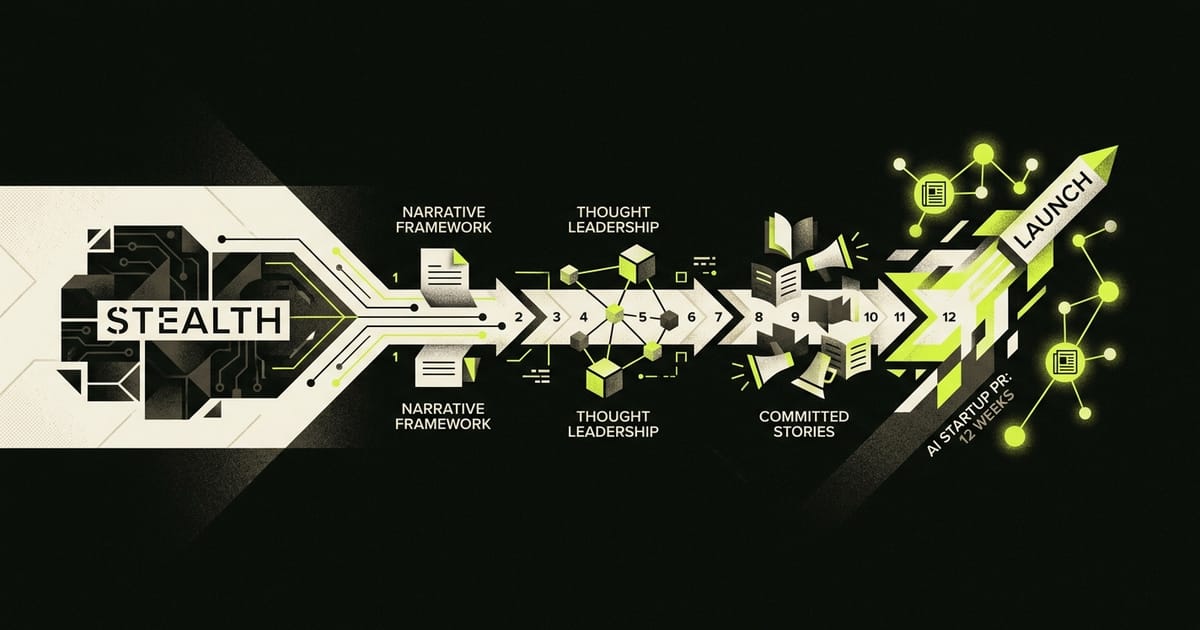
The goal by launch day: 4 to 6 committed stories from tier-1 outlets, not a press release and a hope.
---
Why 12 weeks, not 4
If you're inside four weeks of launch, you're already too late for tier-1 earned coverage. A journalist at Forbes, TechCrunch, or The Information needs time to run down sources, test your demo, brief their editor, and write a story that isn't just a reformat of your press release. That takes two to three weeks minimum from first contact. Which means you need the relationship in place before you ever send the pitch.
Twelve weeks gives you four things that a last-minute sprint can't manufacture: a founder editorial trail that gives a journalist context before you pitch them; a working demo that doesn't embarrass you; customer or design-partner quotes that you own; and an embargo sequence with enough committed outlets that launch day generates compounding noise rather than one story.
The AI press landscape adds one more wrinkle. Coverage in Forbes, TechCrunch, VentureBeat, and Decrypt's AI desk feeds directly into whether you appear in ChatGPT or Perplexity when an investor or enterprise buyer researches your category. If you're not in those AI-generated summaries, you effectively don't exist to a meaningful slice of your buyer pool. That's a PR problem that takes weeks to solve, not days.
---
The 12-week map at a glance
| Window | Focus | Primary owner |
|---|---|---|
| Weeks 12–10 | Narrative, positioning, journalist list | PR operator |
| Weeks 9–7 | Founder editorial presence, podcast seeding | Founder + PR operator |
| Weeks 6–5 | Demo prep, customer proof, analyst briefings | Product + PR operator |
| Week 4 | Op-ed placed, community seeding begins | PR operator + ghostwriter |
| Week 3 | First embargo pitches, exclusives offered | PR operator |
| Week 2 | Embargo locks confirmed, asset distribution | PR operator |
| Week 1 | Final rehearsal, T-72h checks, team briefing | PR operator |
| Launch day | Embargo lifts, social amplification, secondary wave | PR operator + founder |
---
Weeks 12–10: Narrative and journalist mapping
Nothing else matters until you've answered one question: what category does your product own?
Not what it does. What it replaces, why that replacement matters now, and why your team is the only one who can do it. That's the category frame. Everything in the next 11 weeks gets built on top of it.
I spend the first two weeks here. Category positioning doc. A one-sentence contrarian thesis that a journalist can put in a headline. Three talking points that prove the thesis. A list of what you're explicitly not (this is usually more useful than what you are).
The journalist list comes next. For an AI startup, the relevant desk reporters at Forbes Tech Council, TechCrunch AI, VentureBeat, The Information, AI Magazine, Decrypt's AI desk, and Wired. Mapped by beat, recent coverage, and angle affinity. Not a generic list of 200 names. Fifteen to twenty reporters who would genuinely care about this specific story.
Founder deliverable this window: A 30-minute working session to stress-test the category frame. You've been inside the product too long to see it the way a journalist will.
---
Weeks 9–7: Building the founder's editorial trail
A journalist who receives your pitch at week 3 will immediately Google you. If they find nothing, the pitch lands differently than if they find a Forbes Tech Council piece, three substantive X threads on the AI problem you're solving, and a podcast appearance from six weeks ago. The editorial trail does not need to exist before you launched. It needs to exist before you pitch.
Weeks 9 through 7 are where I build it.
Back in 2024, when I was running founder profiling for GAIA's CEO and COO, the approach was a steady cadence of founder interviews around one narrative — decentralized AI agents and node count as proof — that compounded into tier-1 pickup at Forbes and Decrypt. The same principle applies here. You don't need volume. You need consistency around a single thesis.
Concretely: one op-ed or byline placed in a relevant trade outlet (AI Magazine, VentureBeat, a sector-specific Substack with real readership). Two to three podcast bookings confirmed, with at least one publishing before launch week. An active founder voice on X and LinkedIn commenting on category-level news, not just your own product updates.
One thing I've said publicly about launch timing still holds:
wanna activate PR for a major launch/announcement? here's a quick strategy: - Create active thought leadership 1-2 month before the launch - Secure 1-2 podcasts/interviews 1 month before the launch - AMA - 15 days before the launch - Embargo press outreach: week before the launch Shilika Jain on X, 11 Oct 2024
The sequencing still works. The AI-specific version adds analyst briefings at week 6 and a demo proof requirement at week 5 that general startup PR skips.
Founder deliverable this window: Draft the op-ed. I'll shape and place it, but the first draft needs to come from you. Generic ghostwriting without your specific technical insight doesn't pass editorial review at the outlets that matter.
---
Weeks 6–5: Demo proof, customer quotes, analyst briefings
This window is where most AI startups fall down.
By week 5, you need a demo that runs in under eight minutes from cold start to visible outcome. The input should be something a journalist will recognize as real. The output should be on screen and screenshot-able. You should be able to explain what the product is doing at each step without jargon. A customer or design partner should be available to speak to a reporter independently.
If your demo isn't there yet, this is the moment to know that — not launch week.
Customer quotes are non-negotiable. Two to three customers or design partners who will go on record with specific, non-generic claims. "We reduced X by 40%" beats "the product is really impressive" every time. I collect these, draft them for the customers to approve, and get sign-off before the embargo pitches go out.
Analyst briefings are the AI-specific move that most startup PR playbooks skip. Gartner, Forrester, IDC, and smaller specialist firms like Moor Insights or Cambrian AI Research all keep coverage notes on AI infrastructure and vertical AI categories. A 30-minute analyst briefing at T-40 days doesn't generate immediate press coverage, but it does two things: it sharpens your narrative before you pitch journalists (analysts will tell you directly what's weak), and it seeds the category conversation that journalists will reference when they do their own analyst calls.
For enterprise-facing AI products, analyst credibility can also feed directly into the buyer diligence cycle. Skip it if you're pure consumer. Prioritize it if you're selling into healthcare, legal, fintech, or security.
Founder deliverable this window: Complete the demo to the standard above. Schedule and run analyst briefings yourself; analysts want founder access, not PR-filtered access.
---
Week 4: Op-ed live, community seeding starts
By T-28, the op-ed should be live and indexed. This is the piece that pre-sets the category frame before any journalist receives a pitch. It should be in the outlet a tier-1 reporter would see or respect, not on your own blog.
Community seeding starts here too. For AI startups, the relevant communities are specific: Hacker News, relevant Discord and Slack communities, AI-focused subreddits, developer forums if your product has an API. The goal isn't promotion — it's a trail of authentic engagement that a reporter can find when they're digging your background.
If you have a waitlist, this week is also when the drip sequence gets written. Pre-launch email subscribers who get a substantive, non-spammy update two weeks before launch become amplifiers on launch day. A 5,000-person engaged list outperforms a 50,000-person cold list every time.
---
Week 3: First embargo pitches, exclusive sequencing
This is the most operationally specific week in the entire timeline. Get it wrong and you lose your shot at the tier-1 placements you spent 10 weeks building toward.
I pitch the top two or three tier-1 reporters first. Exclusive offers go to one reporter at a time, in priority order, with a 48-hour decision window. If the first reporter declines, the exclusive moves to the next. Only after the exclusive is placed do I pitch the remaining outlets under standard embargo terms.
The embargo pitch is a short, specific email. Category claim, evidence (metric or customer name), demo access, available date for a founder call, embargo lift time. It's not the press release. The press release comes later. The embargo pitch is the hook that earns the reporter's attention.
Two things AI founders get wrong at this stage:
First, they pitch too many outlets simultaneously and create an exclusivity problem. A reporter who discovers you offered the "exclusive" to four others will drop the story. The exclusivity offer has to be real.
Second, they go dark after pitching. A reporter who can't get five minutes on the phone with the founder will produce a softer story or no story. When a reporter responds to the embargo pitch, I get the founder on a call within 24 hours. No exceptions.
Founder deliverable this window: Be available for media calls on one hour's notice. Block the calendar.
---
Week 2: Embargo locks and asset distribution
By T-14, I want four to six embargo confirmations in writing. "Confirmed" means the reporter has accepted the embargo time, their editor is aware, and fact-check questions are in flight. Verbal interest doesn't count as a confirmed story.
The press release gets finalized and locked this week. Not the generic boilerplate version — a version with the customer quotes, the specific metric claims, and the one sentence that a journalist could use as a lede. Short quotes from the founder. No "we are excited to announce" language anywhere.
Asset distribution to confirmed reporters: high-res product screenshots, logo files, demo video link, a press kit URL, approved customer contact details for independent quotes.
If you have a wire release scheduled (optional for AI startups — see my post on the wire service trap), it goes under review this week but doesn't publish until launch day.
---
Week 1: The T-72h rehearsal
Seventy-two hours before embargo lift, I run a final check on every confirmed story. Are the reporters still on track? Have any editorial priorities shifted? Is the embargo time confirmed down to the hour and timezone? Has any reporter broken ranks and published early?
This is also when I brief the full team: founders, co-founders, investors, design partners. Everyone who will be amplifying on launch day gets the timeline, the approved talking points, and explicit instructions on what not to say before the embargo lifts. One loose tweet from an excited team member has destroyed more than one well-run campaign.
The founder's launch day X thread gets drafted and reviewed this week. So does the LinkedIn post. Social copy that reads like a marketing announcement gets ignored. Social copy that reads like a founder talking directly to their community gets shared.
---
Launch day: compounding, not hoping
When embargo lifts — typically between 6am and 9am ET on a Tuesday, Wednesday, or Thursday — the stories should already be written. Your job is amplification, not creation.
The sequence: founder thread on X goes live. Lead investor amplifies. Confirmed design partners and customers post their own takes (you briefed them in week 2). The wire release publishes (if you're using one). Secondary pitches go to tier-2 and vertical trade outlets who weren't in the embargo.
For AI startups, this window is also when you push for AI search visibility. The launch day content — your post, your site update, your press release — should be structured for GEO: clear declarative sentences, citable claims, no marketing fluff. The tier-1 coverage that runs today will become what ChatGPT and Perplexity cite when someone asks about your category tomorrow.
Days 2 through 14 post-launch: follow-on feature pitches to outlets who ran wire coverage but didn't run a feature. Podcast appearances pre-booked to publish in this window. Regional syndication for APAC, India, or MENA if relevant.
---
The scenarios that change the playbook
Pre-seed or seed, no customers yet. Compress analyst briefings, lean harder on design-partner quotes rather than full customer case studies. The op-ed matters more here because it's often the only third-party signal of founder credibility. Target trade and developer-focused outlets (VentureBeat, The New Stack, Hacker News front page) over broad tech press.
Series A, enterprise-facing. Analyst briefings are mandatory. The exclusive pitch goes to The Information or Bloomberg first, not TechCrunch. Customer proof needs to be on-record with named companies, not anonymized "Fortune 500" references.
AI-native product with a consumer angle. Decrypt's AI desk, Wired, Fast Company, and niche AI newsletters (Latent Space, The Rundown) carry more weight with your buyer than Forbes or TechCrunch. Build the outlet list accordingly.
Coming out of stealth with a simultaneous funding announcement. The funding story and the product story are two different pitches, often to two different reporters. Don't conflate them. The funding exclusive goes to one reporter on the business desk. The product story goes to a separate reporter on the AI or product beat.
---
What you actually need to run this
Twelve weeks. A founder who will commit 30 to 45 minutes per week to deliverables. A demo that works. Two or three customers willing to go on record.
That's it. The rest is execution.
If you're inside 12 weeks from your launch date right now, book a 30-minute call and I'll tell you exactly where you are on this timeline and what to prioritize given the time you have left.