
On this page10
- Why one-wave launches fail
- Phase 1: Stealth coordination (T-minus 8 to 10 weeks)
- Phase 2: Narrative architecture and asset preparation (T-minus 6 weeks)
- The dual-audience problem every AI model launch has to solve
- Phase 3: Embargo selection and media outreach (T-minus 7 to 10 days)
- Launch day sequencing
- The benchmark framing trap
- The 30-day post-launch content sequence
- What to skip
- Where the fractional model fits
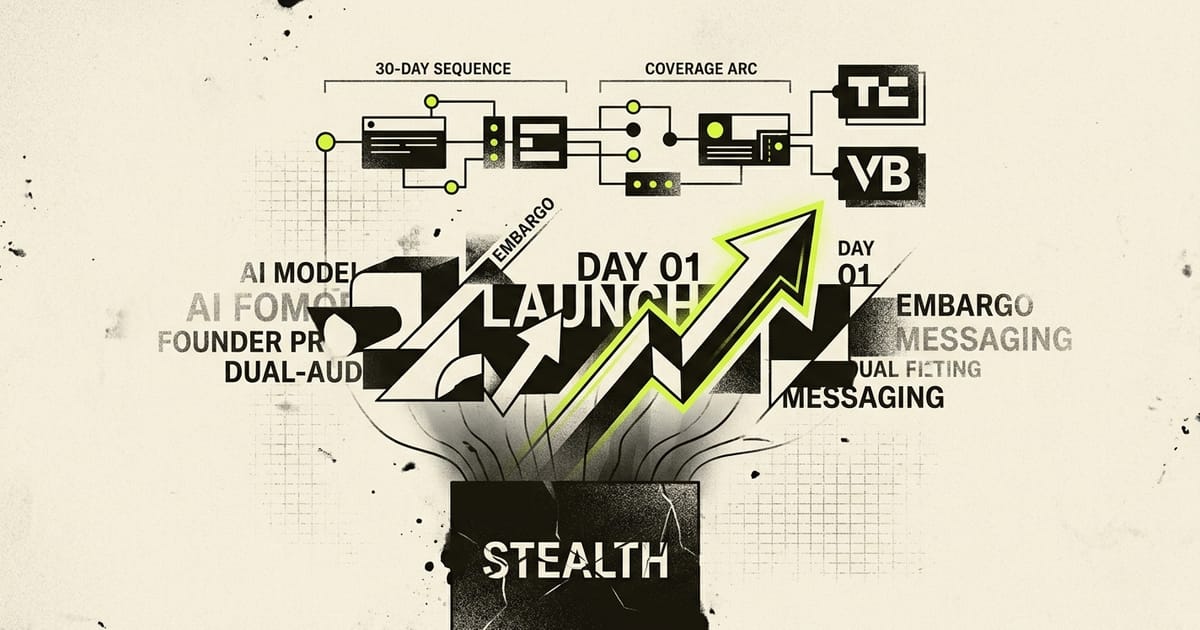
AI Model Launch PR: Stealth to Day-30 Coverage
Most AI model launches get one wave of press on day one, a few LinkedIn reposts, and then silence. The story dies because the founder treated launch day as the finish line instead of the starting gun.
I've run PR for AI founders across Forbes, Decrypt, Cointelegraph, and AI Magazine. The pattern is consistent. Founders who get sustained coverage across TechCrunch, VentureBeat, and The Information don't win on model quality alone. They win because they arrive with a communications architecture that was built 8 to 10 weeks before the press release was ever written.
This post maps that architecture, phase by phase.
---
Why one-wave launches fail
Before the sequence, you need to understand the structural problem.
The AI beat is the most competitive news vertical in tech right now. A reporter covering AI at TechCrunch or VentureBeat is receiving dozens of pitches a week from labs and AI product companies making nearly identical claims. "State-of-the-art performance," "outperforms GPT-4," "production-ready." Each one blurs into the next.
When a launch lands on a Tuesday and the story doesn't run until Wednesday and there's no follow-on content plan, the coverage window closes in about 48 hours. The journalist moves to the next story. Your model disappears.
The fix is not a louder press release. It's a communications arc that starts before you're visible and ends 30 days after the model ships.
---
Phase 1: Stealth coordination (T-minus 8 to 10 weeks)
The instinct is to stay quiet and save everything for launch day. That instinct is wrong.
The 8 to 10 weeks before launch is when you build the context that makes your day-one story legible. Journalists don't cover products in a vacuum. They cover products that fit into a story they're already tracking. Your job in this phase is to become part of that story before you announce anything.
What this looks like in practice:
- The founder publishes 2 to 3 short-form pieces or LinkedIn posts on the specific problem your model solves. Not about the model. About the problem. You're pre-seeding the narrative frame.
- You secure 1 to 2 podcast appearances that publish before launch. The topic is the category you're entering, not the product. This gives you a citation trail that journalists can verify.
- You brief 1 or 2 relevant analysts or researchers informally under NDA. When a journalist calls them to validate your claim later, they'll have context.
I wrote about this timing structure in a thread back in October 2024:
wanna activate PR for a major launch/announcement? here's a quick strategy: - Create active thought leadership 1-2 month before the launch - Secure 1-2 podcasts/interviews 1 month before the launch - AMA - 15 days before the launch - Embargo press outreach: week before the launch Shilika Jain on X, 11 Oct 2024
The AMA at T-minus 15 days is underutilized in AI launches specifically. A Hacker News Ask HN or a Discord session with developers does two things: it generates real feedback that can sharpen your launch messaging, and it creates an organic developer community moment that journalists sometimes pick up as a secondary story.
---
Phase 2: Narrative architecture and asset preparation (T-minus 6 weeks)
The most common failure mode at this stage is writing the press release first. Don't. Write the narrative framework first.
The narrative framework answers four questions:
- What is the named problem? Not "AI is slow" but the specific failure state your model fixes, stated in terms a business buyer and a developer would both recognize.
- What is the category frame? You are not launching "a model." You are launching a model that belongs to a named category a journalist can place in a story. If you're defining a new category, that's the story. If you're not, explain explicitly which existing category you're in and why you're better.
- What is the proof? Named design partners, actual usage numbers with consent, a benchmark result from an independent evaluation suite. Not internal comparisons to a two-year-old baseline.
- What is the stake? Why does it matter now? What breaks if this problem isn't solved?
Once the narrative is set, build your asset stack:
- The press release. Written from the narrative framework, not vice versa.
- The technical blog post. Architecture details, fine-tuning methodology, reproducible benchmarks. This is for developers. It goes live simultaneously with the press release, at a separate URL.
- The model card. Honest capability claims, known limitations, evaluation methodology. Journalists and researchers will check it. If it's missing or evasive, they'll say so.
- A short demo video. Under 3 minutes. The journalist's job is to understand your model fast enough to write 600 words about it. The demo does that in a way a PDF cannot.
---
The dual-audience problem every AI model launch has to solve
This is where most launch plans fall apart.
Your model announcement simultaneously has to speak to two audiences who want completely different things from the same story.
Developers want: architecture details, API access, benchmark methodology, honest limitations, licensing terms, fine-tuning instructions.
Business press wants: a clear narrative, contextual relevance, why this matters now, a named customer or use case, no jargon that needs a glossary.
These are not the same story. Trying to tell both stories in one document produces something that satisfies neither audience.
The solution is separate but coordinated assets pointing at the same launch moment. The press release goes to journalists. The technical blog post goes to Hacker News and your developer community. The model card goes on GitHub. All three go live at the same moment, all three tell one coherent story from their respective angles.
I saw this work well on the GAIA launch, where the narrative around decentralized AI agents ran in parallel tracks: a Forbes piece on the business case and a technical Decrypt piece on the architecture, both landing in the same 48-hour window. Neither story was trying to do the other story's job.
---
Phase 3: Embargo selection and media outreach (T-minus 7 to 10 days)
Pick one outlet for the exclusive. One. Not two.
A launch without an exclusive is a launch competing with every other announcement that day. Give one journalist enough access to write the story you want told, and they'll write it better than your press release could.
How to pick the outlet:
The AI beat has fragmented. TechCrunch has reporters covering enterprise AI, consumer AI, and AI infrastructure as separate beats. VentureBeat tends to run longer, more technical pieces for developer and enterprise audiences. Forbes runs AI under its tech section and gravitates toward business-impact angles with named enterprise customers. The Information and Semafor run deeper features that need more lead time and a stronger evidence base.
Match the outlet to your angle. If your model is an infrastructure play aimed at developers, VentureBeat's enterprise AI desk is a stronger fit than Forbes. If you have a named enterprise customer and a clear cost-reduction story, Forbes makes more sense.
Send the embargo pitch 7 to 10 days before launch, not 24 hours. The reporter needs time to do their own testing, run the benchmark claims, talk to your customers, and write a piece that goes beyond republishing your press release. A 24-hour embargo produces a news item. A 7-day embargo produces a feature.
What goes in the embargo package:
- The press release in full
- The technical blog post
- The model card
- A link to a working demo or API access
- Contact for 2 to 3 sources: the founder, one customer willing to speak on record, and one external researcher or analyst who can validate the claims independently
The external validator is the piece most founders skip. It's also the piece that makes the difference between a 400-word news item and a 1,200-word feature. Journalists covering AI have been burned enough by inflated benchmark claims that an independent voice who can say "I tested this and the numbers hold" is worth more than any quote from the founder.
---
Launch day sequencing
T-72 hours: Send a brief note to investors and advisors. Ask them to hold social posts until the story goes live. One investor posting "excited to announce our portfolio company X" before the embargo lifts burns the exclusive and damages the journalist relationship.
T-24 hours: Confirm with the journalist that everything is on track. Make yourself available for any last-minute questions.
Day zero:
- Story publishes at the agreed time
- Wire release goes out simultaneously (not as a substitute for earned coverage, but as a record and a distribution layer)
- Technical blog post goes live
- Model card goes live on GitHub
- Developer community post on Hacker News or the relevant Discord/Slack goes up
- Founder posts on X and LinkedIn, threads the key points, links to both the earned coverage and the technical post
- Secondary pitches go to 4 to 6 additional outlets simultaneously, citing the exclusive as social proof
The secondary pitches matter more than most founders realize. The exclusive runs. Then you send to VentureBeat, The Block, AI Magazine, and 3 trade outlets with: "TechCrunch ran the exclusive this morning, here's a different angle I'd like to offer you exclusively." The fact of the tier-1 coverage makes the secondary outreach land.
---
The benchmark framing trap
Don't lead your press pitch with benchmark scores.
A claim that your model achieves a specific score on MMLU tells a business journalist nothing actionable and tells a developer reporter something they'll immediately want to stress-test. If your benchmarks don't survive independent reproduction in the first 48 hours, the story that runs is about your failed benchmarks, not your model.
If you have benchmark results worth mentioning, they need three things: an independent evaluator, a recognized evaluation suite, and a real-world use case that explains why the benchmark number matters to someone writing a check. "Our model processes X faster, which means a financial services client can reduce API costs by Y%" is a benchmark story that lands. "We outperform Model Z on MMLU" is not.
Put the raw benchmark data in the model card and the technical post. Keep it out of the press release headline.
---
The 30-day post-launch content sequence
This is the gap in almost every AI model launch plan. Day one gets all the attention. Days 2 to 30 are where the compounding happens.
Days 2 to 7:
- Secondary outlet coverage publishes from the pitches sent on launch day
- Founder appears on 1 to 2 podcasts pre-booked to run in this window. The topic is the category story, not a product replay
- Developer adoption metrics (API calls, GitHub stars, community posts) start accumulating. Screenshot the milestones. These become pitch hooks for week two
- Respond to community feedback publicly. HN comments, Twitter replies, Discord threads. Visible founder engagement drives organic secondary coverage
Days 8 to 14:
- The milestone story. "X API calls in the first week," "Y companies in the waitlist," "Z unexpected use cases we didn't anticipate." Each of these is a pitch hook to journalists who didn't run the original story
- An op-ed from the founder running in a vertical outlet (AI Magazine, Decrypt's AI desk, or a vertical trade outlet that covers your specific use case). The op-ed is not a product recap. It's a perspective piece on the larger problem your model addresses
- A technical deep-dive post from an engineer on the team. Goes to Hacker News. Developers share technical content aggressively when it's honest about trade-offs and limitations
Days 15 to 30:
- A "what we learned" post from the founder covering unexpected use cases, community feedback, and what's changed since launch. This generates a second wave of coverage and signals to journalists that the story is still developing
- One or two partnership or integration announcements timed to land in this window, not on launch day. A named enterprise customer deploying the model is a better story on day 21 than it is on day one, because it proves real adoption rather than pre-launch hype
- Regional syndication if your audience has APAC, EMEA, or India components. The story that ran in TechCrunch on day one can be pitched to Nikkei AI, Economic Times, or APAC tech press as a localized angle with regional relevance
The goal of this 30-day arc is to stretch a single launch moment into 4 to 6 distinct news beats, each with its own story hook. The journalist who didn't cover you on day one has three more legitimate entry points by week four.
---
What to skip
Wire services as a primary channel. A wire release is a record, not a PR strategy. If you're paying a distribution service $500 to send your press release to 300 outlets, you are not doing PR. The posts that pick it up are aggregators. No journalist relationship has ever been built through a wire service.
Pre-briefing too many outlets. The moment you send your embargo to five outlets simultaneously, you have no exclusive to offer and you've made five reporters feel like they're on a mass list. One outlet gets the exclusive. Everyone else gets the secondary pitch after the story runs.
Benchmarks without reproduction paths. Every AI model launch that has damaged the founding team's credibility in the past 18 months has done so because benchmark claims didn't survive independent scrutiny. If you can't share the evaluation harness or point to an independent replication, the number doesn't go in the pitch.
---
Where the fractional model fits
Most early-stage AI labs and AI product companies can't justify a full agency retainer for a single model launch. The agency wants a 6-month contract, $15K to $25K per month, and will staff the account with a senior lead who disappears after the kickoff and a junior team who's never talked to a tier-1 AI reporter.
The structure that works at the launch stage is a senior operator embedded for the launch sprint: 6 to 8 weeks of intensive work building the narrative, mapping the journalists, coordinating the embargo, managing the launch day sequence, and seeding the 30-day post-launch content plan. Then a lighter fractional retainer for the thought leadership layer in the months that follow.
The launch creates the credibility. The thought leadership layer builds the AI-search presence that keeps generating inbound after the news cycle ends.
If you're 60 to 90 days out from a model launch and you don't have a communications architecture in place, that's exactly when this conversation needs to happen.