
On this page9
- Why On-Chain AI Is a Genuinely New PR Problem
- The Two-Layer Narrative Architecture
- Layer One: Build the shared thesis first
- Layer Two: Two separate stories, written separately, pitched separately
- The Demo Access Protocol
- Which Reporters Have Covered This Beat in 2026
- The Sequential Play: Forbes First, Then CoinDesk
- Two Startup Scenarios
- The Pitfall That Breaks Every Campaign
AI Agent On-Chain PR: Two Pitches, Two Rooms, One Thesis
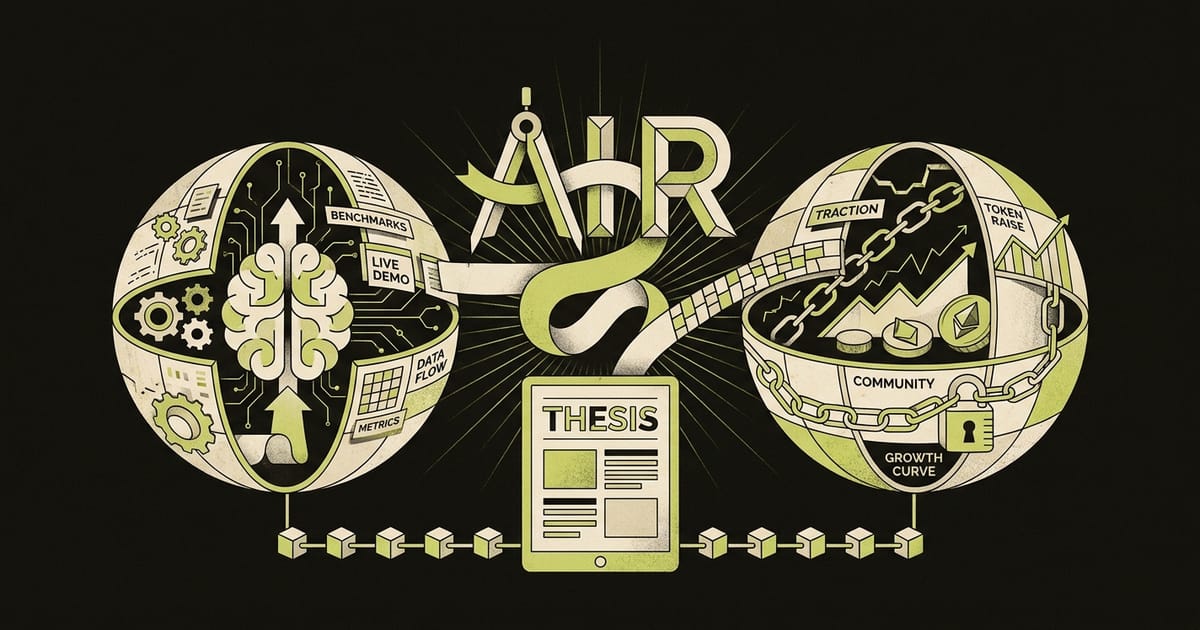
If you're building an on-chain AI agent project in 2026, you have the most structurally difficult PR problem in the current ecosystem. Your audience is split down the middle, and that split is not cosmetic.
The Forbes AI reporter wants sub-100ms inference latency and a demo environment they can poke themselves. The CoinDesk reporter wants the token raise, the on-chain traction numbers, and some signal that the community is real. Writing one pitch and broadcasting it to both rooms loses both rooms. The Forbes reporter skims "token generation event" and files it as crypto noise. The CoinDesk reporter sees "decentralized inference" and assumes it's marketing fluff without a live product.
I ran this exact problem building out the PR program for GAIA, a decentralized AI agent network. The campaign ran from late 2024 through mid-2025. We placed the founder Matt Wright and COO Shashank Sripada in Forbes, Decrypt, Benzinga, and CryptoDaily UK, plus a six-show podcast tour. The lesson that made all of it work: you do not write one pitch. You build one shared thesis, then write two completely separate stories underneath it.
This post is the full playbook. By the end you'll know how to construct the architecture, which journalist targets have actually covered agentic infrastructure recently, and how to set up demo access in a way that unlocks mainstream AI press coverage without burning the crypto relationship.
Why On-Chain AI Is a Genuinely New PR Problem
Most crypto PR challenges come down to hype management and timing. The project is real, the journalists understand the category, and the job is to pick the right moment and the right angle.
AI agent on-chain projects break this because the two audiences don't share vocabulary, evidence standards, or news clocks.
For the AI press, the credibility bar is high and the timeline is slow. Reporters at Forbes, TechCrunch, Wired, and VentureBeat are skeptical by training and look for things they can independently verify: benchmarks, demos, named enterprise customers, a technical paper they can actually read. A story that requires three background calls and a demo environment takes two to three weeks to close, minimum.
For the crypto press, the news clock runs on 24 to 72 hours. CoinDesk, Blockworks, The Block, and Decrypt move on launches, listings, token events, and on-chain traction signals. Their readers are your actual users, your investors, and your future protocol integrations. They want numbers they can anchor: nodes, TVL, active wallets, partnership names.
These are not the same story. Trying to force them into one pitch is what kills most campaigns before they start.
The Two-Layer Narrative Architecture
Layer One: Build the shared thesis first
The shared thesis is the one sentence that is true for both audiences and doesn't require either one to understand the other's vocabulary.
For GAIA, that sentence was something close to: "We're building the infrastructure for autonomous AI agents to transact on-chain, without a human in the loop." A Forbes AI editor can engage with that. A Blockworks crypto editor can engage with that. Neither has to translate it. Neither has to trust the other audience's frame first.
Your shared thesis is not a tagline. It's not a press release headline. It's the internal compass that keeps both pitches pointing at the same project. If you can't write it in one sentence, you don't have a clear enough product position to pitch anyone yet.
A few tests: Does the sentence contain a crypto term that would alienate a mainstream tech reporter? If so, rewrite it. Does it contain an AI term that would confuse a DeFi reporter? If so, simplify. Does it pass the "so what" test for both audiences? If a Forbes reporter reads it and asks "who cares," the thesis is too abstract. If a CoinDesk reporter reads it and asks "is this live or vapor," the thesis is too technical.
Layer Two: Two separate stories, written separately, pitched separately
The AI story goes deep on the technology and the evidence.
What is the agent actually doing that existing cloud inference doesn't do? What's the architecture decision that makes on-chain execution different from a standard API call? Who has tested it independently, and what did they observe? Can the reporter run a demo themselves?
This pitch should be longer, more detailed, and link to a demo or a technical artifact. The lead time is two to three weeks. You're not announcing anything in this pitch. You're inviting a reporter into a story they can own.
The GAIA Forbes piece "AI Agents 101: The Future Of Agentic Web And Onchain AI," published December 2024, worked because the pitch was a category play, not a product announcement. The reporter got to define the category. GAIA got to be the infrastructure example inside it.
The crypto story is shorter and tighter. What's the traction? Node count, active wallets, partnerships with named protocols, any exchange integrations. What's the token structure, and when does the community get involved? This pitch reads more like a brief, not a feature setup. The news hook is concrete. The timeline is days, not weeks.
For GAIA, the Binance Square placement around "Gaia Hits 400K Nodes" and the CryptoDaily UK interview with Shashank at Consensus Hong Kong worked because both had a hard traction number and a named event. The Decrypt piece "Gaia is Building 'Living Knowledge Systems' for AI Agents" hit because it framed the technology in Decrypt's product-focused voice, not the Forbes category voice.
Same project. Same week of news. Three different pitches for three different rooms.
The Demo Access Protocol
Mainstream AI press cannot be won without a demo. This is not negotiable in 2026. Reporters at Forbes, TechCrunch, and MIT Technology Review will not cover an on-chain AI project on the strength of a pitch and a whitepaper. They need something they can interact with.
The problem most founders have is that their demo environment is also their production environment, or the demo requires a wallet setup that takes 40 minutes and three browser extensions. Neither works.
Set up a sandbox environment that:
- Runs in a standard browser, no extension install required
- Has a guest API key or demo wallet pre-loaded with testnet funds
- Produces a visible on-chain output within 60 seconds of the reporter's first action
- Has one specific "show this" moment: an agent completing a task, a transaction settling, a knowledge query returning a verifiable result
Include the sandbox URL in the AI pitch, directly. Not "reach out if you'd like a demo." The URL, the guest credentials if needed, and one sentence on what to do when you land there. Reporters who can demo themselves write faster, deeper stories and don't need three rounds of back-and-forth.
For the crypto press, the demo matters less. What matters there is an on-chain explorer link. A block explorer showing 400,000 node addresses is worth more than any demo environment for CoinDesk's purposes. Give them the link. Let them verify it independently.
Which Reporters Have Covered This Beat in 2026
I don't publish reporter contact details. What I will tell you is where to look.
For the AI side: Forbes has a senior AI staff writer covering AI agents and agentic infrastructure. Forbes' Forbes Digital Assets section also has reporters who specifically cover the AI-on-chain crossover, and their July 2026 piece on BNB Chain and AWS launching self-banking agents shows that beat is actively staffed. The MIT Technology Review AI desk, VentureBeat's AI coverage, and Decrypt's AI section are all running agentic-infrastructure stories in 2026.
For the crypto side: CoinDesk's AI x crypto beat is active right now. A CoinDesk piece in October 2026 tracked AI agents completing 138 million on-chain payments through Coinbase's x402 protocol. That's the kind of traction data that gets a story filed. Blockworks covers the institutional finance angle. The Block covers deep technical protocol analysis. Decrypt has a clear voice for the consumer-facing and ecosystem-building angle.
The pattern I look for when targeting: which reporters filed a story on an agentic infrastructure project in the past 90 days, and what angle did they take? That angle is the blueprint for your pitch. Not a copy, a blueprint. You're giving them the next chapter in a story they've already started.
The Sequential Play: Forbes First, Then CoinDesk
This is the part most founders get wrong. They try to pitch both audiences simultaneously, and they burn the Forbes relationship by moving too fast.
For the GAIA campaign, Forbes came first. The December 2024 Forbes category piece established the narrative: decentralized AI agents, autonomous on-chain transactions, infrastructure for a machine-to-machine economy. That piece gave CoinDesk a reason to take the follow-on story. CoinDesk wouldn't have run it as a launch announcement. They ran it as a category story once Forbes had established the frame.
The sequencing logic is:
- Secure the Forbes or TechCrunch placement first. It takes three to six weeks. It requires demo access and background calls. It's slow.
- Use that placement as the credibility anchor when you approach CoinDesk, Blockworks, and Decrypt. "We were just covered in Forbes on the category angle. The crypto traction story is what we want to bring you."
- The crypto outlets take the traction story, not the category story. They link to the Forbes piece for context. Your project now has coverage in both rooms, with neither story stepping on the other.
Trying to run both pitches in the same week collapses this. Forbes reporters will pass if they think a crypto outlet is about to publish the same story. Crypto reporters will pass if they think it's already stale news from a magazine.
Two Startup Scenarios
Pre-seed or seed-stage: Don't chase Forbes yet. You don't have enough traction data for the crypto story, and you don't have enough product for the AI story. Focus on Decrypt, CryptoDaily, and one or two AI-focused newsletters. Build the demo. Get 10,000 nodes or wallets or an enterprise pilot you can name. Come back to the tier-1 targets when you have proof in both languages.
Series A or later, with live product: You're ready for the two-pitch architecture. The AI pitch needs a working demo, a named technical stakeholder available for background calls, and one clean benchmark claim you can defend. The crypto pitch needs a hard traction number, a named exchange or ecosystem partner, and a clear community narrative. Run the sequence. Forbes first, crypto trade press second.
The Pitfall That Breaks Every Campaign
There's a trap I see constantly, especially with well-funded projects that have good products.
They write one narrative document, usually the pitch deck investor story, and they send a version of it to both audiences. It reads like a whitepaper to the Forbes reporter and like a tech blog post to the CoinDesk reporter. Neither audience is being spoken to. Both pass.
The tell is always the same: the pitch contains the phrase "leveraging blockchain technology to enable AI agents" or some variant. That sentence means nothing to a Forbes AI reporter and sounds obvious to a CoinDesk reporter. It's the phrase you write when you haven't decided which story you're telling.
"builders build, PR's pitch lol" Shilika Jain on X, 28 Mar 2025
That's the real job. The founders I work with are building genuinely new infrastructure. The PR problem is not the product, it's the translation. And translation only works when you know exactly which room you're standing in before you open your mouth.
Build the shared thesis. Write two separate pitches. Set up the demo sandbox. Sequence Forbes before CoinDesk. The reporters are out there and they're actively filing stories on this category right now. They just need to hear the version of your story that was written for them.
---
Book a 30-min teardown with Shilika: calendly.com/shilikajain/30min