
On this page8
- Why the Media Landscape Is Genuinely Bifurcated
- Track One: The Crypto Press Narrative
- Track Two: The Gaming Press Narrative
- The Pixels Playbook: What Community-Driven Earned Media Actually Looks Like
- Building Your Parallel Pitch Infrastructure
- In-Game Events as PR Hooks Across Both Tracks
- The Journalists Who Actually Cover This Beat
- The Positioning Principle That Unifies Both Tracks
Web3 Gaming PR Playbook: How to Earn Coverage in Decrypt, Naavik, and Mainstream Gaming Press
Here is the uncomfortable truth most Web3 gaming founders discover too late: the pitch that lands you in Decrypt will actively repel a gaming journalist at Kotaku. And the story that gets you a feature in Naavik will get a "not for us" from CoinDesk's gaming vertical. The two audiences share almost no editorial DNA, and running a single unified pitch at both is the fastest way to get zero coverage from either.
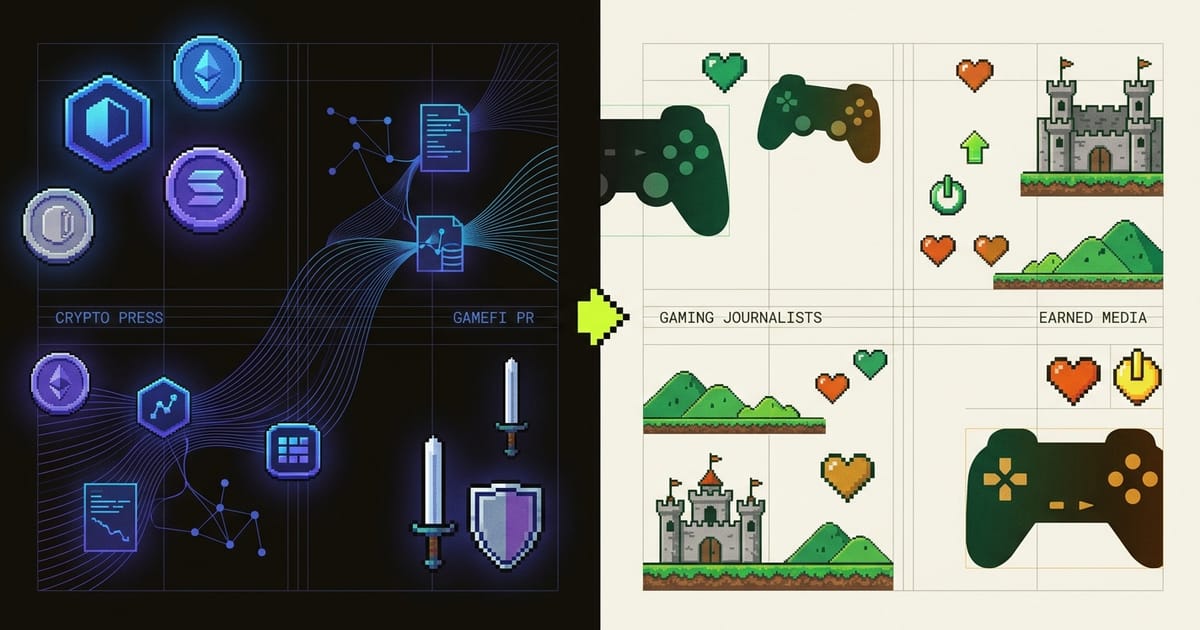
Web3 gaming sits at an awkward intersection. Crypto-native journalists want protocol depth: tokenomics, on-chain data, chain migration rationale, DAU figures verified against wallet addresses. Gaming journalists want player experience, genre fit, retention numbers, and the honest answer to a simple question: is this actually fun? The outlets are not interchangeable, the beats are not overlapping, and the journalists are not the same people. The solution is not to find a middle ground. It is to build two parallel narratives and know exactly when to deploy each.
This playbook walks through how to do that, and how to use your token launch, in-game event, or community milestone as a PR hook across both tracks.
Why the Media Landscape Is Genuinely Bifurcated
The blockchain media ecosystem has now split into two distinct poles. On one side sit crypto-native publications (Decrypt, CoinDesk, The Block, Blockworks) whose readers are your actual users, your investors, and your competitors. On the other sit mainstream gaming and tech outlets whose readers are traditional gamers, game developers, and general tech audiences who may have only a passing familiarity with blockchain.
These two groups have fundamentally different trust signals and editorial standards. Crypto journalists will fact-check tokenomics and challenge vague claims within minutes. They can read a whitepaper, interrogate vesting schedules, and spot a misleading DAU figure. Gaming journalists, by contrast, are often skeptical of blockchain elements by default. Years of poorly designed play-to-earn games and high-profile rug pulls have made mainstream gaming media treat Web3 coverage as inherently high-risk.
The result: the projects that consistently earn coverage across both tracks treat each outlet category as a separate campaign, not a single pitch.
Track One: The Crypto Press Narrative
Who covers Web3 gaming on the crypto side?
For crypto-native coverage, your target outlets are Decrypt (which has a dedicated games section), CoinDesk's gaming and DeFi verticals, The Block for on-chain data stories, and Blockworks for institutional and protocol-level angles. Beyond these, Decrypt has become the most natural home for Web3 gaming coverage that blends token mechanics with player experience.
For research-focused gaming coverage with crypto fluency, Naavik is the outlet that matters most. Naavik is a research, consulting, and advisory firm enabling games industry professionals to master the business of gaming. It has expanded its focus to blockchain games and covers studios like Immutable and the broader on-chain gaming economy. Getting a deep-dive or analyst mention in the Naavik Digest reaches game developers, investors, and publishers who are actively evaluating Web3 gaming as a sector. This audience is analytically sophisticated and will not be moved by token price speculation. They respond to data on retention, monetization design, and game-economy sustainability.
What the crypto press wants from your pitch
Verifiable on-chain data is table stakes. If you claim 1 million daily active users, the journalist will check Token Terminal, DappRadar, and on-chain wallet data independently. Pixels did this right when it reported its user milestone with supporting data, earning coverage in CoinDesk and The Block that explicitly cited chain-level verification.
Protocol architecture is the second requirement. Which chain, why that chain, and what the migration rationale was if you moved. When Pixels migrated from Polygon to Ronin in November 2023, that was itself a newsworthy event. It signaled strategic alignment with an ecosystem built specifically for gaming, and the decision had a verifiable on-chain footprint that journalists could independently verify.
Token economy mechanics need to be explained clearly, not hyped. A clear explanation of how the dual-token or single-token model works, what the sinks are, and how you are managing emission rates is essential. The crypto press is deeply skeptical of GameFi token launches after watching more than 90% of gaming-related token generation events fail to maintain value post-launch.
Community-governance transparency is a pitch asset, not just good community management. The PIXEL token's approach gave players a voice in the community treasury with clear timelines. The team publicly provided at least three days' notice before any token launch and warned the community against scams. That transparency generated trust signals that made the story pitchable to journalists who had grown numb to announcement-driven GameFi PR.
Your crypto press hook options
A token launch or TGE is the obvious hook, but a token announcement alone is not coverage. It is a press release. The editorial angle needs a "why it matters" layer: a new on-chain primitive, a novel tokenomics design, or a measurable outcome from your play-to-airdrop campaign.
An on-chain growth milestone works when it is verified and linkable. A confirmed DAU or unique wallet figure that can be cross-referenced by the journalist belongs in the first paragraph of your pitch. Make it easy by linking directly to the chain explorer, not your own dashboard.
A chain migration or infrastructure upgrade is a legitimate hook when it comes with a clear business rationale and before-and-after metrics.
Original data from inside your economy is the most underused hook in GameFi PR. Return on Reward Spend ratios, token burn rates, in-game GDP metrics. Any proprietary signal that tells a story about the health of your player economy is genuinely newsworthy in crypto media.
Track Two: The Gaming Press Narrative
Who covers Web3 gaming on the mainstream gaming side?
The picture here is harder. Traditional gaming press (IGN, Kotaku, Eurogamer, PCGamer, GamesIndustry.biz) has historically been hostile to blockchain gaming coverage, partly because of reader backlash and partly because much of what was pitched was objectively not worth covering as a game. The play-to-earn wave produced a wave of projects that were, as one industry analysis put it, "glorified spreadsheets with a token attached," and gaming journalists learned to be skeptical.
What has changed in 2026 is that gaming press is increasingly willing to cover Web3 games that lead with gameplay quality and treat the blockchain layer as a backend feature rather than the headline. GamesIndustry.biz and GAMES.GG have expanded Web3 coverage. Naavik, which sits astride both worlds, is arguably the single best outlet for a story that has both gaming and crypto credibility.
What the gaming press wants from your pitch
Gaming press will not cover a game they cannot honestly recommend. The shift that smart GameFi founders made was from "play-to-earn" messaging to what one successful studio described as "fun game, earn on the side." That is a genuine reversal in editorial priority, and it is what makes gaming journalists willing to write the story at all.
The blockchain layer needs to be invisible to players who do not want to see it. Studios that have built wallet creation into onboarding so seamlessly that players do not encounter gas fees until they try to move an asset off-chain are far more pitchable to gaming press. The technology becomes a foundation, not a feature players must manage.
Market size and player behavior data need to exist. Gaming journalists respond to genre analysis, DAU/MAU ratios, session length, and retention curves. These are the same metrics they would evaluate for any Web2 title.
A real player community is the most important signal. Community-driven organic behavior (player-organized tournaments, player-built subcultures, player-created guides) is what gaming press uses to distinguish genuine games from token schemes. If your Discord looks like a price-speculation channel, no gaming journalist will write about you.
Your gaming press hook options
A beta launch or major content update is the cleanest gaming press hook. A new season, a major gameplay mechanic, or a new map is legitimate gaming news. Lead with gameplay, not the token.
Player behavior data works when it tells a genuinely interesting story. If your players are organizing in-game economies, building emergent social structures, or doing something unexpected inside your world, that is a feature story for gaming press.
A crossover genre comparison creates an editorial bridge for gaming journalists who are not fluent in Web3. Framing your game in relation to familiar titles (what Stardew Valley looks like when players truly own the farm) gives the journalist a hook they can explain to their audience without needing to explain the blockchain layer.
A player-driven human story is the hook that actually gets run. A compelling individual player story (someone who built an in-game business, organized an event, or created something remarkable) is the human angle gaming press publishes. Find those players, document their stories, and make the introduction easy for journalists.
The Pixels Playbook: What Community-Driven Earned Media Actually Looks Like
Pixels is worth examining not because it had the biggest marketing budget, but because its earned media approach worked across both press tracks. The game scaled to over 1 million daily active users on the Ronin Network by prioritizing a social, community-driven experience. Players built micro-communities, crafted fresh gameplay styles, and hosted in-game events with hundreds of attendees.
The PR implications of this approach were significant. The crypto press covered Pixels because the on-chain data was striking and independently verifiable. Ronin's user base grew over 700% since the start of 2024, driven primarily by Pixels, and that growth was faster than Solana's meme coin-fueled DeFi landscape and TON during the same period. The gaming angle worked because the game was genuinely social. It was built as a community experience first, with blockchain ownership layered underneath in a way that enhanced rather than dominated the gameplay loop.
The token launch itself was handled with transparent community communication. Explicit warnings against scams, advance notice of timing, and a founder who communicated directly with the player base. That transparency became a PR story in its own right. Responsible token launch communication is rare enough that it is genuinely newsworthy in crypto media, and it gave mainstream outlets a "responsible Web3 company" angle they could run without caveating the entire story.
The lesson is not "copy Pixels." The lesson is that community-driven behavior generates a constant pipeline of earned media hooks that no ad budget can replicate. Your Discord is a newsroom if you are paying attention to what is happening inside it.
Building Your Parallel Pitch Infrastructure
Before you pitch anything, map your story to the outlet:
| Story element | Crypto press angle | Gaming press angle | |---|---|---| | Token launch | Tokenomics architecture, vesting, community allocation | What the token unlocks for players; optional or required? | | DAU milestone | On-chain verification, chain-level growth | Session data, retention curves, genre comparison | | Chain migration | Technical rationale, transaction costs, ecosystem fit | Invisible to players; smoother onboarding result | | In-game event | On-chain prize pool, token mechanics | Community organization, player turnout, what happened | | Player economy data | Token velocity, burn rate, RORS metric | In-game GDP, player trade volume, economic complexity |
The two-track pitch workflow
Build a media list that explicitly separates crypto-native from gaming press contacts. Do not use the same pitch template for both columns.
Lead with the gaming angle for gaming press. Never lead with the token. The blockchain layer should appear in paragraph three, minimum.
Lead with the protocol angle for crypto press, but always anchor it to player behavior data. Tokenomics without users is a whitepaper, not a story.
Use community milestones as the trigger for gaming press outreach. Player-organized events, viral in-game moments, and retention data are the hooks that gaming journalists can write for their audience.
Use token events and on-chain data as the trigger for crypto press outreach. The data needs to be independently verifiable. Link to the chain explorer, not your own dashboard.
What kills Web3 gaming PR pitches in both tracks
Unverifiable user claims are the fastest way to permanently damage a journalist relationship. They will check, and if the numbers do not hold, you will never pitch that journalist again.
Token-first messaging sent to gaming press gets deleted without a reply. A pitch that leads with earning potential will signal immediately that you do not understand the outlet.
Gameplay-only messaging sent to crypto press creates suspicion. If you cannot explain the token model and the on-chain architecture, crypto journalists assume you are hiding something or that the product has not been built yet.
Sending the same press release to both tracks reads as lazy and signals you do not understand either audience.
In-Game Events as PR Hooks Across Both Tracks
In-game events are the most underused PR asset in Web3 gaming because studios think of them as community management, not communications. They are both.
A well-documented seasonal event with measurable player participation data generates two distinct stories simultaneously. For crypto press, the story is the economic activity generated by the event: how many tokens circulated, how the prize pool was funded, what happened to token velocity during the event window. For gaming press, the story is the social dimension: how players organized, what player-created content emerged, whether the community grew during the event.
The key is documenting the event as it happens. Stream data, player participation counts, community content, and economic metrics all captured in real time and packaged for journalists after the event. A post-event data brief sent to targeted journalists with genuine numbers is far more pitchable than a pre-event press release.
The Journalists Who Actually Cover This Beat
On the crypto side, Decrypt's games coverage team and CoinDesk's Web3 ecosystem reporters are the primary targets for product-focused stories. Naavik analysts are best approached with research collaboration or data-sharing pitches. They are not a traditional outlet, and they respond best to founders who can contribute analytical depth, not just announcements.
On the gaming side, GamesIndustry.biz covers the business of games at a level that includes blockchain as an industry-structure story. Specialist outlets like BlockchainGamer.Biz and PlayToEarn cover the sector vertically. For crossover stories with genuine mainstream appeal (a viral player behavior, an economic phenomenon inside a game that non-gamers might find interesting), the New York Times has covered Web3 gaming at exactly this angle, as it did with the Pixels and Philippines play-to-earn resurgence story.
The pattern across all of these outlets: journalists respond to independently verifiable data, genuine player behavior, and founders who understand the difference between a press release and a story.
The Positioning Principle That Unifies Both Tracks
The one framing that works across both crypto and gaming press is this: the blockchain layer should enhance the game, not define it.
Gaming journalists need to know the game stands on its own as entertainment. Crypto journalists need to know the token economy is structurally sound and not dependent on constant new entrants. Both audiences are asking the same underlying question from different directions: is this real, or is this a token scheme dressed up as a game?
The projects that earn consistent media coverage across both tracks are the ones with honest, defensible answers to both versions of that question, backed by the data to prove it. Build the data infrastructure before you build the pitch. Document community behavior before you write the press release. And if you cannot answer "is this actually fun?" with evidence, solve that problem first.
Everything else in this playbook follows from that foundation.