
On this page8
How to Pitch CoinDesk, The Block, Blockworks, and Decrypt in 2026: A Beat-by-Beat Reporter Map
There's a version of this post that lists email formats and tells you to "personalize your outreach." You've probably read it. It didn't help. This is not that post.
Pitching tier-1 crypto outlets without knowing each reporter's beat is the single fastest way to burn a relationship before you need it. The inboxes at CoinDesk, The Block, and Decrypt are not undifferentiated queues waiting for compelling material. They are filtered in the first five seconds by source recognition, subject line specificity, and news value. If your pitch fails those three gates, the body copy never gets read.
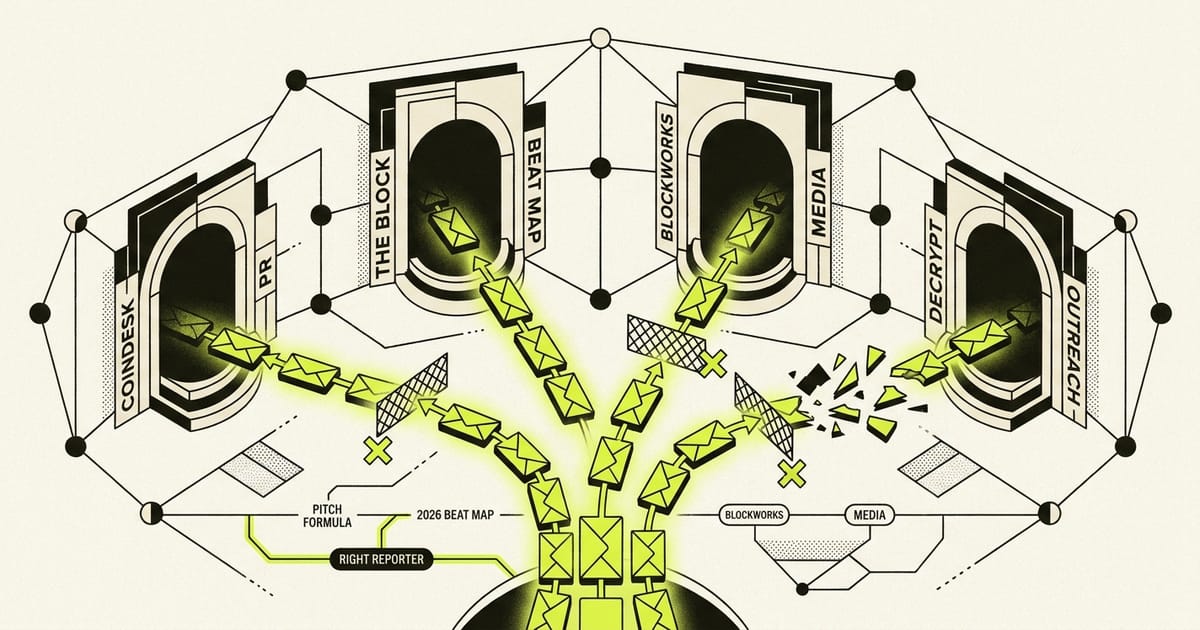
This post maps the active beats at each outlet, names the reporters currently owning them, explains what each newsroom rewards and penalizes, and gives you a pitch structure you can use immediately.
One structural note before we begin: Blockworks shut down its news division in October 2025, pivoting toward data and analytics. Newsletters and podcasts continue. That changes what you can pitch to the Blockworks brand, and we cover it below.
The 2026 Landscape First
Two structural shifts make pitch quality matter more this year than it did two years ago.
First, reader attention has moved from search results to LLM answers. Journalists now cover stories that surface in those answers more often, because those are the stories readers arrive with questions about. A pitch built around a narrative that AI engines are actively surfacing gets traction faster.
Second, newsroom capacity has kept shrinking. Crypto media headcounts have not grown alongside the volume of inbound pitches, so the per-pitch attention budget is smaller than it was. The reporters covering exchanges, tokens, and protocols often understand the technology better than the firms pitching them. Volume does not move them. Specificity, data, and respect for their beat do.
The specialist crypto press, which includes CoinDesk, The Block, and Decrypt, sets category credibility. Coverage in this tier signals to the rest of the industry that a company is real and that its news is substantive. It is the first audience for launches, protocol news, and original research. Each outlet in this tier rewards different inputs. Understanding that difference is the whole game.
CoinDesk: The Paper of Record
CoinDesk is the category's broadest outlet, covering markets, policy, protocol, and institutional finance. Think of it as crypto's paper of record.
What CoinDesk rewards: Exclusivity and embargo. CoinDesk works on embargo and rewards advance, substantive access. It is the right home for category-defining announcements and original data. A CoinDesk reporter wants a clear news hook, a verifiable claim, and access to a named executive.
What CoinDesk penalizes: Fluff and regulatory imprecision. The outlet prefers regulatory and institutional angles and deprioritizes promotional content with no substance behind it.
The masthead, by beat:
CoinDesk's editorial team is cleanly structured by vertical. The masthead as of mid-2026 includes:
- Ian Allison, Senior Reporter: Investigative focus, exchange-level stories and institutional finance. His track record of breaking major stories before competitors has made him one of the most closely watched reporters in the space. His reporting on FTX's deteriorating balance sheet weeks before the collapse demonstrated the value of deep source cultivation.
- Will Canny, Finance Reporter: Markets, exchange fundraising, IPO activity, and institutional deal flow.
- Helene Braun, Exchanges and TradFi Reporter: Traditional finance crossover, exchange infrastructure, and TradFi integration stories.
- Nikhilesh De, Managing Editor, Global Policy and Regulation: Regulators, lawmakers, and institutions. He won a Gerald Loeb award as part of CoinDesk's FTX coverage and was named the Association of Cryptocurrency Journalists and Researchers' Journalist of the Year in 2020.
- Jesse Hamilton, Deputy Managing Editor, Global Policy and Regulation: Washington-based, covering the SEC, CFTC, Federal Reserve, Treasury, and Congress. Before CoinDesk, he spent more than a decade covering Wall Street regulation at Bloomberg News.
- Omkar Godbole, Managing Editor, Markets: Markets and price-level analysis.
- Margaux Nijkerk, Tech Reporter, Protocols: Protocol-layer news and infrastructure.
- Sam Reynolds, Senior Reporter, Asia: Asia-Pacific markets and regulatory developments.
CoinDesk sections include Markets, Policy, Tech, Finance, and the Consensus Magazine. When you pitch, identify which section your story belongs in, then look up the reporter who owns that section. Sending a protocol story to a policy reporter signals you did no homework and trains that reporter to ignore your next message.
CoinDesk also distinguishes clearly between editorial and sponsored content. Sponsored placements offer visibility but carry no editorial endorsement. Editorial coverage operates independently and cannot be influenced by payment. The credibility that makes CoinDesk valuable comes precisely from that separation.
Pitch signal for CoinDesk: Regulatory implication, institutional angle, or original data with a named and available executive ready to go on record. If your story touches the SEC, CFTC, Treasury, or a market structure issue, Jesse Hamilton or Nikhilesh De are the right starting points. If it involves exchange-level activity or institutional deal flow, start with Ian Allison or Will Canny.
The Block: Research-Led and Unforgiving of Hype
The Block is research-led and markets-focused, with a readership weighted toward institutional and professional audiences. It rewards substance: data, structure, and balance-sheet reality. It is unforgiving of hype.
Much of the deeper content sits behind a Pro subscription, and that subscription model tells you something about the audience. The readers paying for access are professionals, not retail participants looking for price speculation. Your pitch needs to serve that reader.
What The Block rewards: Protocol-level depth, on-chain specifics, institutional finance, and data-backed claims. The Block distinguishes itself with deep analysis based on verifiable data. If you have on-chain data, verified metrics, or a source in institutional finance who can go on record, The Block is the right outlet.
What The Block penalizes: Narrative without numbers. Pitch it numbers and named sources, not narrative.
Active beats and team members:
The Block's team covers several clear verticals:
- Sarah (Policy and Regulation Reporter): Securities regulation, legal developments, and legislative tracking. She previously reported on securities regulation at CQ Legal, which is directly relevant to crypto's current regulatory moment.
- Naga (Markets Reporter): Crypto markets, institutional finance, fund flows, DeFi infrastructure, and capital market shifts. Five-plus years across the NFT boom, the FTX collapse, and the bitcoin ETF era.
- Danny Park (East Asia Reporter): Web3 developments and regulatory news from Korea and the broader Asia-Pacific region.
- Timmy Shen (Asia Editor): China-related reporting and Asia tech coverage.
- James Hunt (Deputy Managing Editor): Oversight of daily news and the Daily newsletter.
The Block also produces original research reports on DeFi, markets, and capital formation. If you have data that adds to those research verticals, a tip or briefing to the relevant reporter can generate significantly more traction than a press release.
Pitch signal for The Block: Lead with a number. Specific TVL figures, fund flow data, verified on-chain metrics, or a named institutional counterparty. If your pitch requires the reporter to trust your characterization rather than verify your claim, it is not ready for The Block. Verification-readiness is the threshold.
Blockworks: The Pivot You Need to Understand
In October 2025, Blockworks shut down its news division and laid off its journalism team, pivoting to its data and analytics business. The decision was announced by co-founder Jason Yanowitz, who cited the rapidly growing data business and changing audience behavior. Senior news editor Katherine Ross, economic and policy reporter Casey Wagner, and senior reporter Ben Strack all confirmed their exits.
Blockworks' flagship newsletters, podcasts, and the Digital Asset Summit conference continue. The company is expanding its Blockworks Intelligence and data platform, aiming to become a primary data destination for digital asset professionals.
What this means for PR pitching in 2026:
The traditional Blockworks editorial newsroom pitch is no longer available. If your instinct was to pitch Blockworks journalists on an institutional-angle story about ETFs, treasury allocation, or macro-crypto, those reporters have dispersed. Several are likely at other outlets now, so track their bylines on LinkedIn or Muck Rack before pitching.
What remains at Blockworks is the podcast ecosystem and the institutional event calendar. The podcast network, including the Empire podcast, goes deeper on market structure and macro context than most crypto media. These shows are a distinct pitch surface from a traditional newsroom. If your founder or executive can provide genuine insight on institutional capital flows, macro positioning, or market structure, a podcast booking is a legitimate and valuable channel.
For editorial coverage of the institutional and macro angles that Blockworks once owned, redirect those pitches to The Block and CoinDesk's Finance and Markets teams.
Decrypt: Accessible Storytelling, Broader Narrative
Decrypt covers the same crypto universe with a different editorial stance. Where The Block rewards institutional depth, Decrypt wants accessible storytelling that connects crypto to broader culture, business, or technology trends. It is the most accessible option in the tier-1 set, covering news with genuine effort to explain what events mean for readers who may not already know.
What Decrypt rewards: Narrative clarity, cultural connection, and stories that a technically engaged but non-specialist reader can follow and share. Decrypt covers DeFi, proof-of-stake, NFTs, new tokens, and broader cultural crossovers.
What Decrypt penalizes: Jargon without translation. A pitch full of protocol-layer terminology with no human angle will not move a Decrypt reporter. The outlet is also competitive about exclusivity. News offered to Decrypt after it has already been written up elsewhere is not news.
Pitch signal for Decrypt: Start with the story, not the technology. Lead with the change this creates for an actual person or a recognizable industry dynamic. If the best version of your pitch requires three paragraphs of technical context before you can explain why it matters, rewrite the pitch so the mattering comes first.
The 200-Word Pitch Formula
Crypto editors at major outlets receive between 200 and 500 pitches a day. Most get scanned for less than five seconds. When an editor opens their inbox, three filters run before any body copy gets read: they check the source, they check the subject line for specificity, and they check whether there is genuine news value.
The body copy only gets read if the pitch passes the scan. Here is how to structure the 200 words that follow:
Line 1 (the hook): State the news in plain language. Not "pleased to announce" or "excited to share." State what happened or what changed. The first sentence should be a sentence a reporter could use as a headline.
Lines 2 and 3 (the why-now): Explain why this matters this week, not this quarter. Founders frequently write what is happening and skip the timing argument. Editors are looking for the angle, not the announcement. Give them the angle.
Lines 4 and 5 (the data layer): One or two specific, verifiable figures. A dollar amount with a named counterparty. A growth rate with a timeframe. A before-and-after comparison. This is the signal that you have done the work and that the reporter can verify your claim.
Line 6 (the source): Name the executive available to speak, their title, and their availability. The reporter should not have to ask whether they can get a quote on record.
Line 7 (the outlet-specific flag): One sentence explaining why this story belongs at this outlet, for this reporter. This is where beat research pays off.
Send it to one or two reporters by name, not to a list. Personal pitches outperform broadcast pitches by a factor most founders significantly underestimate. The subject line should contain the news, not an announcement noun. A subject line that reads like the start of a story gets opened. A subject line that reads like a press release header does not.
The Errors That Kill Relationships
The most common failure is a pitch sent to a reporter who does not cover that beat. It signals the firm did no homework and trains the reporter to ignore the sender.
Beyond beat mismatch, the kill-list includes: unsubstantiated superlatives, partnership announcements with no substance behind them, price talk, walls of jargon with no news inside, and aggressive follow-up after the pitch. Three or more follow-ups in a short window ends relationships.
Crypto reporters are unusually expert. They understand the technology, they know the on-chain data, and they have seen every version of inflated claim the market produces. The reporters who cover this beat often understand the technology better than the firms pitching them. A pitch that respects that knowledge becomes a durable channel. A pitch that ignores it closes one permanently.
Before You Pitch: The Pre-Send Checklist
- Read the reporter's last five published pieces. Their published work tells you what angles they are open to and what topics they have already covered thoroughly.
- Verify the reporter is still at that outlet and still on that beat. Journalists move publications and beat assignments frequently.
- Test the subject line. If someone outside your project cannot identify why the story matters from the subject line alone, rewrite it.
- Strip the body copy. Most crypto press releases run twice as long as they need to. The cuts almost always improve them.
- Confirm your executive is available and briefed. A reporter who calls and gets a communications hold loses confidence in the pitch immediately.
The tier-1 crypto press is too knowledgeable to be moved by anything less than specificity, and knowledgeable enough to become a durable channel when the pitch respects the beat. That is the whole framework. Everything else is execution.