
On this page7
- Why the 48-Hour Window Is Real and Why It Closes Fast
- The Regulatory Monitoring Stack You Need
- Pre-Drafting: The Scenario Playbook
- The Channel Split: Where to Pitch and What Each Outlet Wants
- Legal Guardrails: What You Cannot Say
- Pitching Journalists: The Mechanics
- Building the Infrastructure Before the Next Announcement
Regulatory Announcement PR: How Web3 and AI Founders Should Respond to SEC, MiCA, and GENIUS Act News Cycles
Every major regulatory announcement in crypto creates two groups of founders: those who get quoted in the follow-up coverage as experts, and those who watch from the sidelines while competitors shape the narrative. The distance between those two groups is not expertise. It is preparation and speed.
2026 has already delivered a cascade of market-moving regulatory events. The SEC and CFTC issued a landmark joint interpretive release on crypto asset taxonomy. The GENIUS Act's implementation rules are stacking up across multiple federal agencies. And MiCA's full enforcement deadline of July 1, 2026 is arriving now, with ESMA confirming there are no extensions and no additional grace periods. Each of these announcements triggered an intense, compressed media cycle. Founders who had commentary ready within hours got sourced. Those who waited for legal clearance a week later did not.
This post is a tactical guide for Web3 and AI founders who want to operate effectively inside those cycles. It covers monitoring the right signals, drafting pre-positioned commentary, pitching journalists within the window, and doing all of it inside the legal guardrails that govern what you can say publicly about your token.
Why the 48-Hour Window Is Real and Why It Closes Fast
Regulatory news cycles in crypto do not behave like typical news stories. When a major ruling drops, reporters are filing within hours. The first story goes up with quotes from whoever was ready. Then a second wave of follow-up pieces begins, analyzing implications, and that is typically where founders get sourced if they can turn around informed commentary quickly.
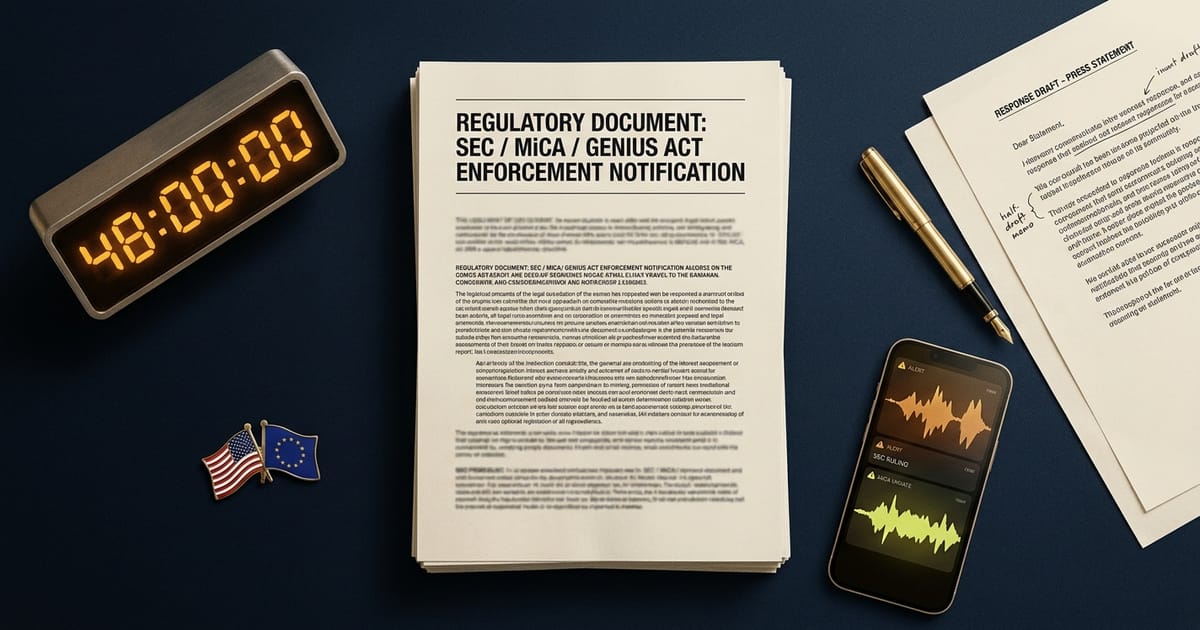
The optimal reactive window is roughly 4 to 24 hours after a story breaks. That is when journalists are actively searching for expert sources, fresh angles, and supporting data for follow-up articles. After 48 hours, the story has moved on, journalists have filed, and your pitch lands in a dead inbox.
The failure mode is almost always internal process, not expertise. Founders often have the knowledge to comment intelligently. What they lack is a system for getting a comment reviewed and approved in under an hour. A defined approval chain, pre-approved messaging frameworks, and a culture of moving fast on media opportunities separates founders who appear consistently in reactive coverage from those who watch the opportunity pass.
The Regulatory Monitoring Stack You Need
You cannot react to news you do not know about. Build a lightweight monitoring system before the next announcement drops.
SEC.gov newsroom. Follow press releases and speeches. The March 2026 joint interpretive release, the SEC's token taxonomy, and Chair Atkins' remarks at the Digital Asset Summit all hit here first.
CFTC and OCC bulletins. The OCC published its GENIUS Act proposed rules on February 25, 2026. Most founders found out days later via trade press rather than at source.
Federal Register. The FDIC GENIUS Act rules, the FinCEN/OFAC AML proposed rules for payment stablecoin issuers, and the Treasury's state-regime "substantially similar" NPRM all landed in the Federal Register before any trade publication covered them in depth.
ESMA supervisory statements. For EU operators, ESMA's April 2026 statement on MiCA enforcement confirmed hard deadlines and addressed the "reverse solicitation" loophole explicitly. That was the moment to comment publicly on what the EU enforcement structure means for compliant and non-compliant platforms operating in Europe.
Google Alerts and X/Twitter searches. Set alerts for "SEC crypto," "MiCA enforcement," "GENIUS Act rulemaking," and your token category.
Trade press as the relay layer. CoinDesk, The Block, Blockworks, and Decrypt all cover regulatory beats in real time. Monitoring their push notifications tells you when the story has begun circulating and when the reactive window is opening. CoinDesk in particular gravitates toward regulatory and institutional angles and tends to cover enforcement and policy prompts faster than most other crypto-native outlets.
Pre-Drafting: The Scenario Playbook
The single highest-leverage action you can take before the next announcement is to pre-draft commentary for the regulatory scenarios most likely to affect your project in the next 90 days. This is not guesswork. The regulatory calendar is largely public.
For H2 2026, the known catalysts include MiCA full enforcement on July 1, GENIUS Act final rules on July 18, and ongoing SEC rulemaking on token safe harbors and exemptions. Each of these events will generate intense media coverage. You can draft today.
How to structure a pre-drafted scenario:
- The announcement. One sentence on what the ruling or rule does, in plain English.
- What it means for your category. One to two sentences specific to your project type: stablecoin, DeFi protocol, tokenized asset, or AI infrastructure layer.
- Your position. A 75- to 100-word quote from your founder that is genuinely analytical, not promotional.
- The "so what" for builders. One concrete implication for other Web3 founders or developers.
- Your offer. A clear note to the journalist that you are available for a longer call.
The quote in step three is the critical piece. Journalists remember sources who are fast, clear, and consistent. A quote that only restates the announcement adds nothing. A quote that contextualizes it, explaining what changed, what remains unclear, and what builders should watch next, earns a callback.
Pre-draft at least three scenarios: one where the regulatory development validates your category, one where it creates compliance complexity, and one where it is a near-miss that affects adjacent projects but not yours directly. The last scenario is often underused. Commenting analytically on news that affects your peers signals genuine expertise rather than self-promotion, and builds the journalist relationship without the transactional dynamic of only commenting when the news is personally favorable.
The Channel Split: Where to Pitch and What Each Outlet Wants
Not all regulatory coverage lives in the same place. The pitch strategy differs significantly by channel.
Crypto trade press is the first and fastest arena. CoinDesk prefers regulatory and institutional angles. The Block looks for protocol-level depth and on-chain specifics. Decrypt wants accessible storytelling that connects crypto to broader culture, business, or technology trends. Cointelegraph remains open to story diversity but expects a clear news peg in the lead. Your pitch to trade press should arrive within four to six hours of the regulatory announcement. Three short paragraphs: what happened, why your perspective is distinct, and your founder's availability for a quick call. Attach the pre-drafted quote. One specific, timely angle per send.
Business and financial press operates on a longer cycle and covers regulatory crypto news when it has mainstream financial implications. The GENIUS Act stablecoin framework is exactly the kind of story that crosses into Bloomberg's fintech and banking beats. MiCA's July 1 enforcement affecting the operations of thousands of European crypto companies is a European financial news story as well as a crypto story. Pitches to business press should lead with the market implication, not the regulatory mechanism. The journalist covering fintech at Bloomberg is not as deep in the details of crypto regulation as a CoinDesk reporter. Your quote needs to do more translation work and assume less background knowledge.
Mainstream financial media is the third tier, typically with a consumer-facing or investor-facing angle. These outlets cover regulatory news when it affects retail investors, major platforms, or wallet holders. The MiCA story, specifically the gap between licensed and unlicensed providers now creating real market access risk for European users, is a mainstream reader story about where their money can and cannot go. Frame it accordingly.
Legal Guardrails: What You Cannot Say
This is not optional reading. The current regulatory environment has shifted materially. The SEC's enforcement posture is far more accommodating under the March 2026 joint interpretation. But that shift does not eliminate risk, particularly for founders whose tokens may still be subject to investment contract analysis.
The SEC's interpretive framework confirms that the investment contract analysis focuses on the substance and totality of the issuer's representations or promises relevant to a reasonable expectation of profits. In plain language: what you say publicly about your token's return potential, growth trajectory, or investment value still matters legally, regardless of how you label it. The interpretation is also not binding on federal courts, and private litigation risks remain.
What you can generally do safely in reactive regulatory commentary:
- Explain what a regulatory development means for your product category
- Describe your compliance approach and the legal structures you have in place
- Offer analysis of what the ruling means for the broader builder ecosystem
- Comment on implementation timelines and operational implications
- Discuss the difference between your token's utility characteristics and investment contract exposure, with legal review in advance
What to avoid in public statements without explicit legal clearance:
- Forward-looking price or return statements for your token tied to regulatory developments
- Claims that a new ruling definitively resolves your token's legal status
- Statements implying regulatory approval of your specific project
- Characterizing regulatory developments as removing compliance obligations that may still apply
Run your pre-drafted quotes through legal review as part of the scenario-building process, not on deadline. That is the only way to maintain approval speed without cutting corners.
Pitching Journalists: The Mechanics
A reactive pitch to a journalist is not a press release. It is a short, specific note that arrives at exactly the right moment, from someone who has a plausible claim to expertise.
Subject line. Lead with the ruling, not your project. "Quick comment on SEC token taxonomy, [Founder Name], [Project]" will be opened faster than anything that leads with your brand.
First sentence. State what just happened in one line, so the journalist knows you have read the same thing they are writing about.
Second and third sentences. Your distinct angle. What does your specific vantage point as a stablecoin issuer, DeFi protocol, L2 infrastructure project, or AI-adjacent Web3 founder let you see that a generic market observer cannot?
Attached quote. 75 to 100 words, cleared by legal, ready to use with minimal editing.
Offer. "Happy to jump on a 10-minute call if useful."
Do not pitch the same reactive angle to competing outlets simultaneously without disclosing that it is non-exclusive. The journalists covering the same regulatory beat know each other and talk.
One structural note: reactive pitches sent through established relationships land faster than cold outreach. The credibility check passes faster when your name is already in the journalist's notes from a previous conversation, an earlier comment, or an introduction from a trusted source. This is why building journalist relationships before a regulatory event is not optional preparation. It is the prerequisite for the reactive window to work at all.
Building the Infrastructure Before the Next Announcement
The founders who consistently appear in regulatory coverage do not succeed because they are faster readers than everyone else. They succeed because they have built the infrastructure that allows rapid response.
That infrastructure has three components: a monitoring system that surfaces relevant news quickly, a process for rapid internal approval of reactive commentary, and existing relationships with journalists covering the regulatory beat.
The internal approval process is where most projects break down. They have the monitoring. They do not have a system for getting a founder or executive comment reviewed and approved in under an hour. Building that system before the next ruling, with a defined approval chain, pre-approved messaging frameworks, and a culture of moving fast on media opportunities, is what separates consistent reactive presence from watching the story pass.
This means the work of regulatory PR is not just reactive. It is building the journalist relationships and establishing the expert positioning in advance, without a specific ask, that make the reactive window productive when it opens.
The regulatory calendar is not slowing down. MiCA 2 is already in preparation at the European Commission. The SEC's token safe harbor proposed rules are expected. GENIUS Act final implementation rules are due. Each announcement is a 48-hour window. The question is whether you are ready when it opens.
Regulatory PR strategy intersects with ongoing narrative positioning and media relationships. For the underlying work of establishing your founder as a credible source before a ruling hits, see our guides on becoming a quoted expert in Bloomberg, FT, and WSJ and pitching CoinDesk, The Block, Blockworks, and Decrypt.