
On this page7
Press Release Blindness in Web3: What Founders Should Do Instead in 2026
There is a ritual many Web3 founders know well. You spend two days getting the language exactly right, route it through legal, approve the distribution package, and watch the dashboard light up with syndication numbers. Dozens of outlets. Hundreds of pickups. You screenshot the coverage report and share it in Slack.
Then nothing happens.
No inbound from investors. No journalist follow-ups. No movement in the one metric that actually matters: the number of credible, editorial sources talking about your project because they think it is worth covering.
That gap between distribution volume and real-world impact now has a name. It came from inside the building.
The Crisis Has a Name
In May 2026, Crypto.news published a feature citing Katerina Zemskova, Head of PR at Formula by Cointelegraph, describing the current environment as a "press-release blindness" crisis. The diagnosis is blunt. AI-fueled content saturation has pushed Web3 projects to ditch rigid retainers and build founder-led, macro-aware narratives instead of generic press blitzes, because Web3 PR strategies are failing as AI-generated content has overwhelmed audience attention.
This is not a fringe opinion from a frustrated agency. It is a structural critique from the editorial side of one of the industry's most-read publications. And it tracks with what practitioners have been observing for some time.
One analyst put it starkly, writing that there is "at best a 0.5% chance, a generous estimate, that a press release will generate meaningful positive impact for your project." Wire distribution produces syndicated copy that appears under "Press Release" or "Sponsored" labels on publisher sites, is typically tagged nofollow for SEO purposes, and represents publication of copy rather than coverage by journalists. When journalists receive a wire release, most delete it.
Read that last line again. Most delete it.
Why the Wire-Only Model Fails
The wire distribution model was designed for a different media environment: scarce channels, low publishing volume, journalists who actively monitored release feeds for story leads. None of those conditions exist in crypto media in 2026.
More than 20,000 blockchain projects are competing for investor trust, media exposure, and active user adoption, yet fewer than 5% gain lasting visibility. The noise floor is simply too high for undifferentiated distribution to clear it.
There is also a credibility problem baked into the format itself. Unknown senders create verification costs. Crypto journalism developed in an environment filled with fabricated metrics, exaggerated partnerships, inflated user counts, and manipulated trading data. Reporters learned to default toward skepticism because skepticism saves time. That means credibility signals matter before a release even gets opened.
What wire distribution actually produces is reach without resonance. Hundreds of low-authority placements generate noise, not credibility. Three placements in CoinDesk, The Block, and Decrypt carry more weight than 200 auto-syndicated mirrors on no-traffic domains.
The implication is uncomfortable but clear: if your entire PR strategy is built around press releases, you are spending money to create the appearance of coverage rather than the reality of it.
What Earned Media Actually Requires
The projects that consistently generate editorial coverage in 2026 share a different operating posture. They treat PR not as a press release service but as a continuous strategic communication function. They invest in narrative before they need distribution. They build media relationships before they have news to share.
This is a meaningful reframe. Press release thinking is transactional: you have an announcement, you broadcast it, you measure pickups. Earned media thinking is relational: you are building the conditions under which a journalist will want to call you when a story is developing that you would be useful for.
Relationship-driven PR consistently outperforms random outreach blasts. A trusted sender lowers perceived risk. The editor spends less energy verifying legitimacy and more energy evaluating whether the story itself matters.
That shift from "blast and hope" to "build and pitch" requires understanding which story types actually survive editorial filters at tier-1 outlets.
The Three Story Types That Still Get Picked Up
Not all news is created equal. Editors at CoinDesk, The Block, Blockworks, and their mainstream counterparts are evaluating incoming pitches against a simple question: does this story serve my readers, or does it serve the company pitching me? Most press releases fail that test immediately.
Three story frames consistently pass it.
Data-driven insight. Original data is among the most reliable pitch hooks in crypto journalism. On-chain analytics, user behavior trends, protocol metrics, or proprietary survey results give a journalist something they can independently verify and a hook their readers have not seen before. The pitch is not "our protocol is growing" but "here is what our data reveals about how DeFi users are behaving in a rising rate environment, and here is why it matters." The insight does the work. Your project is the source.
Milestone narrative. Not all milestones are newsworthy, but the ones that map onto a broader industry story can be. A TVL milestone becomes interesting when it illustrates a trend. A partnership announcement becomes interesting when it reveals a shift in how institutions are approaching the space. The test is whether a journalist could write a story about the trend using your milestone as the primary evidence. If yes, you have a pitch. If the milestone only makes sense inside your own ecosystem, you have a press release.
Contrarian thesis. This is the highest-risk, highest-reward format, and the one most founders underuse. A specific, defensible argument that challenges a consensus view in the industry, backed by evidence your team is positioned to provide, is genuinely useful to editors. It sparks debate, generates reader response, and positions the founder as a thinker rather than a promoter. The pitch for this type is not a release at all. Use contrarian, specific, and timely arguments, not thought-leadership essays. Editors decide in under two minutes. The pitch must carry the thesis, the author's standing to make it, and a news peg, in that order.
How to Structure a Pitch That Bypasses Editorial Filters
A pitch is not a shorter press release. It is a different document with a different job. Where a press release broadcasts information, a pitch makes a case for why this story matters to this journalist's readers at this specific moment.
The structure that works has three parts, and only three.
First, the story in one sentence. Not what happened, but why it matters. "Our protocol crossed $500M TVL" is not a story. "Retail-first DeFi protocols are now outpacing institutional products for the first time since 2022, and our growth data explains why" is a story.
Second, why you are the right source. Journalists are evaluating your credibility alongside your content. Your standing to make the claim, your track record, your proximity to the data: all of this reduces the verification cost the journalist faces in pursuing the story. Provide genuine news rather than marketing, research journalists' previous work to ensure pitch alignment, offer exclusive information or access, and respect editorial independence without expecting guaranteed positive coverage.
Third, a specific offer. An exclusive dataset. An embargo on findings before anyone else. A call with the founder plus an on-chain proof point. The more exclusive the content, the better your chances of getting valuable earned media. Exclusivity signals that you are treating the journalist as a partner in the story, not a distribution channel for your announcement.
Keep the pitch to five sentences or fewer on first contact. No drafts attached on first contact. Pitch the argument, then send the content. If the journalist is interested, they will ask. If they are not, a longer email would not have changed that.
Measuring Whether Your PR Is Building Authority or Just Impressions
One of the reasons press releases persist is that they produce metrics that look like success. Pickup counts, reach numbers, syndication reports: all of it lands in a slide deck and creates the impression of momentum. None of it tells you whether your PR investment is compounding.
The distinction matters because impressions decay. A press release that generates 80 pickups has a half-life measured in days. Earned editorial coverage in a tier-1 outlet compounds over time, because it becomes a citation that future journalists reference, an authority signal that AI systems surface, and a credibility anchor that future investors can verify.
A single Tier-1 placement can generate hundreds of AI citations over months or years, creating persistent visibility that traditional PR metrics cannot capture. This is the compounding effect that wire-only strategies cannot produce.
94% of AI citations come from earned media. AI citation tracking now lets PR teams prove placement value, replacing older retainer models with measurable, performance-based outcomes.
The practical measurement framework for founders looks like this. Track three metrics and ignore the rest.
Citation velocity. Are tier-1 outlets referencing your project in stories where you were not the subject? Being mentioned as supporting evidence in a broader piece is a stronger signal than being the subject of a press-release-driven story. It means journalists see you as a credible source, not just a client.
Search and AI discoverability. The best PR programs measure whether your brand is cited in AI-generated summaries, how your narrative appears in Perplexity's cited sources, and whether your team's thought leadership appears in AI-training-adjacent content. These are the signals that determine whether your project exists in the discovery layer that future investors and partners will use.
Narrative persistence. Run a search for your project's core claim or thesis six months after a campaign. If journalists and analysts are still using your framing to describe the space, your narrative has become infrastructure. If nobody is using it, your coverage was a spike, not a foundation.
The Strategic Shift
Zemskova argues crypto firms should abandon rigid PR retainers in favor of flexible, goal-based campaigns tied to market cycles. That is a sound instinct, but the more fundamental shift is upstream of the retainer structure. It is about the theory of change underlying your communications.
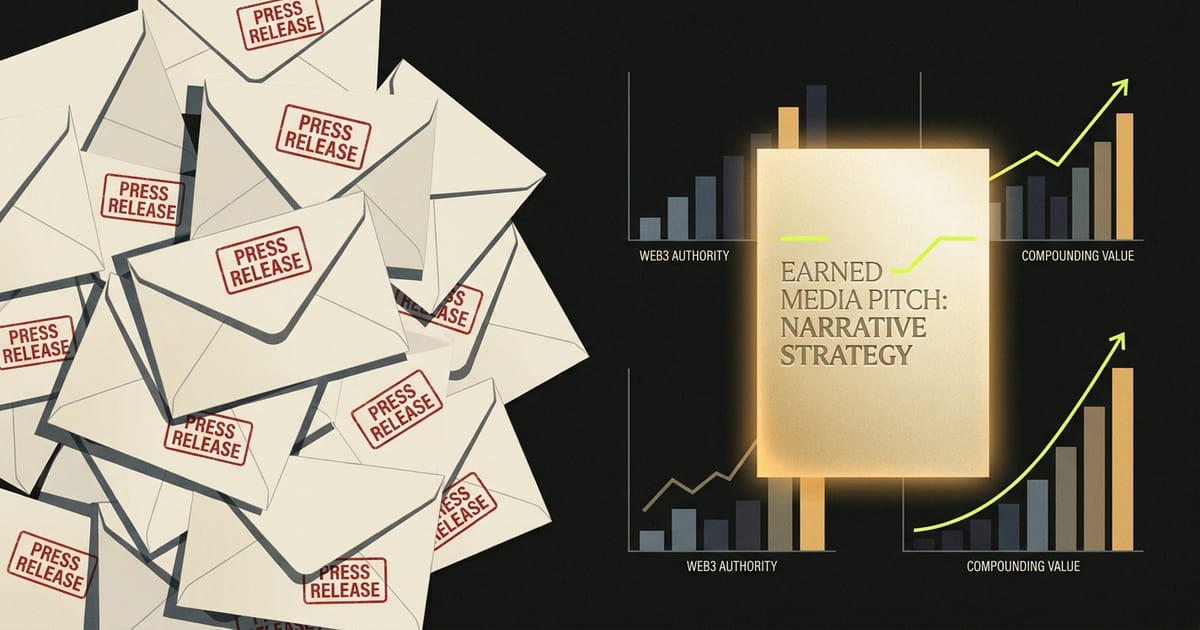
Press releases assume that if you put information in front of enough eyeballs, some percentage will care. Earned media strategy assumes that a small number of deeply engaged editorial relationships, built over time around genuinely useful story contributions, will produce more compounding value than any volume play.
Blockchain companies that get consistent coverage in 2026 treat PR as a long-term credibility infrastructure project, not a press release distribution exercise.
That means the question changes. Instead of asking "how do we distribute this announcement?" you ask: "what story does the market need right now that we are uniquely positioned to tell?" The distribution question is secondary. It follows naturally when the story is right.
The projects winning in 2026 are not necessarily those with the most technically impressive protocols. They are the ones that have built the communication infrastructure to make their innovation understood, trusted, and valued by the audiences that determine their adoption.
Press release blindness is not a media problem. It is a strategy problem. The fix is not a better press release. It is a different model entirely.