On this page11
- Why Technical Founders Have a Structural Advantage (That They Waste)
- Step 1: Build Your Thesis Document
- Step 2: The Content Extraction Audit
- Step 3: The Conversion Map, From Source Material to Format
- Post-Mortem Converts to a CoinDesk Op-Ed
- Engineering Blog Post Converts to a Decrypt Feature Pitch
- Governance Debate Converts to an X Thread Series
- Step 4: Build a Six-Month Content Calendar from One Thesis Doc
- Step 5: The Pitch Stack, Run It Simultaneously Not Sequentially
- A Worked Example: DeFi Protocol Founder
- The One Rule That Makes This Work
Web3 Founder Thought Leadership Without a Ghost-Writer: A DIY Framework for Technical Builders
Most thought leadership guides assume you'll outsource the writing. Hire an agency, brief a ghost-writer, hand over your brain dump, and wait for polished copy that sounds vaguely like you. Except it doesn't, and your community notices.
Technical Web3 founders tend to resist this model, and for good reason. Your credibility is built on protocol depth. When an op-ed under your byline describes a governance mechanism in language that would embarrass a junior dev, the damage is real. A ghost-writer who doesn't understand calldata compression or validator incentive design isn't just unhelpful. They're a liability.
The alternative is not "write everything yourself from scratch on a blank page at 11 PM." The alternative is a structured extraction system: a way to turn the thinking you are already doing, including post-mortems, architecture decisions, and governance debates, into media-ready content without losing the signal that makes your voice worth reading.
This is that system.
Why Technical Founders Have a Structural Advantage (That They Waste)
Editors at crypto-native publications receive dozens of pitches per week from comms professionals who are excellent at framing and poor at substance. What they don't receive enough of is copy that contains an actual insight. Something derived from running a protocol, not from reading about running one.
Your structural advantage is that you have witnessed things. You've watched a governance proposal pass with 63% quorum only to get blocked at execution. You've run a liquidity incentive campaign and observed the exact block at which mercenary capital rotated out. You know the difference between the invariant that held and the one that nearly didn't.
That is your raw material. The framework below converts it into publishable form.
Step 1: Build Your Thesis Document
Before any individual piece of content, you need a single living document (call it your Thesis Doc) that articulates your point of view on the one or two questions that matter most in your area of the protocol stack.
A Thesis Doc is not a whitepaper. It is not a roadmap. It is 600 to 900 words of opinionated conviction organized around three questions:
- What is broken or misunderstood in your corner of Web3 right now?
- What will be true in 18 to 36 months that most builders are not yet pricing in?
- What have you personally learned from building that contradicts the conventional wisdom?
Write this document badly the first time. That's fine. The purpose is to externalize a coherent worldview so you have something to mine. Most founders discover, when they try to write this, that they have three or four different theses competing with each other. That's useful information. Pick one.
Your Thesis Doc becomes the source of truth for every piece of content you produce for the next six months. An X thread is a paragraph from the Thesis Doc, expanded. A conference talk is the whole document, structured with evidence. A CoinDesk op-ed is the thesis applied to a news hook. A podcast appearance is the Thesis Doc delivered conversationally.
One document. Six months of content.
Step 2: The Content Extraction Audit
Once per month, spend 45 minutes doing a Content Extraction Audit. Scan the last 30 days of your own work product and ask: what did I write or say that contained a genuine insight?
Look in these places:
- Internal post-mortems and incident reports. These are gold mines. A well-written post-mortem contains a root cause analysis, a sequence of decisions under uncertainty, and a set of hard-won lessons. Every one of those is a publishable idea.
- Governance forum posts. If you wrote a 400-word reply to a governance thread, that reply contains an argument. Arguments are articles.
- Engineering blog drafts. Even abandoned drafts contain at least one concept that non-technical readers would find illuminating.
- Slack and Discord messages. Search your own messages for the week you were most animated. That's where your genuine opinions live.
- Investor update emails. The section where you explain a setback or a strategic pivot often contains your most honest and interesting thinking.
Tag each item with a rough content type: Observation (something you noticed), Argument (something you believe that others don't), or Explainer (something you understand that your audience doesn't yet).
Step 3: The Conversion Map, From Source Material to Format
Different source materials convert naturally into different content formats. Here is the map.
Post-Mortem Converts to a CoinDesk Op-Ed
A governance or technical post-mortem is already structured as a narrative with a problem, a sequence of decisions, and a resolution. To convert it to an op-ed pitch:
- Strip the internal jargon and technical specifics down to one paragraph of context.
- Restate the core lesson as a claim that applies beyond your protocol. Not "our multisig threshold was misconfigured" but "multi-sig governance fails at the same structural point across DeFi protocols, and the pattern is predictable."
- Connect the claim to a news hook from the last 30 days, such as a similar incident at another protocol, a regulatory comment, or an academic paper.
- Write a 150-word pitch to the editor. The pitch should contain: the hook (why now), the argument (your specific claim), and proof of standing (one sentence about what you've built).
CoinDesk's opinion section, The Block's contributor program, and Blockworks' editorial desk all accept unsolicited pitches from founders with operational standing. They are not looking for PR copy. They are looking for a point of view backed by experience. A post-mortem is exactly that.
Engineering Blog Post Converts to a Decrypt Feature Pitch
An engineering blog post typically explains how something works. A Decrypt feature story typically explains why something matters. The conversion move is to extract the implication, not the implementation.
If your engineering post explains how you re-architected your oracle to reduce latency, the feature pitch becomes: "Slow oracles are a hidden attack surface in DeFi lending. Here is what we learned building a faster one, and why it changes the security assumptions every protocol should be making."
When pitching a Decrypt reporter, target the specific reporter who covers your beat rather than the editor in general. Frame it as a story tip, not a pitch. "I think there's a story here that would interest your readers, and I've built something that could give it a concrete angle." Reporters do not want founders telling them what to write. They want founders who can point them at an interesting problem and then be a useful source.
Governance Debate Converts to an X Thread Series
Governance debates compress well into X threads because they already have two sides. The format: open with the counterintuitive position (not the one you'd expect the protocol founder to take), spend three or four tweets building the steel-man of the opposing view, then pivot with the data from your vote and what it actually showed.
This structure works because it demonstrates that you've actually thought about the problem rather than just advocating for your own interests. Technical credibility on X is built by being someone who updates their view when confronted with evidence.
One governance thread per month, posted during a period when the debate is live in the broader ecosystem, compounds quickly.
Step 4: Build a Six-Month Content Calendar from One Thesis Doc
Here is a concrete content calendar structure based on a single well-formed Thesis Doc. This assumes one core thesis, three supporting arguments, and a handful of concrete examples from your own build.
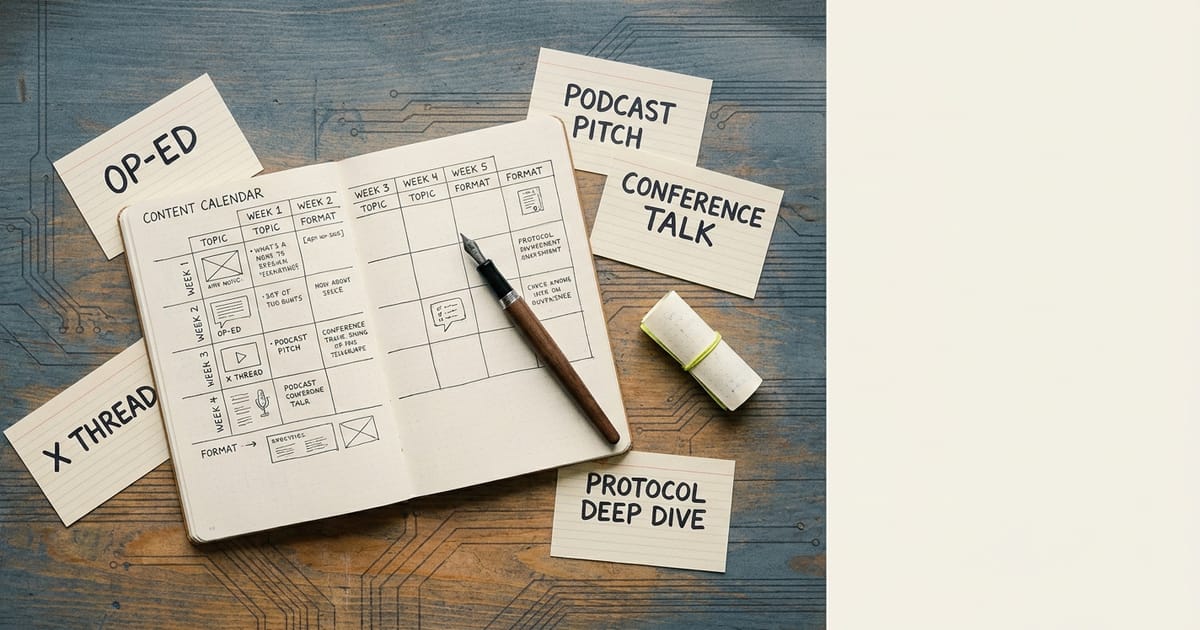
| Month | Output | Format | Source Material | |-------|--------|--------|-----------------| | 1 | Establish the thesis | Long-form X thread (12 to 15 tweets) | Thesis Doc, section 1 | | 2 | First supporting argument | Op-ed pitch to tier-1 crypto outlet | Governance post-mortem | | 3 | Technical explainer | Engineering blog post adapted for Decrypt pitch | Architecture decision | | 4 | Counter-intuitive take | X thread plus podcast pitch | Governance debate | | 5 | Data-backed claim | Original research thread plus byline pitch | On-chain data you have access to | | 6 | Synthesis | Conference talk proposal | Everything above |
The conference talk proposal in month six is not arbitrary. It is the culmination of six months of public reasoning. By month six, you have a record of consistent thinking on a topic, which is exactly what program committees look for in a speaker who isn't a household name yet.
Step 5: The Pitch Stack, Run It Simultaneously Not Sequentially
One mistake technical founders make when they do try to pitch: they pitch one outlet, wait for a rejection, then pitch the next. The result is that a piece of content that was timely in January gets placed in March, if at all.
Build a pitch stack. For any given idea, identify three outlets or formats simultaneously:
- Tier-1 outlet pitch (CoinDesk, The Block, Blockworks): highest bar, slowest timeline, most valuable placement
- Mid-tier or niche outlet (Decrypt, Unchained, a protocol-specific publication): faster turnaround, more receptive to technical depth
- Owned channel (your engineering blog, your X thread, your newsletter): publish here regardless of what the outlets decide
If the tier-1 pitch doesn't land within two weeks, escalate to mid-tier and publish the owned-channel version simultaneously. You keep the idea alive and in circulation without losing momentum waiting for a gatekeeper.
A Worked Example: DeFi Protocol Founder
Consider a founder who runs a lending protocol. Over three months, the protocol experienced a governance failure. A parameter change that passed on-chain was executed incorrectly, resulting in a brief window of incorrect collateral ratios. No funds were lost, but the incident was public.
Month 1: The founder writes an internal post-mortem. It's detailed, honest, and contains a structural insight: on-chain governance execution and off-chain parameter implementation are two separate systems that almost no protocol has formally synchronized. This becomes the thesis.
Month 2: They convert the post-mortem into a 900-word op-ed pitch for CoinDesk: "On-Chain Governance Passed. The Protocol Didn't Get the Memo. A Systemic Risk No One Is Tracking." The pitch includes data from five other protocols that have experienced the same gap. The editor commissions it.
Month 3: The op-ed runs. They post an X thread the same day expanding on one specific technical claim from the piece. The thread focuses on the architectural gap between governance modules and execution layers. The thread gets picked up by a podcast focused on DeFi infrastructure. They appear on the podcast six weeks later.
Month 4: They submit a conference talk proposal to a developer-focused conference. The title: "The Governance Execution Gap: What I Learned Running a Vote That Almost Broke Our Protocol." The proposal is accepted. They now have a speaking slot, a published byline, and a podcast appearance, all sourced from a single post-mortem written for internal use.
Total external writing time: approximately eight hours across four months.
The One Rule That Makes This Work
Everything in this framework depends on one precondition: you have to actually write your Thesis Doc.
Not a draft of it. Not a note that says "I should write this." The full 600 to 900 words, in your own voice, making a claim you would be willing to defend publicly.
Founders who skip this step find that every piece of content feels like starting from scratch. Founders who do it once find that they always know what to say next, because they know what they believe.
That document is the system. Everything else is distribution.
If you're at the stage where you have the thesis but need help converting it into a placed byline or a structured media strategy, that's the gap where fractional PR support is most useful. Not to replace your voice, but to handle the mechanics of placement so you can focus on the thinking.