On this page14
- Why Post-TGE PR Gets Dropped
- Days 1-30: Sustain the Signal
- The Post-Launch AMA
- Exchange Listing Announcements as Earned Media Events
- On-Chain Metric Storytelling
- Days 31-60: Build the Earned Media Engine
- The Milestone-to-Pitch Calendar
- Reactive Commentary as Founder Visibility
- Podcast and Long-Form Thought Leadership
- Days 61-90: Governance Communication and the Sustained PR Cadence
- Governance as a Communications Channel
- The 90-Day Review and the Sustained Cadence
- The Calendar in Summary
- The Core Insight
Post-TGE PR: The 90-Day Communications Plan After Your Token Goes Live
The launch announcement ran. The tier-1 coverage landed. The community Discord hit its all-time high for concurrent users. And then, somewhere around day four, the Telegram notifications started to slow, the trading volume curve bent downward, and the team turned back to building.
This is the moment almost every post-TGE PR guide ignores.
Most communications playbooks treat the token generation event as a finish line. They focus almost entirely on pre-launch narrative, the embargo sequence, and launch-day coordination. What happens in the 90 days after the TGE, when the hype window closes and the market starts asking whether this project is real, gets a paragraph at best.
That gap is expensive. For a project entering a crowded market, more than 70 percent of new tokens lose trading momentum within 90 days, and earned media is a vital tool for cutting through the noise and turning early attention into lasting demand.
The builders who survive that window are not necessarily the ones with the best technology. They are the ones who kept the story moving.
Here is a sequenced, milestone-driven communications plan for the 90 days after your token goes live.
Why Post-TGE PR Gets Dropped
Before the calendar, it helps to name the problem clearly.
Post-token launch crypto PR and marketing is often described as "often overlooked" in the Web3 space. Many projects fall into what practitioners call a "builder's trap," where marketing efforts take a backseat to increasing internal capacity for maintaining products or services. That shift can lead to a decline in project growth immediately following the token launch.
The pattern is predictable. The team spent months in pre-TGE mode, running hot on comms. Launch day required everyone. The week after, someone had to fix a contract bug, someone else was negotiating a tier-2 listing, and the PR retainer quietly went into maintenance mode.
Meanwhile, the market moved on. A project that goes silent after listing day loses the compounding effect of everything built during the pre-listing PR phase. Coverage density, journalist familiarity, community trust: all of it depreciates when there is nothing new to say.
The fix is not to run launch-week intensity indefinitely. It is to replace that intensity with a structured, lower-effort cadence that keeps milestones in the conversation without burning the team.
Days 1-30: Sustain the Signal
The first 30 days after TGE are the most fragile. Airdrop recipients are deciding whether to hold or sell. Between 50 and 70 percent of airdropped tokens are sold within the first 30 days of distribution, with a significant share of recipients selling at the token generation event itself. The community is watching whether leadership shows up with something real or disappears into a building sprint.
The Post-Launch AMA
Run a structured founder AMA within the first two weeks. Not a casual Twitter Space, but a prepared session with pre-collected questions, clear answers on tokenomics, vesting schedules, and the next 60 days of product milestones. Distribute a written recap across Discord, Telegram, and your project blog within 24 hours.
This serves two purposes. It gives the community something to share and discuss, extending the reach of the session beyond live attendees. And it signals to journalists that there is a continuing story to cover, not just a launch announcement to file.
Founder-led communication builds trust by humanizing the project and signaling long-term commitment. The AMA format, done well, mirrors the CEO-led approach of an IPO roadshow: accessible, informed, aligned with community and investor interests.
Exchange Listing Announcements as Earned Media Events
Your first post-TGE exchange listing is not a press release. It is a PR campaign in miniature.
Exchange listing PRs often trigger significant community and investor interest. But the projects that extract maximum value from a listing treat it as a storytelling moment, not a checkbox. Projects should focus on storytelling instead of simply announcing a listing. Investors are constantly exposed to thousands of token launches and exchange announcements. To stand out, projects need to explain why their technology, utility, ecosystem, or vision matters.
Specifically: coordinate the listing announcement with a founder quote placed in a tier-1 outlet, prepare a community guide explaining deposit timelines and trading pairs, and track secondary syndication across CoinMarketCap, Binance Square, and Google News. Exchange listing press releases are essential for boosting trading volume and expanding your token's reach, and they must be clear and precise: traders and investors want specific details on when and where they can buy your token.
A strong token listing PR strategy does not end when trading starts. It transitions into sustained earned media: product updates, partnerships, and thought leadership. Each subsequent listing, if you have them coming, should follow the same sequenced approach.
On-Chain Metric Storytelling
This is the most underused asset in a post-TGE communications strategy.
Your blockchain is generating data in public, in real time. Wallet growth, transaction volume, TVL trajectory, governance participation rates: these numbers tell a verifiable story that no press release can replicate. In Web3, credibility is reinforced through transparency, traceability, and community validation. Smart contract audits, on-chain metrics, DAO governance records, and public GitHub repositories all contribute to brand legitimacy.
The tactical move is simple: publish a weekly or bi-weekly on-chain update. One paragraph of context, one or two headline numbers, a link to your Dune dashboard or equivalent. Distribute it natively in Discord and Telegram, and cross-post it as a thread on X. Journalists covering your vertical will begin to treat this as a primary data source. Community members will share the numbers that make them feel good about holding.
Track lifetime value through on-chain activity, retention rates, and token holder behavior rather than just clicks and impressions. Focus on metrics like total value locked, transaction volume, governance participation, and long-term user retention. When those numbers improve, you have an earned media pitch ready to go.
Days 31-60: Build the Earned Media Engine
By day 30, the launch hype is gone. The market has made its initial judgment. This is where most post-TGE PR falls apart, because there is no obvious hook to pitch.
The answer is to manufacture the hooks by turning roadmap milestones into sequenced media events.
The Milestone-to-Pitch Calendar
Map every product development, partnership, and governance decision on your roadmap for the next 60 days. For each one, identify the narrative angle that a journalist at a vertical publication would find genuinely interesting. Not "we launched feature X" but "here is what feature X means for users who are currently doing Y the hard way."
Projects that release original insights, for example a Layer-2 publishing a report on gas fee reduction or a stablecoin protocol analyzing emerging markets, often attract organic media interest. Data is a magnet for journalists. Commission a short data report tied to your protocol's area of focus. Use your own on-chain data as the primary source. Pitch it as an exclusive to one publication, then make it available broadly after publication.
Reactive Commentary as Founder Visibility
Between milestones, the fastest path to consistent earned media is founder commentary on breaking news in your sector.
Reactive commentary is the fastest path to tier-1 placements during this phase. When a regulatory development, a major protocol exploit, or a market structure shift lands in your vertical, a founder with a clear perspective and a communications team that can respond in hours will consistently beat teams that wait for something to pitch.
Build a short media list of five to eight journalists who cover your space specifically. Monitor their beats. When something relevant breaks, draft a four-sentence expert quote, get founder approval, and send it within two hours of the story appearing. Over 60 days, this alone can generate four to eight tier-1 or tier-2 placements without a single press release.
Podcast and Long-Form Thought Leadership
Positioning founders as experts builds authority beyond the project itself. A DeFi founder writing or speaking about yield mechanics, governance design, or L2 tradeoffs in a publication read by their target audience is creating persistent, searchable content that compounds over time.
This is the period to begin a podcast tour. Book six to eight shows over 30 days, targeting programs with audiences in your sector. Prepare two to three evergreen talking points that can anchor any conversation without requiring the founder to pitch the project directly. Bylined articles, op-eds in industry publications, and executive positioning in trade media build long-term credibility rather than short-term visibility spikes.
Days 61-90: Governance Communication and the Sustained PR Cadence
By day 60, the project should have established a baseline of consistent coverage. The third month is about formalizing what worked and integrating governance communication into the PR program.
Governance as a Communications Channel
This is where Web3 PR diverges most sharply from traditional tech PR, and where most teams leave the most value on the table.
DAO communications make PR uniquely complicated: there is no single spokesperson, decisions are made through governance votes, and community sentiment can shift faster than any communications team can manage. Rather than treating this complexity as a liability, the strongest projects treat it as a differentiated story.
Every significant governance proposal is a PR event. When a meaningful vote is approaching, publish a plain-language summary of the proposal for non-technical holders, coordinate a community call or AMA around the vote, and brief one or two journalists in your sector on what the governance decision could mean for the protocol's direction. Governance participation becomes a data point in your on-chain narrative: measures of success include governance turnout, active wallet retention, and the ratio of engaged to passive holders, not just headline impressions.
This approach converts governance mechanics from an operational chore into proof that the community owns the protocol's future. That proof is exactly what journalists covering decentralization and long-term protocol health want to cite.
The 90-Day Review and the Sustained Cadence
At the close of day 90, run a structured communications audit before renewing or expanding your PR program.
Measure earned placements by tier, share of voice against named competitors in your vertical, on-chain metric trajectory, community growth rate, and inbound partnership or investor inquiries that cited media coverage as a discovery point. Establishing clear KPIs that align with your PR goals, such as media mentions, website traffic, social media engagement, or investor inquiries, is fundamental to gauging success.
Use the audit to identify which story angles generated the most secondary pickup, which journalist relationships produced the most coverage, and where the narrative gaps are heading into the next quarter. Then build the next 90-day calendar from that data, not from instinct.
The Calendar in Summary
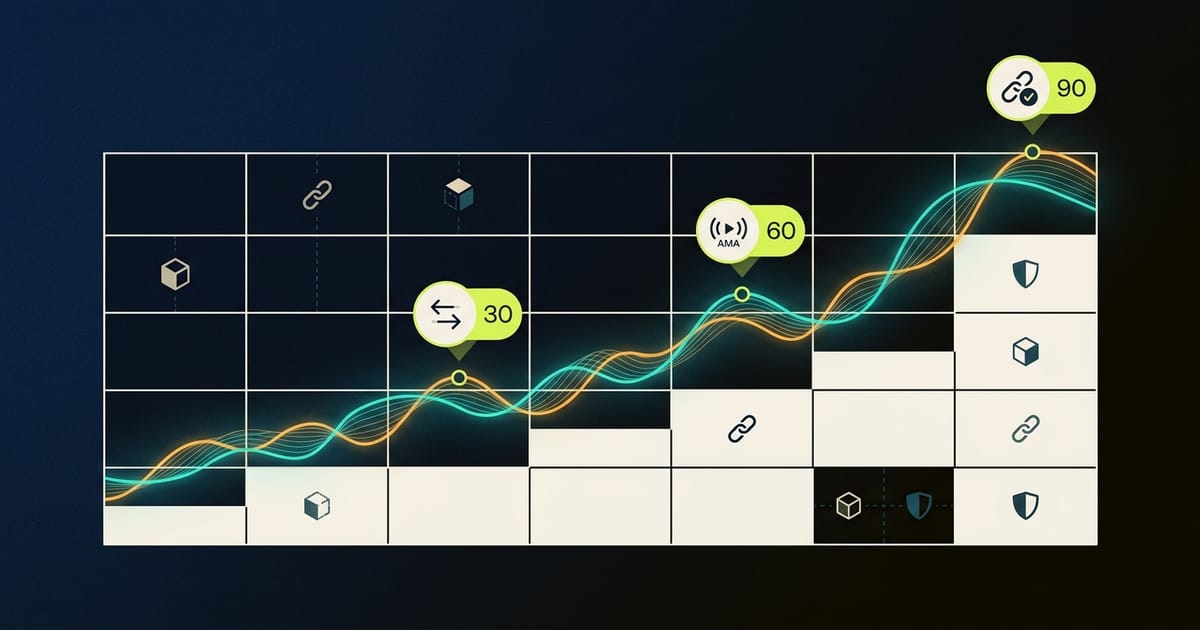
Days 1-30: - Founder AMA within two weeks; distribute written recap - First post-TGE exchange listing treated as a coordinated media campaign - Launch weekly on-chain metric updates across community and media channels
Days 31-60: - Map roadmap milestones to pitchable editorial angles - Commission a short original data report for an earned media exclusive - Build a reactive commentary pipeline: five to eight relevant journalists, same-day response capability - Begin a six to eight episode podcast tour
Days 61-90: - Integrate governance proposals into the PR calendar: plain-language summaries, community calls, journalist briefings - Treat governance participation data as a primary narrative metric - Run a structured 90-day communications audit; rebuild the next calendar from results, not assumptions
The Core Insight
Poor token marketing is usually what separates a crypto project that holds value after launch from one that spikes and disappears. The 90-day post-TGE window is where that divergence becomes visible. It is not about running a launch-week push indefinitely. It is about replacing one-time intensity with a sequenced, sustainable cadence that gives the market a reason to keep paying attention.
This sustained content flow prevents the common pitfall of "launch-day hype followed by silence," which quickly erodes investor trust. A founder AMA, an on-chain data report, a reactive quote in a tier-1 outlet, a governance briefing: none of these is a heavy lift in isolation. Together, over 90 days, they compound into the kind of media presence that makes a token feel like a project with a future.
That is the difference between a token that holds and one that fades.