On this page9
- Why Being "Covered in the Press" No Longer Guarantees LLM Visibility
- The Four Citation-Killing Patterns
- The Content Architecture That Fixes It
- 1. Publication Cadence and Venue Selection Hierarchy
- 2. Topical Authority Compounding
- 3. Quotable Sentence Construction
- 4. Consistent Entity Vocabulary
- Where the Fractional PR Consultant Comes In
- What to Do This Week
How to Build an LLM Citation Footprint as a Web3 or AI Founder
There's a gap opening up between two groups of Web3 founders right now. Most founders don't know which side they're on.
The first group has press coverage: interviews on The Block, CoinDesk bylines, a steady X presence, and agency-managed PR. They show up in Google. They rank. By most traditional metrics, their earned media program is working.
The second group has all of that and also shows up when an institutional investor or enterprise partner types their name (or their category) into ChatGPT or Perplexity.
The difference between the two groups isn't volume of coverage. It's content architecture.
Why Being "Covered in the Press" No Longer Guarantees LLM Visibility
This is the uncomfortable shift happening in 2026: traditional earned media and LLM citation are two different things, and they don't automatically convert to each other.
A blockchain company can rank reasonably well in Google while remaining nearly invisible inside ChatGPT, Perplexity, Gemini, and Google AI Overviews. The editorial coverage exists. It just isn't structured, distributed, or sustained in a way that creates a stable signal for AI systems to reference.
Why does this matter for Web3 and AI founders specifically? Because institutional investors and enterprise partners increasingly use AI tools as the first filter in their discovery process. Where reference calls and pitch decks once carried the weight of initial diligence, AI search tools now surface a wider range of signals: published coverage, entity consistency, cross-platform presence, and third-party validation. If you're not visible there, you don't exist at the moment that matters most.
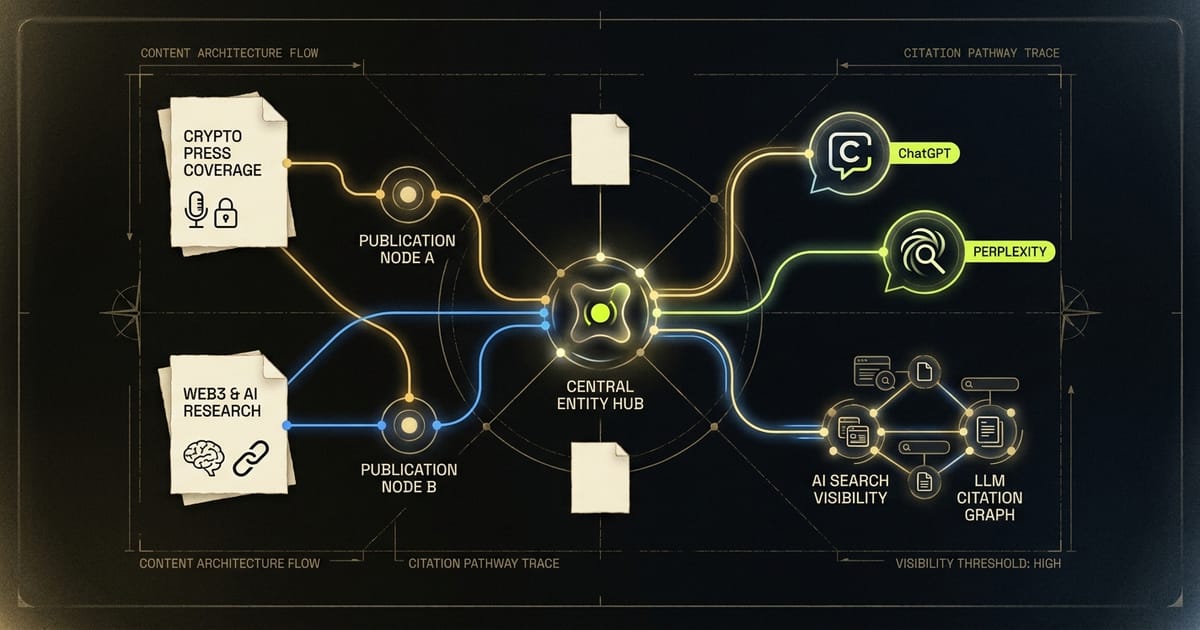
The mechanic is straightforward, even if the execution isn't. LLMs synthesize answers based on patterns they've encountered across training data and, in retrieval-augmented models, across indexed web content. When multiple authoritative sources independently reference a founder or project with consistent, specific claims, LLMs develop what amounts to confidence in that entity. Repetition across independent sources is the AI equivalent of domain authority.
That mechanism breaks down in four predictable ways for crypto and AI founders.
The Four Citation-Killing Patterns
1. X-only content reliance
X is the heartbeat of crypto culture and genuinely valuable for community building and narrative seeding. But tweets don't index the way editorial content does, they're not treated as authoritative sources by LLMs, and they evaporate from retrieval systems almost immediately. If the majority of a founder's content output lives on X, they have almost no surface area for AI to reference when generating answers.
2. Venue fragmentation without depth
Occasional coverage across a dozen outlets sounds like it adds up to something. It doesn't. Not for LLMs. A single sponsored article or a one-off news mention rarely creates durable AI visibility. Repeated appearance across authoritative environments does. Fragmented coverage that never concentrates in a consistent venue, on a consistent topic, gives AI systems nothing to pattern-match against.
3. Formulaic agency ghostwriting
There's a specific type of Web3 PR ghostwriting that reads like it was written by a committee in 2019: the "we're disrupting X industry" op-ed, the "why decentralisation matters" piece, the funding announcement dressed up as thought leadership. This content gets placed, gets a brief traffic spike, and disappears from any meaningful signal layer. LLMs don't treat promotional language as authoritative. In fact, highly promotional content from a project's own ecosystem is treated cautiously. Independent, analytical, and specific writing carries significantly more weight.
4. Lack of repeating vocabulary
This is the structural problem that's easiest to miss and hardest to fix without intentional design. LLMs build entity understanding by synthesising patterns across documents. If a founder is described differently across interviews (with different positioning, different vocabulary, different attributed expertise), the AI struggles to build a stable model of who they are and what they stand for. Inconsistency across a media footprint produces an LLM that either ignores the entity or synthesises a confused version of it.
The Content Architecture That Fixes It
Fixing an LLM citation gap isn't a campaign. It's a structural build with four components that compound on each other.
1. Publication Cadence and Venue Selection Hierarchy
The starting point is not "how much content can we produce?" It's "which venues does an LLM actually reference for questions in our category?"
Every niche has what you might call a Trust Hub: the cluster of domains LLMs pull from when generating answers for that niche. For Web3, this includes Tier-1 editorial outlets like CoinDesk, The Block, Decrypt, and Cointelegraph. These publications carry weight not because of traffic, but because they represent the kind of vetted, editorial-reviewed content models have learned to trust. A piece placed there, and then referenced or syndicated elsewhere, creates a compounding citation signal that a press release on a wire service simply cannot.
The practical implication: one deep, analytical byline in a Tier-1 outlet published monthly on a consistent topic produces more LLM citation surface than a dozen scattered news mentions. Publication cadence should be regular enough to establish topical pattern, and the venue hierarchy should be built from the LLM's reference set, not the founder's ego or the agency's existing relationships.
Investors and enterprise partners using Perplexity for high-stakes decisions expect citations, not just synthesis. That means earning visibility inside institutional data networks and financial news sources that Perplexity actually references, not simply maintaining general press coverage.
2. Topical Authority Compounding
Topical authority in AI search is the degree to which LLMs recognise a source as a comprehensive and consistent reference across an entire subject area, not just one ranking page. In AI search, it's measured through coverage depth, entity consistency, and citation frequency across a complete topic cluster.
For a founder, this means picking a corner of the Web3 or AI landscape where they have genuine expertise, and then publishing enough analytical, specific content around that corner (across owned channels and earned placements) that LLMs begin to associate the founder's entity with that topic.
This is not about keyword strategy. It's about entity association. The question to ask is: when an LLM is asked about a given topic, whose perspective should it synthesise? The answer is whichever entity has demonstrated the most consistent, depth-first coverage of that topic across the most authoritative sources.
The compounding effect is real but slow. Most practitioners see meaningful LLM citation shifts around the 120-day mark, when AI crawlers have re-indexed enough of a content cluster to recognise topical pattern. Niche founders with topical depth have achieved outsized AI visibility relative to their size because LLMs reward expertise concentration over domain-wide authority.
3. Quotable Sentence Construction
This is the layer of the content architecture that most PR programs completely skip. It's also where a lot of otherwise solid placements fail to generate citations.
LLMs extract specific, standalone passages. They don't paraphrase long narratives or summarise argumentative essays. They pull clean, self-contained statements that answer a specific question completely.
A citation hook is a short, standalone statement that can be lifted word-for-word into an LLM answer. Content structured for LLMs is built for extraction, not for narrative flow. The atomic paragraph (two to four lines, one idea) is the base unit of AI-readable content. An answer that needs three other paragraphs for context will not be cited.
Practically, this means every byline a founder publishes should contain four to six of these citation hooks: short, declarative statements that name the claim explicitly, include a specific number or mechanism, and stand alone without surrounding context. The difference between a quotable and non-quotable sentence is the difference between "we believe transparency matters in DeFi" (nothing for an LLM to extract) and "DeFi protocols that publish monthly on-chain treasury reports are cited three times more often by institutional analysts than those relying on Discord updates" (specific, verifiable, extractable).
Quote attribution compounds this effect. When a founder is quoted and attributed by name in news articles and analysis pieces across multiple publications, LLMs increasingly associate that name and those attributed insights with the topic. Quotes that are clearly attributed and repeated across sources train LLMs to recognise the speaker as an authoritative voice.
4. Consistent Entity Vocabulary
The fourth component ties everything together: a controlled vocabulary for the founder's positioning that stays stable across every piece of content, every interview, every byline.
LLMs synthesise patterns across thousands of documents. If a founder is described as a "DeFi architect" in one interview, a "Web3 infrastructure builder" in a press release, and a "crypto entrepreneur" in a podcast transcript, the AI builds a fragmented entity model or fails to build one at all. When AI systems encounter a project described inconsistently across interviews, press releases, founder posts, and media coverage, they struggle to build a stable understanding of the brand.
A stable entity vocabulary means the founder's title, core thesis, attributed expertise, and primary category label are the same across every context. This isn't a limitation on authentic expression. It's the infrastructure that allows everything else in the architecture to compound. Without it, even excellent placements in strong venues produce a scattered LLM signal.
Where the Fractional PR Consultant Comes In
The content architecture described above is genuinely difficult to design and execute inside a Web3 startup's existing team. It requires:
- Knowing which venues actually contribute to LLM citation for a given category (as opposed to which venues look impressive in a monthly report)
- Understanding how to develop a controlled entity vocabulary that covers interview prep, byline ghostwriting, and press release language simultaneously
- Producing citation-hook-optimised writing across owned and earned channels at a cadence that creates topical pattern rather than episodic noise
- Tracking LLM citation share by running the relevant queries through ChatGPT, Perplexity, Gemini, and Claude monthly, rather than simply counting clips
A fractional PR consultant with an LLM-citation-aware methodology can design and operate this system without the overhead of a full agency retainer. The advantage isn't just cost. It's that this work requires a strategic operator who can hold the long view across a 120-to-180-day compounding cycle, not a campaign team optimised for press spike metrics.
The founders who invest in this architecture now will be the ones AI systems cite as default authorities in their categories by 2027. The ones who don't will have excellent clip reports and will be invisible where institutional discovery actually happens.
What to Do This Week
Three things, in order:
Audit your current LLM visibility. Run the twenty to thirty most important queries in your category through ChatGPT and Perplexity. Document where you appear. Most founders are surprised by how invisible they are, even with strong Google rankings. That baseline is your starting point.
Pick a corner to own. Choose one specific angle at the intersection of your expertise and your category, specific enough that dominating it is achievable in six months. Build the topical coverage plan from there before adding venues.
Rewrite your entity vocabulary. Decide how you want to be described (title, core thesis, attributed expertise, category label) and make that language consistent across your website, bio, byline author profile, LinkedIn, and any future press quotes. This is the foundation that everything else compounds on.
The LLM citation gap between Web3 founders who understand this architecture and those who don't is still small enough to close. In twelve months, it won't be.