On this page7
- Why Exchanges Care About PR Before They List You
- Phase 1 (Months 1 and 2): Foundation, Build the Searchable Proof Layer
- Phase 2 (Months 3 and 4): Credibility Build, Bylines, Podcasts, and Expert Commentary
- Phase 3 (Month 5): Acceleration, Sequenced Press Releases and Milestone Coverage
- Phase 4 (Month 6): The Window Before the Announcement
- Timing the Announcement for Price Momentum Without Regulatory Risk
- What the Listing Team Finds When They Google You
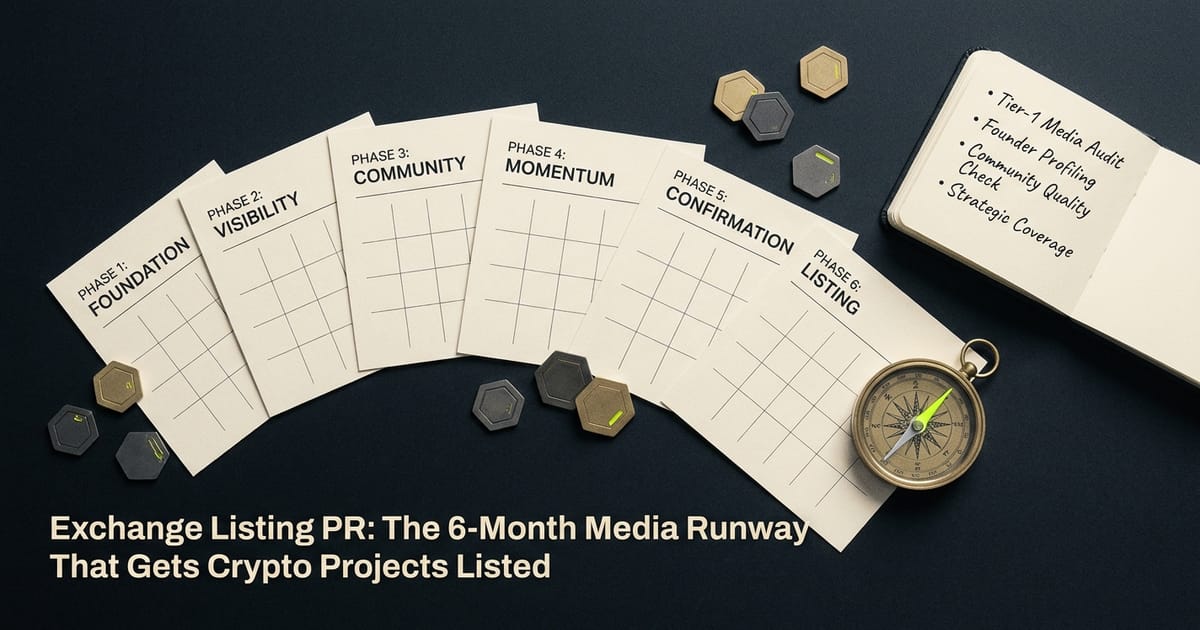
Exchange Listing PR: The 6-Month Media Runway That Gets Crypto Projects Listed on Tier-1 Exchanges
Most founders treat exchange listing PR as a post-decision announcement. The listing comes through, the team fires off a press release, the Discord lights up, and the celebration begins. But that sequence gets the logic exactly backwards.
Tier-1 exchanges don't just evaluate your smart contract audit and tokenomics spreadsheet. They run a qualitative audit of your project's market presence: media coverage, founder credibility, community quality. They do this before the listing committee ever votes. By the time a positive decision lands in your inbox, the PR that influenced it was published months earlier.
This playbook maps the six-month earned media runway, phase by phase, that builds the coverage exchanges actually look for.
Why Exchanges Care About PR Before They List You
Here's what most guides miss: exchange listing decisions are not purely quantitative. Yes, the technical threshold matters. A completed audit from a firm like CertiK or OpenZeppelin is non-negotiable, and tokenomics need to be clean and transparent. But the decision doesn't stop there.
Listing teams look for proof that a project has earned genuine market traction. Research on tier-1 listing criteria confirms that teams must show active wallets, consistent transaction volume, and steady user growth, because these metrics indicate the token will attract real trading activity post-listing. Community engagement also enters the picture. Exchanges analyze engagement quality, not just follower counts, and artificial growth patterns often fail detection checks and lead to rejection.
Beyond on-chain signals, exchanges conduct due diligence on project founders. They examine backgrounds, previous ventures, and reputation within the industry. The presence of established venture capital backing or institutional partnerships often strengthens a listing application.
What this means in practice: a founder who has given zero media interviews, published no opinion pieces, and appears nowhere in CoinDesk, The Block, or Blockworks is a harder sell than one with a documented, searchable record of expert commentary. Exchange listing PR is not about manufacturing buzz. It is about building a verifiable public record that listing teams can actually audit.
Phase 1 (Months 1 and 2): Foundation, Build the Searchable Proof Layer
Before you pitch a single journalist, your project needs a coherent media footprint. Listing teams do the same Google searches your investors do. If they find nothing, or worse find unresolved controversy, the application starts underwater.
Audit your current footprint first. Search your project name, token ticker, and founder name across Google, CoinGecko, X, and Reddit. Identify the gaps. If a search for your own name plus "crypto" returns nothing substantive, that is the first problem to solve.
Publish a research-backed announcement. Commission a genuine market analysis, protocol benchmark, or sector data piece that your team can claim authorship over. Original research is the fastest path to unprompted coverage in outlets like CoinDesk and The Block. It also creates the kind of searchable, citeable proof layer that listing analysts can find months later.
Secure your first two or three earned placements in mid-tier crypto outlets. These do not need to be CoinDesk exclusives. Coverage in Decrypt, Blockworks, The Defiant, or a credible vertical outlet establishes proof of newsworthy traction. The goal here is creating a searchable record, not generating a price spike.
Establish the founder's expert profile on X and LinkedIn. Listing teams often check whether founders communicate transparently in public. An account with consistent, substantive posts signals a project that plans to operate openly after listing.
The trap to avoid in this phase: paid placement and press release wire distribution. Wire syndication does not create the editorial credibility that exchanges look for. A hundred syndicated placements from a single press release carry less weight than one independently written story from a journalist who came to you.
Phase 2 (Months 3 and 4): Credibility Build, Bylines, Podcasts, and Expert Commentary
By month three, the foundation exists. Now you extend it. This is where founder visibility moves from invisible to documented.
Bylined op-eds. Pitch a founder byline to at least two publications your target exchange's team would realistically read. For Coinbase, that often means publications focused on regulatory clarity, institutional adoption, and compliance, since Coinbase emphasizes legal and regulatory standards above almost everything else. For OKX and Binance, the editorial bar tilts toward product traction and long-term ecosystem development. Match the byline angle to the exchange you are targeting: a piece on institutional DeFi adoption lands differently than one on meme coin culture.
The byline should carry a genuine perspective that advances a real debate. Exchanges are sophisticated readers. A thought leadership piece that reads like a promotional brochure is immediately obvious and counterproductive.
Podcast appearances. Crypto podcast appearances create several things simultaneously: a discoverable audio record, show notes that generate backlinks, and evidence of a founder who can explain their thesis clearly and handle adversarial questions. Shows in the Blockworks Network, Unchained, The Defiant, and Bankless orbit reach exactly the audience exchanges care about. These are also the podcasts that listing team members often listen to personally.
When you book podcast appearances, choose hosts who ask hard questions. A founder who handles a pointed interview about token vesting, competitive positioning, or regulatory risk earns more listing credibility than one who only appears on friendly, promotional shows.
Reactive expert commentary. Tier-1 media placements happen fastest when a founder becomes a go-to source during a news cycle. If your project has a thesis around DeFi infrastructure, stablecoins, or layer-2 scaling, position the founder to comment on relevant breaking developments. A single well-placed quote in CoinDesk during a market-moving event does more for listing credibility than three months of wire releases.
Phase 3 (Month 5): Acceleration, Sequenced Press Releases and Milestone Coverage
Five months into the runway, you should have at least four to six earned placements, a founder byline in a credible outlet, and at least two podcast appearances. Now the sequencing of press releases begins in earnest.
The mistake most projects make is releasing everything at once: one giant news dump in the week before listing. That approach creates a spike with no supporting context. Exchange analysts who research your project during due diligence want to see a pattern of legitimate milestones over time: a partnership announcement, a protocol upgrade, a community growth metric, a new integration.
What to release in month five:
A substantive partnership or integration announcement that is newsworthy on its own merits, not a logo swap but a partnership with demonstrable utility.
A community growth or on-chain activity milestone such as total wallets, TVL threshold, or transaction counts, packaged with data journalists can verify independently.
A developer update that shows continued product momentum.
Each release should be offered to one or two journalists on an exclusive or early-access basis before going to wire. This is how you build the journalist relationships that generate independent coverage rather than reprinted press releases. Reporters remember the sources who engage thoughtfully with their work, and that relationship capital pays dividends on listing day.
Phase 4 (Month 6): The Window Before the Announcement
The listing date is approaching but not yet public. This window is operationally the most sensitive in the entire runway.
Seed context without revealing the listing. Place two or three articles about recent product milestones in outlets that exchange analysts read. The goal is that when the listing announcement lands, it lands in context rather than a vacuum. A journalist covering your listing for the first time should be able to reference three or four independent prior stories, not one self-published press release.
Prepare the embargo kit. Draft the announcement press release, founder commentary, FAQ document, and trading pair details. Build an embargoed press kit for journalist distribution. Offer a small number of trusted reporters early access under embargo, with a simultaneous lift timed for maximum newsroom attention: Tuesday through Thursday, mid-morning in your target market's time zone.
Monitor for premature leaks. Listing rumor communities are active and well-organized. If speculation surfaces before your announcement, respond through official channels with factual clarifications. Any contradiction between a press article and a Discord announcement erodes trust at the worst possible moment.
Prepare the community in parallel. Publish clear, factual guides about what to expect: deposit deadlines, supported trading pairs, and first-day logistics. Distribute through Discord, Telegram, X, and the project blog. The community's behavior on listing day, how they talk about the token and how they respond to volatility, is a soft signal that exchanges and investors observe closely.
Timing the Announcement for Price Momentum Without Regulatory Risk
This is where founder judgment matters most. The goal is to create a newsworthy moment that amplifies genuine market interest without doing something that looks, in hindsight, like coordinated pump activity.
A few principles that matter under the current regulatory framework:
Do not coordinate the announcement with large token movements. In 2026, the SEC and CFTC issued joint guidance establishing a five-part token taxonomy and clarifying how federal securities laws apply to crypto assets. The regulatory environment has improved significantly for genuine utility tokens, but market manipulation provisions still apply broadly. Coordinating a price spike with a listing announcement is exactly the pattern that attracts scrutiny.
Let the news create momentum organically. An embargoed announcement that drops simultaneously across three or four independent outlets, with the founder available for immediate follow-up commentary, generates more durable price support than an orchestrated social media campaign. Journalists who break the story have a professional incentive to follow up. That follow-up coverage is what sustains momentum past day one.
Do not overstate what the listing means. Founders who claim a listing validates their token's fundamental value are setting a trap for themselves. Post-listing corrections are common, with significant price pullbacks occurring within the first 30 days as early holders take profits. The announcement should focus on what the listing enables: access, liquidity, institutional credibility. Not what it predicts.
What the Listing Team Finds When They Google You
Imagine a member of a listing team running a routine due diligence search on your project six months after you started this playbook. Here's what they should find.
A founder with a named, verifiable professional history and a public track record of expert commentary.
Three to five independently written articles in recognizable crypto outlets covering distinct milestones, not reprints of the same press release.
At least one founder byline in a publication their team respects.
A community that discusses the project on substance, not just price speculation.
No red flags: no unresolved controversy, no anonymous team, no disappeared media coverage from a single paid campaign that vanished after the initial push.
That combination does not guarantee a listing. But it removes the friction that causes listing teams to pass on technically sound projects. In a market where exchanges are more selective and communities are far more vocal, the projects that secure tier-1 listings fastest are not always the most innovative. They are the most visible, the most trusted, and the most consistently covered.
Six months is enough time to build that record. The only condition is that you start before you need it.
Ready to build your pre-listing media footprint? Start with the audit: search your project name and your own name right now and see what a listing team would find.