On this page14
- What an Embargo Is (and What It Isn't)
- Phase 1: Before You Touch a Journalist (Weeks 4 to 6 Out)
- Lock internal alignment first
- Build your asset package
- Phase 2: Journalist Selection and Outreach (Weeks 2 to 3 Out)
- Who gets the embargo
- The outreach sequence
- Phase 3: Managing the Embargo Window
- Timing your lift
- During the window
- Phase 4: Lift-Day Execution
- The Compliance Overlay You Cannot Skip
- What Kills Embargo Coordination in Crypto
- The Post-Lift Debrief
How to Coordinate Embargoed Press Releases for Blockchain Funding Rounds
You closed the round. Wires are confirmed, cap table is signed, and your lead investor is ready to make noise. The next question (the one most founders underestimate) is: how do you actually get multiple journalists to publish the story at exactly the same moment without something going sideways?
In traditional tech PR this is difficult. In crypto, it is exponentially more complicated. Token prices move on rumor. On-chain activity is visible to anyone watching. A single early tweet from a reporter's personal account can detonate your announcement before legal has cleared the wire copy. And the regulatory environment around funding communications, with the GENIUS Act, MiCA, and updated SEC-CFTC guidance all in play, means that every word in that press release now carries real legal weight.
This guide is a step-by-step operational playbook for coordinating embargoed press releases for blockchain funding rounds. It covers how embargoes actually work, how to structure the process from investor sign-off to lift, and the failure modes that kill coverage on what should be your biggest PR day.
What an Embargo Is (and What It Isn't)
An embargo is a mutual agreement between you and a journalist: you share news early, they hold publication until a specific date and time. Think of it as a coordinated launch strategy. You hand journalists your news early, sometimes days or even weeks ahead, giving them time to dig into the details, interview your executives, and build real stories instead of rushing a same-day summary.
That comes with one rule: they hold it until the exact time you set. No early posts, no exceptions.
The critical word is mutual. As one journalist put it, "if the journalist does not agree to the embargo before receiving the material, there simply is no embargo." Sending embargoed materials without first securing agreement is like a source saying something and then specifying it was off the record. It simply does not work that way.
An embargo is not: - A wire service blast scheduled for a future date (that is timed distribution, not an embargo) - An exclusive (which gives one outlet the story first, with no competing simultaneous coverage) - A guarantee of coverage (accepting embargo materials does not commit a journalist to writing anything)
The distinction between an embargo and an exclusive matters enormously for funding announcements. A multi-outlet embargo maximizes breadth. Multiple publications run the story simultaneously, which signals importance to readers and signals momentum to future investors. An exclusive builds a deeper editorial relationship and often produces a longer, more favorable piece, but you sacrifice that coordinated splash. For most funding rounds above a meaningful threshold, the embargo approach wins on signal strength.
Phase 1: Before You Touch a Journalist (Weeks 4 to 6 Out)
Lock internal alignment first
The most common embargo failure in crypto is not a journalist breaking the news. It is a founder's own team breaking it. Discord mods who know. An investor who posts a vague congratulatory tweet. A team member who mentions it on a podcast the week before lift.
Before a single journalist receives anything:
- Investor approvals: Confirm that every named investor has reviewed and approved all quotes attributed to them, has cleared the announcement through their own legal and PR team, and knows the exact lift date and time.
- Legal review: Every public statement about a funding round touching a token, treasury asset, or future roadmap must be cleared against applicable securities law. In 2026, this means understanding the SEC-CFTC joint interpretive framework, MiCA's transparency requirements if you have EU operations or EU-facing users, and the GENIUS Act's implications if stablecoins are anywhere in your stack. Legal review is non-negotiable. Every public statement must be checked before distribution.
- Internal communication lockdown: Only the people who absolutely must know should know. Write a brief internal memo that states: the round is closed, the announcement date, and that any public communication before that date is prohibited. Put it in writing.
Build your asset package
Journalists under embargo need everything in one place to write before the story goes live. Prepare:
- Final press release (legal-reviewed, complete with investor quotes)
- Founder Q&A document (anticipates the ten questions every reporter will ask)
- Supporting data: metrics, growth numbers, protocol stats, anything verifiable
- High-resolution founder and logo assets
- Embargo lift time stated clearly, in multiple time zones, at the top of every document
Phase 2: Journalist Selection and Outreach (Weeks 2 to 3 Out)
Who gets the embargo
Not every reporter on your list. The number one mistake teams make is sending embargoed materials to purchased media lists or unverified contacts. Every recipient should be individually selected. Sending to an unknown contact virtually guarantees leaks.
For a blockchain funding round, think in tiers:
Tier 1 (crypto-native): CoinDesk, The Block, Blockworks, Decrypt. These outlets cover funding rounds as genuine news, have crypto-literate editorial teams, and their coverage carries weight with the VC community that will see your next round.
Tier 1 (mainstream financial): Bloomberg, Reuters, TechCrunch, Forbes. Relevant if the round size or investor names have mainstream financial significance. This tier is increasingly important as traditional finance converges with crypto. A funding round warrants tier-1 outreach combined with wire distribution.
Tier 2 (vertical and newsletter): Sector-specific publications, prominent newsletters, analyst outlets. Send to this group later in the embargo window, one to two days before lift, once your tier-1 commitments are confirmed.
Smart projects engage media three to six months before major fundraising rounds, building foundational credibility through strategic coverage in publications that VCs actually read, establishing thought leadership that demonstrates founder expertise. If you are reaching out for embargo access to journalists who have never heard of you, expect a lower response rate.
The outreach sequence
Step 1: The teaser approach. Do not include the full press release or the substance of your news in your initial email. Secure the journalist's agreement to the embargo terms before sending anything substantive. The initial message should serve as a teaser, enough context to establish the story's value, without revealing sensitive details before they accept the conditions.
A good teaser: - Names the round size and stage (if material enough to hook them) - Names the lead investor (if the name adds credibility) - States the embargo lift date and time - Asks for explicit agreement before materials are shared
Step 2: Materials only after agreement. Once a journalist replies accepting the embargo terms, send the full package. Track this in a simple spreadsheet: journalist name, outlet, contact method, agreement confirmed (yes/no), date materials sent, interview scheduled (yes/no), status.
Step 3: Structured interviews. Offer founder availability for briefing calls. A journalist who has interviewed your CEO will write a substantially better story, and a longer one, than a journalist who has only read the release. Stagger these calls across the embargo period so you are not fielding ten calls on the last day.
Phase 3: Managing the Embargo Window
Timing your lift
Crypto runs on a 24-hour cycle, but your coverage does not. The optimal lift time for most blockchain funding announcements is between 6:00 AM and 9:00 AM Eastern Time on a Tuesday, Wednesday, or Thursday. This catches morning editorial cycles at US outlets, overlaps with European afternoon newsrooms, and gives stories time to propagate through newsletters and social amplification before the trading day ends in the US.
A breaking news piece about a funding round might need only 24 to 48 hours of journalist prep time, while an in-depth feature examining your technology's implications for an industry could require two weeks or more. Give tier-1 journalists enough lead time to write a real story, typically five to seven business days. Give tier-2 contacts one to two days before lift.
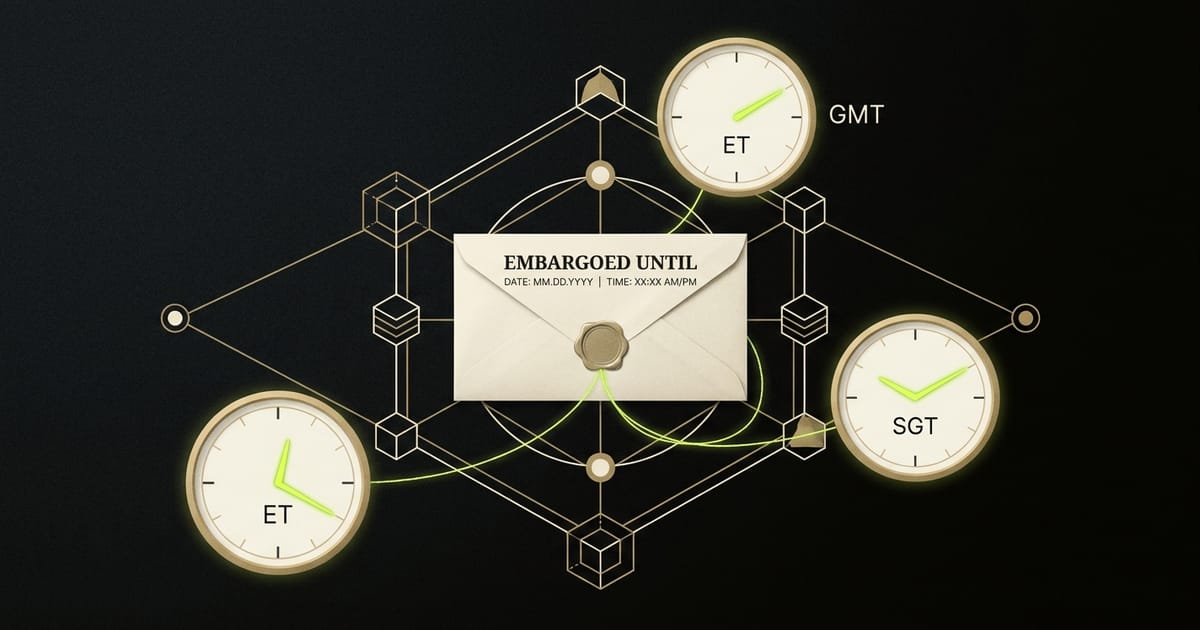
Always state the embargo lift time in multiple time zones. "8:00 AM ET / 1:00 PM GMT / 9:00 PM SGT" eliminates the most common source of early breaks: time zone confusion.
During the window
Keep the list small and the communication tight. Respond to journalist questions promptly. A reporter who cannot get an answer before deadline will either miss the story or file without your input.
Watch for signals of interest: follow-up questions, requests for additional data, requests for a call. A journalist asking three detailed questions about your token distribution is probably writing something. One who goes silent after receiving materials probably is not, but do not assume either way until the embargo lifts.
If you discover that a journalist has broken the embargo early, you face a decision: lift the embargo for all outlets immediately, or wait and absorb the first-mover disadvantage. In most cases, lift immediately. An early break by one outlet that you let sit for hours will look worse than a coordinated release that happened slightly ahead of schedule.
Phase 4: Lift-Day Execution
The embargo lift is not the end of your work. It is the beginning of a window you need to manage in real time.
At lift time: - Post the founder blog or founder letter on your company site simultaneously with the embargo lift - Publish the founder's personal statement on X/Twitter and LinkedIn - Ensure all investors have their posts pre-drafted and ready to publish - Send the wire distribution (if applicable) scheduled to coincide with lift time - Alert community channels including Telegram and Discord with a brief, factual announcement
In the hours after lift: - Monitor coverage: which outlets published, what they wrote, whether any errors need correction - Engage with coverage on social, reshare, add context, thank journalists publicly - Brief your team on how to discuss the round publicly - Keep spreading the news after the embargo lifts. There are many VC and startup newsletters that can amplify the announcement after the initial wave.
The Compliance Overlay You Cannot Skip
Blockchain funding announcements in 2026 sit at the intersection of press relations and securities law. The regulatory environment has shifted significantly. The SEC-CFTC joint interpretive framework now classifies crypto assets into distinct categories, MiCA is moving into full EU-wide enforcement, and the GENIUS Act introduces new obligations for projects with stablecoin exposure.
In practice, this means three specific things:
Token language. If your announcement references a token, its future utility, its pricing, its distribution, that language must be reviewed by legal counsel with crypto-specific expertise. "We will use the capital to accelerate our token launch" may require specific disclaimers or a rewrite depending on your jurisdiction and token classification.
Forward-looking statements. Standard startup fundraising press releases include growth projections. In crypto, forward-looking statements touching on protocol performance, token value, or user growth carry heightened scrutiny. Keep claims verifiable. Mainstream journalists will scrutinize them.
Multi-jurisdiction complexity. If you have named investors or users in the EU, you are operating under MiCA's transparency requirements. If the announcement references anything that could be characterized as an investment contract in the US, the SEC framework applies. A blockchain PR agency with genuine crypto expertise runs every press release through legal before distribution and understands the regulatory distinction between utility and security tokens in different jurisdictions.
What Kills Embargo Coordination in Crypto
Beyond the basics, a few failure modes are specific to blockchain environments:
The investor who posts early. Your lead VC's marketing team prepares their portfolio page update and mistakenly makes it public the night before your lift. This happens. Require written confirmation from every named investor's communications team that their content will not go live before your lift time.
The on-chain signal. Large treasury movements, new smart contract deployments, or wallet activity associated with your project can surface on-chain data aggregators and alert crypto-native journalists before your announcement. If the round involves token distribution, time those transactions for after the announcement.
The embargo to too many. Coordinated coverage makes or breaks a major announcement. You need multiple outlets to publish at once, and that signals importance. But getting journalists to sync up is complicated. The more outlets you include in an embargo, the greater the statistical probability of a break. Prioritize quality over quantity. A tight embargo with five journalists who will actually publish beats a broad blast to twenty who may not.
Non-newsworthy content. Not every funding announcement deserves an embargo. Reserve embargoes for genuinely significant announcements. Using embargoes for routine news irritates journalists and damages the relationship you need for future major announcements. The threshold for crypto media in 2026 is material: significant funding rounds with named investors are newsworthy; smaller rounds are only newsworthy if investors are particularly notable.
The Post-Lift Debrief
After the announcement cycle closes, document what worked and what did not. How many journalists confirmed the embargo? How many published? Were there any early breaks? Which outlets produced the most substantive coverage? Each embargo campaign provides learning opportunities. Document successes and challenges, gather feedback, and refine your approach.
The coordination effort for a funding announcement embargo is substantial. But the return is substantial too: simultaneous coordinated coverage in tier-1 outlets, a clean media record for due diligence, and a relationship with journalists who now know your story. That return compounds over every subsequent announcement you make.
Get the lift-day right, and you set the narrative on your terms.