On this page8
AI Startup Funding Announcement PR: The 4-Week Plan for Seed Through Series B
You closed the round. Now you have a narrow window to make it count.
Most AI founders treat the announcement as the finish line. Wire the press release, post on LinkedIn, done. That instinct is wrong in a specific and expensive way. The announcement is the opening of a visibility window, typically three to six weeks, during which your startup has more media leverage than at almost any other point in its existence. What you do with that window determines whether the round compounds into pipeline, hiring momentum, and downstream capital conversations, or evaporates into a single news cycle.
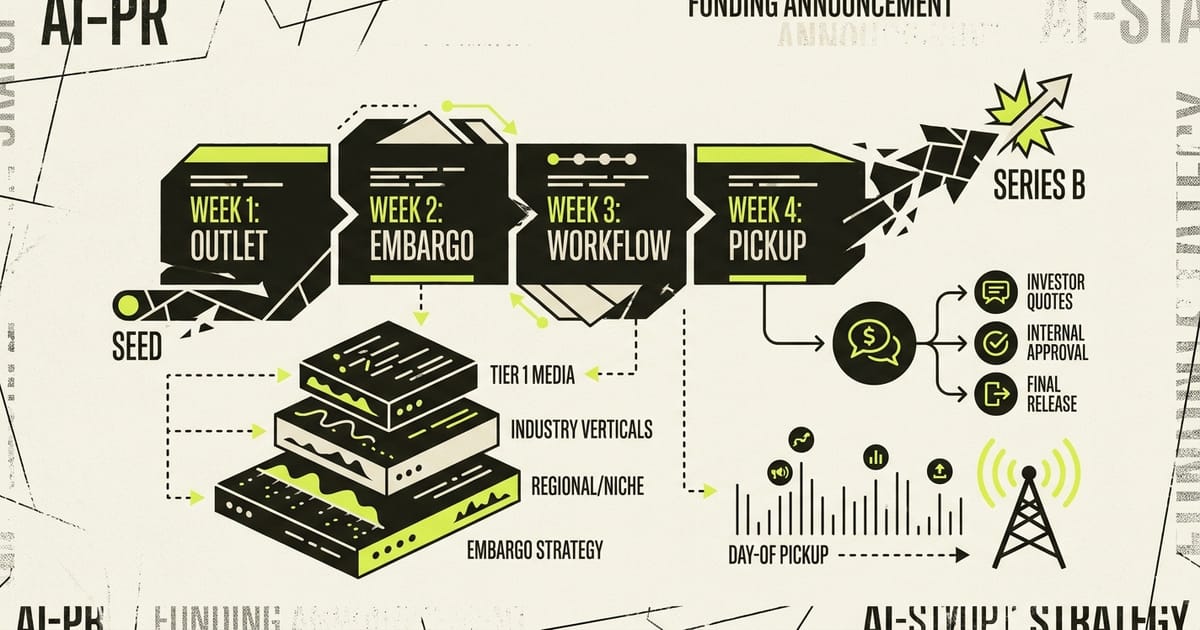
This post documents the four-week plan we use for AI funding announcements: outlet selection logic, the embargo tier structure, how to run the investor quote workflow without losing three weeks to revision loops, and the day-of sequence that drives pickup.
Why AI Funding PR Is Different
The volume problem is real. Journalists covering AI are inundated. The appetite for AI stories has never been higher. Outlets like TechCrunch, Bloomberg, Forbes, Wired, MIT Technology Review, and The Information carry enormous downstream weight with investors, enterprise buyers, and talent. But the pitch volume is correspondingly brutal. TechCrunch alone receives hundreds of pitches per week.
The competitive context makes this worse. Mega-rounds at OpenAI, Anthropic, and xAI have reset journalist expectations for what constitutes a news event. For the median AI startup raising $3M to $20M at Seed or Series A, the media landscape is both saturated and selective. A round without a strong non-financial hook, such as a notable lead investor, a genuine technical differentiation, a high-profile enterprise customer, or a founder with a compelling story, will not clear the editorial bar at the publications that matter most.
The implication: your announcement architecture needs to be decided before you approach a single journalist.
The Core Framework: Six Artifacts Before You Pitch Anyone
Before your announcement goes out, six assets need to exist in finished form:
- Press release: the factual anchor with amount, round, lead investor, use of funds, and key metrics
- Company blog post: longer, contextual, includes product demos and customer testimonials; this is what gets shared internally
- Exclusive or embargoed article: pitched to one reporter at your target outlet; they write an independent story before the announcement goes live
- Customer testimonials: at minimum written quotes; video testimonials carry more weight and increasingly appear in coverage
- Launch video: short, creative, designed for social amplification
- Social media playbook: pre-written posts for the founder, co-founders, investors, and key employees, sequenced to fire at announcement time
If any of these are missing on the day of pitch, the exclusive play collapses. Reporters who agree to embargos expect to have everything they need to write without chasing you for basics.
Week 1: Outlet Selection and Reporter Targeting
The biggest mistake in AI funding announcement PR is pitching the wrong person at the right outlet, or the right person at an outlet that won't serve your actual goals.
Outlet selection logic by stage:
Seed ($1M to $5M). TechCrunch at this range is unlikely to write a standalone feature unless the hook is exceptional. The realistic targets are Axios Pro Rata and similar deal newsletters, which cover virtually every round regardless of size. Trade publications relevant to your AI vertical, whether healthcare AI, legal AI, or defense tech, often cover rounds this size with more depth than generalist tech press. Do not chase a TechCrunch story that does not exist. Chase the coverage that actually reaches your target buyers.
Series A ($5M to $30M). The exclusive play at TechCrunch, VentureBeat, or a vertical trade publication becomes viable here. The hook must go beyond the dollar amount. What makes your AI approach genuinely different? Who is the lead investor and why does their backing tell a story? What customer are you already working with who will quote on record?
Series B ($20M and up). At this stage, The Information becomes a realistic target for AI companies with enterprise traction. Forbes AI coverage starts to apply when there is a business narrative beyond the raise: revenue trajectory, customer logos, or a founder profile angle. Bloomberg Tech is relevant when there is a market or competitive context that goes beyond the individual company.
Reporter targeting inside each outlet:
This is the part that most founders get completely wrong. Knowing which reporter at TechCrunch covers AI infrastructure versus AI applications, and pitching accordingly, is the difference between a response and silence. The same applies at Forbes, where a reporter working on an enterprise AI adoption feature is a fundamentally different target than the funding desk. At The Information, reporter beat specialisation matters more than at other outlets because the publication's subscriber base is smaller and more specific.
The practical approach: read bylines for the past 90 days. Map reporters to their actual coverage areas. Confirm that the specific reporter is currently active on the beat, since reporters move, go on leave, and shift focus regularly. Only then personalise your pitch approach.
What to do in Week 1: - Finalise all six announcement artifacts - Map your target outlet tier (Tier 1 exclusive, Tier 2 embargo, Tier 3 wire) - Identify the specific reporter at each outlet, verify current beat coverage, and draft personalised pitch angles for each
Week 2: Embargo Tier Construction
The embargo is not just a timing tool. It is a relationship instrument, and using it badly damages the press relationships you need for the next 24 months.
The structure:
An embargo is an agreement where a journalist gets news early but commits to not publishing until a specified time. If the journalist does not agree to the embargo before receiving the material, there is no embargo. It is just unsolicited information. Always send a brief note to confirm interest before sharing anything.
For AI funding announcements, the embargo tier typically runs as follows:
Tier 1 (Exclusive, 7 to 10 days out). One reporter at one outlet gets an exclusive offer. They write an independent story. You provide founder, lead investor, and one key customer for interviews. This reporter's story runs first, then the general embargo lifts.
Tier 2 (Embargo group, 3 to 5 days out). Four to six reporters at adjacent outlets receive embargoed materials. These stories publish simultaneously with or shortly after the exclusive. Keep this list under 30 contacts. Sending to too many outlets increases leak risk without proportionally increasing quality coverage.
Tier 3 (Wire release, day of). Once the exclusive runs, the press release hits the wire. This drives pickup in trade publications, newsletters, and aggregators that were not part of the embargo.
Embargo label and terms. Label all embargoed materials prominently with "EMBARGOED UNTIL [DATE AND TIME]" at the top of every document. Include the specific time zone. Be explicit that the embargo lifts when the exclusive story goes live, not at a calendar time. This prevents situations where a Tier 2 reporter publishes before the Tier 1 story runs.
What to do in Week 2: - Confirm exclusive reporter interest and acceptance - Share press release and supporting materials with exclusive reporter under formal embargo confirmation - Prepare Tier 2 embargo list and materials for dispatch at the three to five day mark - Build the wire distribution plan
Week 3: The Investor Quote Workflow
Investor quotes are where funding announcements lose weeks. The CEO of a top-tier VC fund is not waiting to review your draft. Their communications team has their own approval process. Their legal team may require a review. The partner who led your round may be traveling.
Running the investor quote workflow in parallel with everything else, not at the end, is the single most important process discipline in AI funding announcement PR.
The workflow:
- Draft the quote for them. Provide a draft investor quote with the press release. Do not ask for a quote from scratch. Give them something to react to. This is standard practice and saves weeks.
- Specify the approval path upfront. When you send the draft, ask directly: who else needs to see this before it is approved? Get names. Know the process on Day 1 of outreach, not Day 7.
- Set a hard deadline with context. The journalist has an embargo deadline. That deadline is not flexible. Give the investor a deadline that is 48 hours before the journalist's deadline, and explain why.
- Escalate early, not late. If the draft has not been approved within 48 hours of sending, follow up with the partner directly, not just the communications team.
- Collect the customer quote on the same timeline. A customer quote from a named enterprise deploying your AI is worth more than the investor quote in most AI coverage. The quote needs to make a specific claim about what your product does for them. A generic "we are excited to work with them" line adds nothing.
What to do in Week 3: - Send draft investor quotes to lead investor and all participating investors you plan to name - Send draft customer quote to reference customer contact - Confirm embargo acceptance from Tier 2 reporters - Brief all internal stakeholders, including employees and cap table participants, and ask them to hold all public posts until announcement day
Week 4: The Day-Of Pickup Sequence
Day of announcement is not a single event. It is a sequenced operation with defined tasks at defined times.
T-24 hours: - Confirm the exclusive journalist has everything they need - Verify wire distribution is scheduled correctly - Confirm social media posts are drafted and ready in the accounts that will post them - Stage the company website homepage with a banner linking to the announcement blog post
T-0 (exclusive story publishes): - Exclusive story goes live - Press release hits the wire simultaneously or within minutes - Founder and all stakeholders amplify immediately on LinkedIn, X, and any platform where the founder has an audience - The general embargo lifts; Tier 2 stories can now publish - Company homepage banner goes live - Email announcement goes to existing customers, partners, and the current investor community
T+1 to T+5 days: - Pitch follow-on stories to trade publications and vertical AI media that were not part of the embargo - Identify reporters who covered the initial announcement and offer founder access for follow-up angles: the technology story, the market story, the team story - Monitor for inaccuracies in coverage and correct quickly. The first 48 hours is when errors get cited repeatedly.
T+2 to T+4 weeks: - The announcement visibility window is still open. Use it. - Founder op-eds in relevant publications, podcast bookings where the funding context provides a news hook, speaking submissions for upcoming conferences - Brief your target customer segments with a message that interprets the raise in terms of what it means for them, not just what it means for your company
Avoiding the Most Common Failure Modes
Announcing into a news void. The announcement needs a foundation. Journalists who already know your name, from prior pitches, from founder commentary they have quoted elsewhere, from a prior piece you were featured in, are more likely to give the announcement the treatment it deserves. A founder without that existing media presence gets the inbox treatment. Build the foundation before you need it.
Pitching the dollar amount as the story. The dollar amount becomes background. It is a reason for a reporter to consider covering you, not the story itself. The actual story is the specific claim your company is making about a specific problem in a specific market, and why this capital validates that claim.
Conflating exclusive and embargo. Offering an exclusive to one reporter means everyone else waits. Offering an embargo means multiple reporters can prepare stories for simultaneous publication, but none gets the first-mover advantage. These are different structural arrangements with different implications for journalist relationships. Conflating them, or switching from one to the other mid-process, breaks trust in ways that are hard to recover from.
The Measurement Framework
Define success metrics before announcement day, not after:
- Pickup rate: Percentage of targeted outlets that run or reference your story within 48 hours of the wire release
- Tier 1 placement: Did the exclusive story run in the target publication at the editorial depth you needed?
- Inbound velocity: Investor inquiries, partnership inquiries, and qualified hiring leads in the 30 days post-announcement
- Citation share: Query AI engines, including Perplexity, ChatGPT, and Gemini, two to three weeks after announcement to verify your company is being accurately described and cited in relevant category queries
Ignoring AI engine visibility is the most underused opportunity in funding PR. A funding announcement produces exactly what AI engines favor: a dated event, named investors, hard dollar figures, and a clear company entity. Structure the press release and blog post so the answerable facts appear in the first lines. Spell out entities in full. Inconsistent entity names and stale bios get misattributed inside AI answers for months after the announcement.
The announcement is not the goal. The compounding visibility that follows, including the next journalist introduction that references the coverage, the investor who already knows the story before the first meeting, and the hire who wants to join because they read about the round, is the goal.
Four weeks of disciplined execution is what separates the announcements that compound from the ones that evaporate.